
Paul Simon - 50 Ways to Leave Your Lover Ukulele Chords
Before you play, tune your ukulele and use the tools below to set up your view and flow.
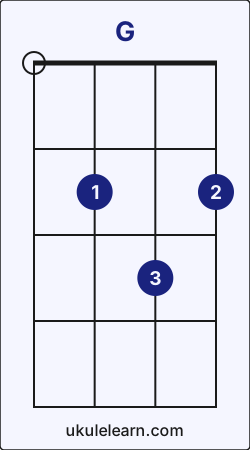 Ukulele G chord diagram
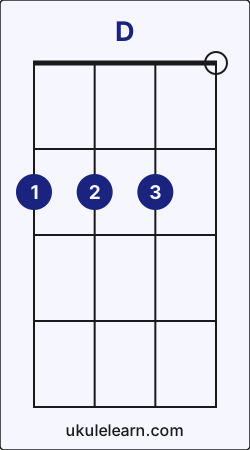 Ukulele D chord diagram
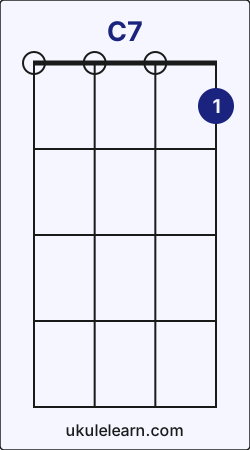 Ukulele C7 chord diagram
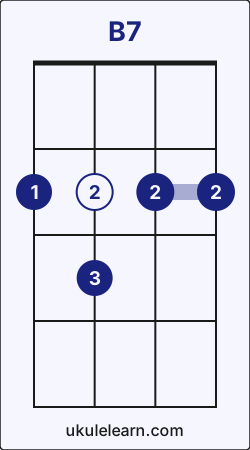 Ukulele B7 chord diagram
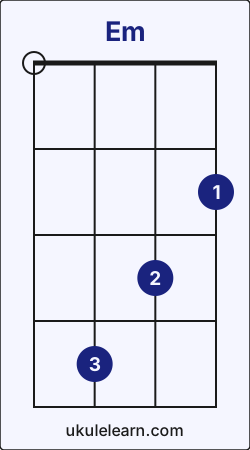 Ukulele Em chord diagram
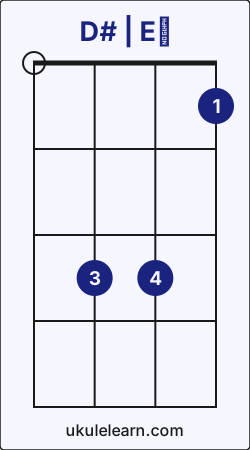 Ukulele D# | E♭ chord diagram
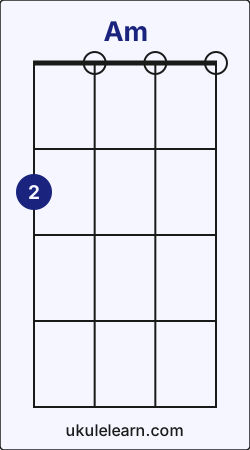 Ukulele Am chord diagram
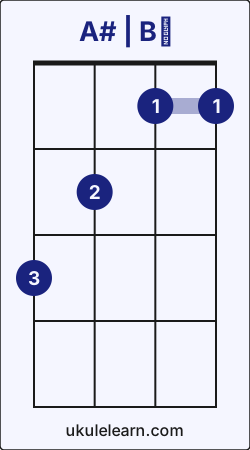 Ukulele A# | B♭ chord diagram
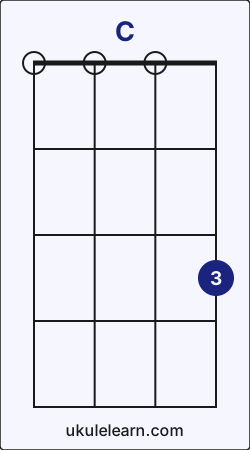 Ukulele C chord diagram
[Opening]
[G]”The problem is [D]all inside your [C7]head”, she said to [B7]me,
[Em]”The answer is [D#]easy if you [C7]take it logic[B7]ally.
[G]I’d like to [D]help you in your [C7]struggle to be [B7]free.
There must be, [Em]fifty [Am]ways to leave your [Em]lover”
[section 2]
[G]She said: “It’s [D]really not my [C7]habit to in[B7]trude,
Further[Em]more I hope my [D#]meaning won’t be [C7]lost or miscon[B7]strued,
But I’ll re[G]peat myself, [D]at the [C7]risk of being [B7]crude.
There must be, [Em]fifty [Am]ways to leave your [Em]lover
[Em]Fifty [Am]ways to leave your [Em]lover”
[chorus]
You just slip out the [G]back Jack, make a new [Bb]plan Stan,
You don’t need to be [C]coy Roy, just get yourself [G]free
Hop on the [G]bus Gus, you don’t need to dis[Bb]cuss much,
Just drop off the [C]key Lee, and get yourself [G]free.
[chorus]
Slip out the [G]back Jack, make a new [Bb]plan Stan,
You don’t need to be [C]coy Roy, you just listen to [G]me
Hop on the [G]bus Gus, you don’t need to dis[Bb]cuss much,
Just drop off the [C]key Lee, and get yourself [G]free.
[section 3]
[G]She said: “It [D]grieves me so to [C7]see you in such [B7]pain.
I wish there was [Em]something I could [D#]do to [C7]make you smile a[B7]gain.”
I said: “I a[G]ppreciate [D]that and [C7]would you please ex[B7]plain
About the, [Em]fifty ways” [Am] [Em]
[Closing]
[G]She said: “Why [D]don’t we both just [C7]sleep on it to[B7]night,
And I be[Em]lieve that in the [D#]morning you’ll be[C7]gin to see the [B7]light.”
Then she [G]kissed me and I [D]realized, she [C7]probably was [B7]right,
There must be [Em]fifty [Am]ways to leave your [Em]lover,
[Em]Fifty [Am]ways to leave your [Em]lover
[chorus]
You just slip out the [G]back Jack, make a new [Bb]plan Stan,
You don’t need to be [C]coy Roy, just get yourself [G]free
Hop on the [G]bus Gus, you don’t need to dis[Bb]cuss much,
Just drop off the [C]key Lee, and get yourself [G]free.
[chorus]
Slip out the [G]back Jack, make a new [Bb]plan Stan,
You don’t need to be [C]coy Roy, you just listen to [G]me
Hop on the [G]bus Gus, you don’t need to dis[Bb]cuss much,
Just drop off the [C]key Lee, and get yourself [G]free.
How to play 50 Ways to Leave Your Lover on Ukulele (Step-by-step)
Paul Simon - 50 Ways to Leave Your Lover on ukulele requires 9 chords and 12 core chord transitions. You can find the full step-by-step guide below. Before you start, tune your instrument. The song uses the ↓-↓↓↑ pattern; practice it muted first, or simplify to downstrokes while you learn the changes.
50 Ways to Leave Your Lover uses these transitions most often: C7 → B7 (12), B7 → Em (8), and Bb → C (8). These transitions may feel a little challenging at first, but with steady practice you can play this song quickly.When you are ready, begin with G - D chord transition.
1. G → D chord transition
To move from G to D;
- Lift your index finger from C string fret 2 and place it on G string fret 2.
- Slide your middle finger from A string fret 2 to C string fret 2.
- Slide your ring finger on E string from fret 3 to fret 2.
2. D → C7 chord transition
To move from D to C7;
- While playing D, first lift your middle finger and ring finger.
- Lift your index finger from G string fret 2 and place it on A string fret 1.
3. C7 → B7 chord transition
To move from C7 to B7;
- Lift your index finger from A string fret 1 and place it on G string fret 2.
- Place middle finger on C string fret 3.
4. B7 → Em chord transition
To move from B7 to Em;
- Lift your index finger from G string fret 2 and place it on A string fret 2.
- Slide your middle finger from C string fret 3 to E string fret 3.
- Place ring finger on C string fret 4.
5. Em → D# chord transition
To move from Em to D#;
- While playing Em, lift your middle finger from E string fret 3.
- Slide your index finger on A string from fret 2 to fret 1.
- Slide your ring finger on C string from fret 4 to fret 3.
- Place pinky on E string fret 3.
6. D# → C7 chord transition
To move from D# to C7;
- While playing D#, first lift your ring finger and pinky.
- Keep index finger on A string fret 1.
7. B7 → G chord transition
To move from B7 to G;
- Lift your index finger from G string fret 2 and place it on C string fret 2.
- Slide your middle finger from C string fret 3 to A string fret 2.
- Place ring finger on E string fret 3.
8. Em → Am chord transition
To move from Em to Am;
- While playing Em, first lift your index finger and ring finger.
- Lift your middle finger from E string fret 3 and place it on G string fret 2.
9. Em → G chord transition
To move from Em to G;
- Lift your index finger from A string fret 2 and place it on C string fret 2.
- Slide your middle finger from E string fret 3 to A string fret 2.
- Lift your ring finger from C string fret 4 and place it on E string fret 3.
10. G → Bb chord transition
To move from G to Bb;
- Lift your index finger from C string fret 2 and place it on E string fret 1.
- Slide your middle finger from A string fret 2 to C string fret 2.
- Lift your ring finger from E string fret 3 and place it on G string fret 3.
11. Bb → C chord transition
To move from Bb to C;
- While playing Bb, first lift your index finger and middle finger.
- Lift your ring finger from G string fret 3 and place it on A string fret 3.
12. C → G chord transition
To move from C to G;
- Lift your ring finger from A string fret 3 and place it on E string fret 3.
- Place index finger on C string fret 2.
- Place middle finger on A string fret 2.
50 Ways to Leave Your Lover chord transition analysis
A short, data-driven summary of the chord flow in 50 Ways to Leave Your Lover.
- 50 Ways to Leave Your Lover includes 88 chord transitions, 12 of them unique.
- These transitions represent 0.02% of all chord transitions in Ukulelearn.
- 50 Ways to Leave Your Lover contains 2 of the top 10 transitions across Ukulelearn.
- These transition patterns show how 50 Ways to Leave Your Lover connects to the rest of Ukulelearn. Mastering them helps you move to similar songs faster.After G, the most likely next chords across Ukulelearn are C (25%), D (24%), and Am (13%).
- G → D: 24%
- G → Bb: 0%
After Em, the most likely next chords across Ukulelearn are C (27%), G (18%), and D (17%).- Em → G: 18%
- Em → Am: 12%