
Train - 50 Ways to Say Goodbye Ukulele Chords
Before you play, tune your ukulele and use the tools below to set up your view and flow.
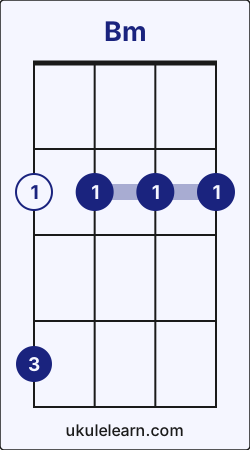 Ukulele Bm chord diagram
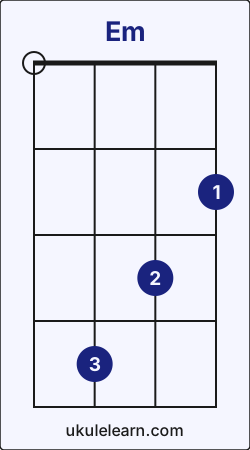 Ukulele Em chord diagram
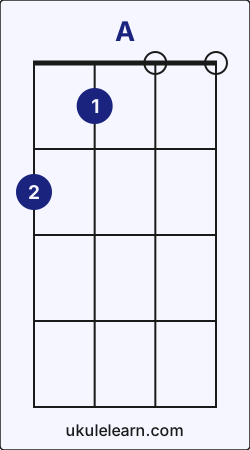 Ukulele A chord diagram
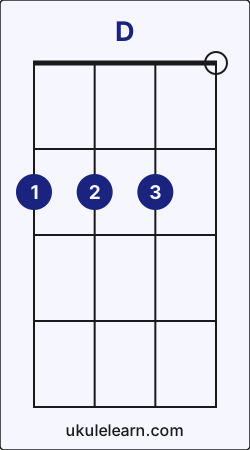 Ukulele D chord diagram
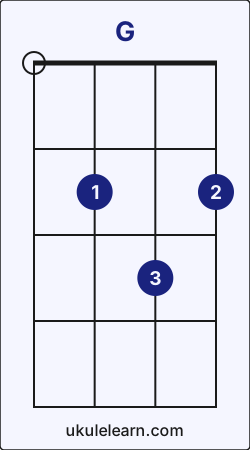 Ukulele G chord diagram
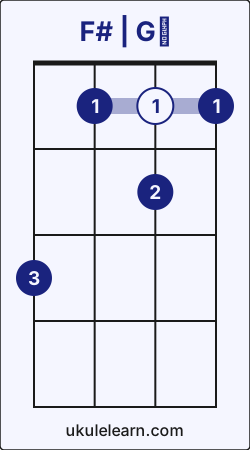 Ukulele F# | G♭ chord diagram
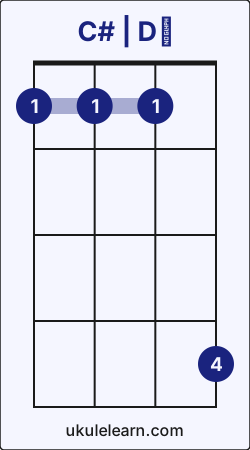 Ukulele C# | D♭ chord diagram
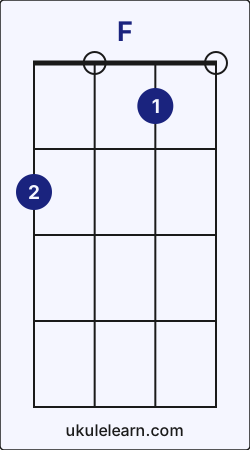 Ukulele F chord diagram
[Opening]
[Bm] [Em] [A] [D] [G] [Em] [F#]
[Bm]My heart is [Em]paralyzed, [A]my head was [D]oversized
[G]I’ll take the [Em]high road like I [F#]should
[Bm]You said it’s [Em]meant to be, [A]that it’s not [D]you, it’s me
[G]You’re leaving [Em]now for my own [F#]good
That’s cool but if my, friends ask where you are I’m gonna say
[chorus]
She went [G]down in an airplane, [D]fried getting suntanned
[A]Fell in a cement [Bm]mixer full of [A]quicksand
[G]Help me, help me I’m no [D]good at [C#]goodbyes [F#]
She met a [G]shark underwater, [D]fell and no one caught her
[A]I returned [Bm]everything I ever [A]bought her
[G]Help me, help me I’m all [D]out of [F#]lies, and ways to say good bye
[section 2]
[Bm] [Em] [A] [D] [G] [Em] [F#]
[Bm]My pride still [Em]feels the sting, [A]you were my [D]everything
[G]Someday I’ll [Em]find a love like [F#]yours (A love like your’s)
[Bm]She’ll think I’m [Em]Superman, [A]not super [D]minivan
[G]How could you [Em]leave on Yom [F#]Kippur
That’s cool but if my friends ask where you are I’m gonna say
[chorus]
She went [G]down in an airplane, [D]fried getting suntanned
[A]Fell in a cement [Bm]mixer full of [A]quicksand
[G]Help me, help me I’m no [D]good at [C#]goodbyes [F#]
She met a [G]shark underwater, [D]fell and no one caught her
[A]I returned [Bm]everything I ever [A]bought her
[G]Help me, help me I’m all [D]out of [F#]lies, and ways to say you died
[section 3]
[Bm] [Em] [A] [D] [G] [Em] [F#] [F]
I [A]wanna live a thousand lives with you, I [G]wanna be the one you’re dying to
[A] [G]Love, but you don’t want to
[F#]That’s cool but if my friends ask where you are I’m gonna say
[F#]That’s cool but if my friends ask where you are I’m gonna say
[chorus]
She went [G]down in an airplane, [D]fried getting suntanned
[A]Fell in a cement [Bm]mixer full of [A]quicksand
[G]Help me, help me I’m no [D]good at [C#]goodbyes [F#]
She met a [G]shark underwater, [D]fell and no one caught her
[A]I returned [Bm]everything I ever [A]bought her
[G]Help me, help me I’m all [D]out of [F#]lies,
[Closing]
She was [G]caught in a mudslide, [D]eaten by a lion
[A]Got run over by a [Bm]crappy purple [A]Scion
[G]Help me, help me I’m no [D]good at [C#]goodbyes [F#]
She dried [G]up in the desert, [D]drowned in a hot tub
[A]Danced to death at an [Bm]east side [A]nightclub
[G]Help me, help me I’m all [D]out of [F#]lies, and ways to say you died
[F#] [D] [A] [G] [D] [A]
How to play 50 Ways to Say Goodbye on Ukulele (Step-by-step)
Train - 50 Ways to Say Goodbye on ukulele requires 8 chords and 15 core chord transitions. You can find the full step-by-step guide below. Before you start, tune your instrument. The song uses the ↓-↓↑-↑↓↑ pattern; practice it muted first, or simplify to downstrokes while you learn the changes.
50 Ways to Say Goodbye uses these transitions most often: G → D (17), A → G (11), and D → A (10). These transitions may feel a little challenging at first, but with steady practice you can play this song quickly.When you are ready, begin with Bm - Em chord transition.
1. Bm → Em chord transition
To move from Bm to Em;
- Lift your index finger from C string fret 2 and place it on A string fret 2.
- Slide your ring finger from G string fret 4 to C string fret 4.
- Place middle finger on E string fret 3.
2. Em → A chord transition
To move from Em to A;
- While playing Em, lift your ring finger from C string fret 4.
- Lift your index finger from A string fret 2 and place it on C string fret 1.
- Slide your middle finger from E string fret 3 to G string fret 2.
3. A → D chord transition
To move from A to D;
- Lift your index finger from C string fret 1 and place it on G string fret 2.
- Slide your middle finger from G string fret 2 to C string fret 2.
- Place ring finger on E string fret 2.
4. D → G chord transition
To move from D to G;
- Lift your index finger from G string fret 2 and place it on C string fret 2.
- Slide your middle finger from C string fret 2 to A string fret 2.
- Slide your ring finger on E string from fret 2 to fret 3.
5. G → Em chord transition
To move from G to Em;
- Lift your index finger from C string fret 2 and place it on A string fret 2.
- Slide your middle finger from A string fret 2 to E string fret 3.
- Lift your ring finger from E string fret 3 and place it on C string fret 4.
6. Em → F# chord transition
To move from Em to F#;
- Lift your index finger from A string fret 2 and place it on C string fret 1.
- Slide your middle finger on E string from fret 3 to fret 2.
- Lift your ring finger from C string fret 4 and place it on G string fret 3.
7. F# → Bm chord transition
To move from F# to Bm;
- While playing F#, lift your middle finger from E string fret 2.
- Slide your index finger on C string from fret 1 to fret 2.
- Slide your ring finger on G string from fret 3 to fret 4.
8. F# → G chord transition
To move from F# to G;
- Slide your index finger on C string from fret 1 to fret 2.
- Slide your middle finger from E string fret 2 to A string fret 2.
- Lift your ring finger from G string fret 3 and place it on E string fret 3.
9. A → Bm chord transition
To move from A to Bm;
- While playing A, lift your middle finger from G string fret 2.
- Slide your index finger on C string from fret 1 to fret 2.
- Place ring finger on G string fret 4.
10. A → G chord transition
To move from A to G;
- Slide your index finger on C string from fret 1 to fret 2.
- Slide your middle finger from G string fret 2 to A string fret 2.
- Place ring finger on E string fret 3.
11. D → C# chord transition
To move from D to C#;
- While playing D, first lift your middle finger and ring finger.
- Slide your index finger on G string from fret 2 to fret 1.
- Place pinky on A string fret 4.
12. C# → F# chord transition
To move from C# to F#;
- While playing C#, lift your pinky from A string fret 4.
- Lift your index finger from G string fret 1 and place it on C string fret 1.
- Place middle finger on E string fret 2.
- Place ring finger on G string fret 3.
13. D → F# chord transition
To move from D to F#;
- Lift your index finger from G string fret 2 and place it on C string fret 1.
- Slide your middle finger from C string fret 2 to E string fret 2.
- Lift your ring finger from E string fret 2 and place it on G string fret 3.
14. F# → F chord transition
To move from F# to F;
- While playing F#, lift your ring finger from G string fret 3.
- Lift your index finger from C string fret 1 and place it on E string fret 1.
- Slide your middle finger from E string fret 2 to G string fret 2.
15. F → A chord transition
To move from F to A;
- Lift your index finger from E string fret 1 and place it on C string fret 1.
- Keep middle finger on G string fret 2.
50 Ways to Say Goodbye chord transition analysis
A short, data-driven summary of the chord flow in 50 Ways to Say Goodbye.
- 50 Ways to Say Goodbye includes 127 chord transitions, 15 of them unique.
- These transitions represent 0.03% of all chord transitions in Ukulelearn.
- 50 Ways to Say Goodbye contains 2 of the top 10 transitions across Ukulelearn.
- These transition patterns show how 50 Ways to Say Goodbye connects to the rest of Ukulelearn. Mastering them helps you move to similar songs faster.After A, the most likely next chords across Ukulelearn are D (29%), G (13%), and E (12%).
- A → D: 29%
- A → G: 13%
After G, the most likely next chords across Ukulelearn are C (25%), D (24%), and Am (13%).- G → D: 24%
- G → Em: 9%