
The Killers - Be Still Ukulele Chords
Before you play, tune your ukulele and use the tools below to set up your view and flow.
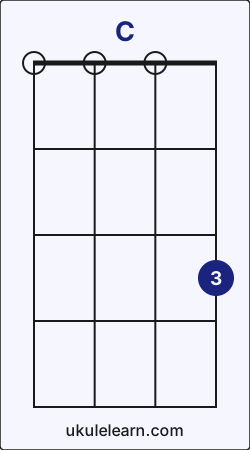 Ukulele C chord diagram
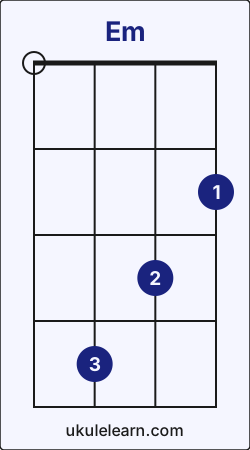 Ukulele Em chord diagram
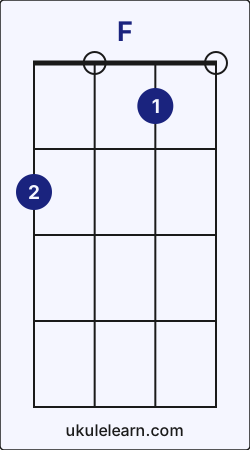 Ukulele F chord diagram
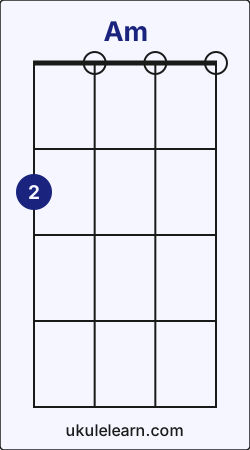 Ukulele Am chord diagram
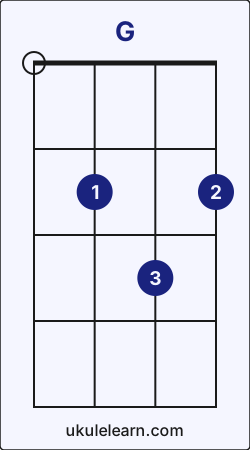 Ukulele G chord diagram
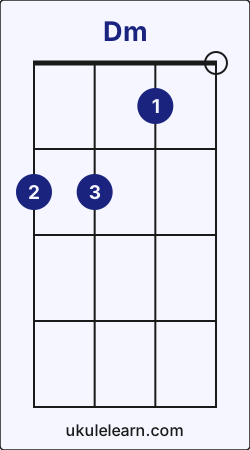 Ukulele Dm chord diagram
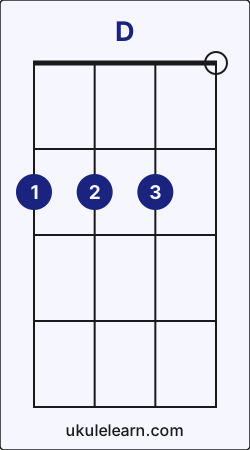 Ukulele D chord diagram
[Opening]
[C] [Em] [F] [C]
[C]Be still, and go on to [Em]bed, nobody knows [F]what lies [C]ahead
[C]And life is short, to say the [Em]least
We’re in the [F]belly of the [C]beast
[section 2]
Be [Am]still, wild and [F]young, long may your innocence [G]reign
Like shells on the [Am]shore, and may your limits be [F]unknown
And may your efforts be your [C]own, if you ever feel you can’t [G]take it anymore
[section 3]
[Am]Don’t break [F]character, you’ve got a [C]lot of [G]heart
[Am]Is this real or just a [Dm]dream? [D]Rise up like [G]the [Am]sun
[F]Labor till [G]the [Am]work [G]is [F]done
[section 4]
[C]Be still, one day you’ll [Em]leave, [F]fearlessness on your [C]sleeve
[C]When you’ve come back tell me what did you [Em]see
Was there some[F]thing out there for [C]me?
[section 5]
Be [Am]still, close your [F]eyes, [C]soon enough you’ll be on your [G]own
Steady and [Am]straight, and if they drag you through the [F]mud
It doesn’t change what’s in your [C]blood, over chains, [G]when they knock you down
[section 6]
[Am]Don’t break [F]character, you’ve got a [C]lot of [G]heart
[Am]Is this real or just a [Dm]dream? [C]Be [Em]still
[F]Be [C]still, [C]be [Em]still, [F]be [C]still
[section 7]
[Am]Over rock and [F]chain, over sunset [C]plain, over trap and [G]snare
When you’re in too [Am]deep, in your wildest [F]dream, in your made up [C]scheme
When they knock you [G]down, when they knock you [Am]down
[Closing]
[Am]Don’t break [F]character, you’ve got so [C]much [G]heart
[Am]Is this real or just a [Dm]dream?
[F]Rise up like [G]the [Am]sun, [F]labor till [G]the [Am]work [G]is [F]done
[F]Rise up like [G]the [Am]sun, [F]labor till [G]the [Am]work [G]is [F]done
[F]Rise up like [G]the [Am]sun, [F]labor till [G]the [Am]work [G]is [F]done
How to play Be Still on Ukulele (Step-by-step)
The Killers - Be Still on ukulele requires 7 chords and 13 core chord transitions. You can find the full step-by-step guide below. Before you start, tune your instrument. The song uses the ↓-↓↑-↑↓↑ pattern; practice it muted first, or simplify to downstrokes while you learn the changes.
Be Still uses these transitions most often: G → Am (17), F → C (16), and Am → F (13). These transitions may feel a little challenging at first, but with steady practice you can play this song quickly.When you are ready, begin with C - Em chord transition.
1. C → Em chord transition
To move from C to Em;
- Lift your ring finger from A string fret 3 and place it on C string fret 4.
- Place index finger on A string fret 2.
- Place middle finger on E string fret 3.
2. Em → F chord transition
To move from Em to F;
- While playing Em, lift your ring finger from C string fret 4.
- Lift your index finger from A string fret 2 and place it on E string fret 1.
- Slide your middle finger from E string fret 3 to G string fret 2.
3. F → C chord transition
To move from F to C;
- While playing F, first lift your index finger and middle finger.
- Place ring finger on A string fret 3.
4. C → Am chord transition
To move from C to Am;
- While playing C, lift your ring finger from A string fret 3.
- Place middle finger on G string fret 2.
5. Am → F chord transition
To move from Am to F;
- Keep middle finger on G string fret 2.
- Place index finger on E string fret 1.
6. F → G chord transition
To move from F to G;
- Lift your index finger from E string fret 1 and place it on C string fret 2.
- Slide your middle finger from G string fret 2 to A string fret 2.
- Place ring finger on E string fret 3.
7. G → Am chord transition
To move from G to Am;
- While playing G, first lift your index finger and ring finger.
- Lift your middle finger from A string fret 2 and place it on G string fret 2.
8. C → G chord transition
To move from C to G;
- Lift your ring finger from A string fret 3 and place it on E string fret 3.
- Place index finger on C string fret 2.
- Place middle finger on A string fret 2.
9. Am → Dm chord transition
To move from Am to Dm;
- Keep middle finger on G string fret 2.
- Place index finger on E string fret 1.
- Place ring finger on C string fret 2.
10. Dm → D chord transition
To move from Dm to D;
- Lift your index finger from E string fret 1 and place it on G string fret 2.
- Slide your middle finger from G string fret 2 to C string fret 2.
- Lift your ring finger from C string fret 2 and place it on E string fret 2.
11. D → G chord transition
To move from D to G;
- Lift your index finger from G string fret 2 and place it on C string fret 2.
- Slide your middle finger from C string fret 2 to A string fret 2.
- Slide your ring finger on E string from fret 2 to fret 3.
12. Dm → C chord transition
To move from Dm to C;
- While playing Dm, first lift your index finger and middle finger.
- Lift your ring finger from C string fret 2 and place it on A string fret 3.
13. Dm → F chord transition
To move from Dm to F;
- While playing Dm, lift your ring finger from C string fret 2.
- Keep index finger on E string fret 1.
- Keep middle finger on G string fret 2.
Be Still chord transition analysis
A short, data-driven summary of the chord flow in Be Still.
- Be Still includes 94 chord transitions, 13 of them unique.
- These transitions represent 0.03% of all chord transitions in Ukulelearn.
- Be Still contains 7 of the top 10 transitions across Ukulelearn.
- These transition patterns show how Be Still connects to the rest of Ukulelearn. Mastering them helps you move to similar songs faster.After F, the most likely next chords across Ukulelearn are C (40%), G (21%), and Am (11%).
- F → C: 40%
- F → G: 21%
After C, the most likely next chords across Ukulelearn are G (35%), F (16%), and D (11%).- C → G: 35%
- C → Am: 10%