
Bon Jovi - Always Ukulele Chords
Before you play, tune your ukulele and use the tools below to set up your view and flow.
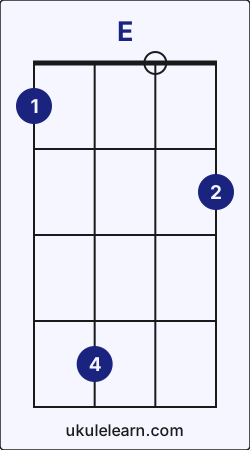 Ukulele E chord diagram
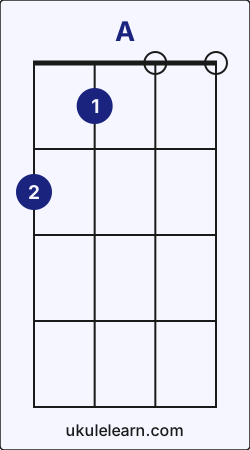 Ukulele A chord diagram
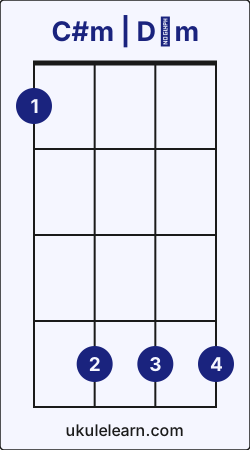 Ukulele C#m | D♭m chord diagram
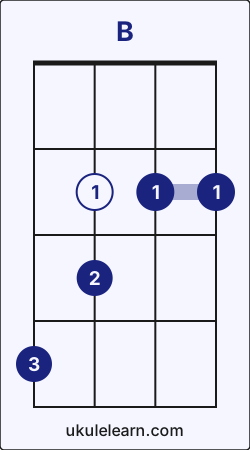 Ukulele B chord diagram
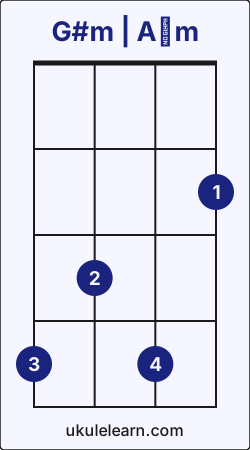 Ukulele G#m | A♭m chord diagram
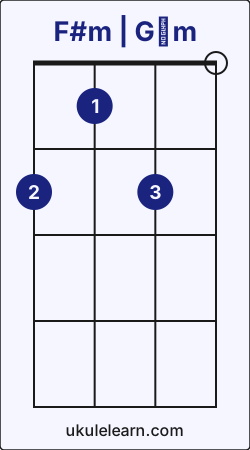 Ukulele F#m | G♭m chord diagram
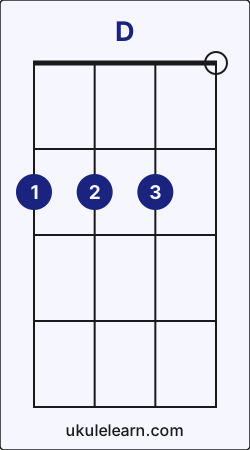 Ukulele D chord diagram
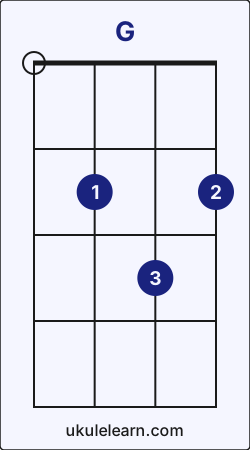 Ukulele G chord diagram
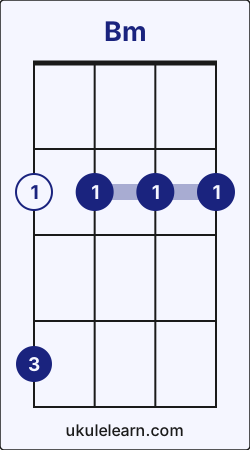 Ukulele Bm chord diagram
[Opening]
[E] [A] [C#m] [B] [A]
[C#m] This Romeo is bleeding, [B]but you can’t see his blood
[A]It’s nothing but some feelings, that this [G#m]old [G#m]dog, [A]kicked [B]up
[C#m] It’s been raining since you left me, now I’m [B]drowning, in the flood
[A]You see I’ve always been a fighter, but [G#m]without [G#m]you, I’d give [A]up [B]
[section 2]
[C#m] Now I can’t sing a love song, like the [B]way it’s meant to be
Well I [A]guess I’m not that good anymore, but b[B]aby t[B]hat’s just[A] me[B]
[chorus]
[E]Yeah, I will [B]love you, [F#m]baby
[C#m][B]Always, and [E]I’ll be there, [B]forever and a [A]day
[C#m][B]Always, [E]I’ll be there, till the stars don’t shine
Till the [B]heavens burst, and the words don’t rhyme, I know [A]when I die
You’ll be on my mind, and I’ll [B]love [B]you, [A] [B][C#m]always [A][A][A][B]
[section 3]
Now the [C#m]pictures that, you left behind
Are just [B]memories, from a different life
Some that [A]made us laugh, some that made us cry
One that [G#m]made [G#m]you, have to [A]say [B]goodbye
[section 4]
What I’d [C#m]give to run my fingers, through your hair
[B]Touch your lips, to hold you near
When you [A]say your prayers, try to understand
I’ve [G#m]made [G#m]mistakes, I’m [A]just a [B]man
[section 5]
When he [C#m]holds you close, when he pulls your near
When he [B]says the words, you’ve been needing to hear
I wish, [A]I was him, ’cause these words are mine
To [B]say to [B]you, till [A]the end [B]of time
[section 6]
[E]Yeah, I will [B]love you, [F#m]baby
[C#m][B]Always, and [E]I’ll be there, [B]forever and a [A]day, [C#m][B]always
[section 7]
[D]If you told me to [G]cry for you, [A]I could
[D]If you told me to [G]die for [A]you, I [Bm]would
Take a [A]look at my [G]face, there’s no price I won’t [A]pay
To [A]say these words to you
[Closing]
[E][B][F#m][C#m][B][E][B][A][B][B][A][B]
Well there [A]ain’t no luck, in these loaded dice
But [B]baby if you give me just one more try
We can [C#m]pack up our own dreams and our own lives
We’ll [B]find a place, [A]where the sun [B]still shines
[chorus]
[E]Yeah, I will [B]love you [F#m]baby
[C#m][B]Always, and [E]I’ll be there, [B]forever and a [A]day
[C#m][B]Always, [E]I’ll be there, till the stars don’t shine
Till the [B]heavens burst, and the words don’t rhyme
I know [A]when I die, you’ll be on my mind
And I’ll [B]love [B]you, [A] [B] [E]always
[outro]
[E][B][C#m][B][A][E][B][C#m][B][A]
[E][B][C#m][B][A][E][B][C#m][B][A]
How to play Always on Ukulele (Step-by-step)
Bon Jovi - Always on ukulele requires 9 chords and 13 core chord transitions. You can find the full step-by-step guide below. Before you start, tune your instrument. The song uses the ↓-↓↑-↑↓↑ pattern; practice it muted first, or simplify to downstrokes while you learn the changes.
Always uses these transitions most often: B → A (24), C#m → B (19), and A → B (17). These transitions may feel a little challenging at first, but with steady practice you can play this song quickly.When you are ready, begin with E - A chord transition.
1. E → A chord transition
To move from E to A;
- Lift your index finger from G string fret 4 and place it on C string fret 1.
- Slide your middle finger from A string fret 2 to G string fret 2.
2. A → C#m chord transition
To move from A to C#m;
- Lift your index finger from C string fret 1 and place it on G string fret 1.
- Slide your middle finger from G string fret 2 to C string fret 4.
- Place ring finger on E string fret 4.
- Place pinky on A string fret 4.
3. C#m → B chord transition
To move from C#m to B;
- While playing C#m, lift your pinky from A string fret 4.
- Lift your index finger from G string fret 1 and place it on E string fret 2.
- Slide your middle finger on C string from fret 4 to fret 3.
- Lift your ring finger from E string fret 4 and place it on G string fret 4.
4. B → A chord transition
To move from B to A;
- While playing B, lift your ring finger from G string fret 4.
- Lift your index finger from E string fret 2 and place it on C string fret 1.
- Slide your middle finger from C string fret 3 to G string fret 2.
5. A → G#m chord transition
To move from A to G#m;
- Lift your index finger from C string fret 1 and place it on A string fret 2.
- Slide your middle finger from G string fret 2 to C string fret 3.
- Place ring finger on G string fret 4.
- Place pinky on E string fret 4.
6. B → E chord transition
To move from B to E;
- While playing B, lift your ring finger from G string fret 4.
- Lift your index finger from E string fret 2 and place it on G string fret 4.
- Slide your middle finger from C string fret 3 to A string fret 2.
7. B → F#m chord transition
To move from B to F#m;
- Lift your index finger from E string fret 2 and place it on C string fret 1.
- Slide your middle finger from C string fret 3 to G string fret 2.
- Lift your ring finger from G string fret 4 and place it on E string fret 2.
8. F#m → C#m chord transition
To move from F#m to C#m;
- Lift your index finger from C string fret 1 and place it on G string fret 1.
- Slide your middle finger from G string fret 2 to C string fret 4.
- Slide your ring finger on E string from fret 2 to fret 4.
- Place pinky on A string fret 4.
9. B → D chord transition
To move from B to D;
- Lift your index finger from E string fret 2 and place it on G string fret 2.
- Slide your middle finger on C string from fret 3 to fret 2.
- Lift your ring finger from G string fret 4 and place it on E string fret 2.
10. D → G chord transition
To move from D to G;
- Lift your index finger from G string fret 2 and place it on C string fret 2.
- Slide your middle finger from C string fret 2 to A string fret 2.
- Slide your ring finger on E string from fret 2 to fret 3.
11. G → A chord transition
To move from G to A;
- While playing G, lift your ring finger from E string fret 3.
- Slide your index finger on C string from fret 2 to fret 1.
- Slide your middle finger from A string fret 2 to G string fret 2.
12. A → D chord transition
To move from A to D;
- Lift your index finger from C string fret 1 and place it on G string fret 2.
- Slide your middle finger from G string fret 2 to C string fret 2.
- Place ring finger on E string fret 2.
13. A → Bm chord transition
To move from A to Bm;
- While playing A, lift your middle finger from G string fret 2.
- Slide your index finger on C string from fret 1 to fret 2.
- Place ring finger on G string fret 4.
Always chord transition analysis
A short, data-driven summary of the chord flow in Always.
- Always includes 132 chord transitions, 13 of them unique.
- These transitions represent 0.04% of all chord transitions in Ukulelearn.
- Always contains 2 of the top 10 transitions across Ukulelearn.
- These transition patterns show how Always connects to the rest of Ukulelearn. Mastering them helps you move to similar songs faster.After B, the most likely next chords across Ukulelearn are E (21%), Em (16%), and A (16%).
- B → E: 21%
- B → A: 16%
After A, the most likely next chords across Ukulelearn are D (29%), G (13%), and E (12%).- A → D: 29%
- A → G: 13%