
Ruth Etting - Button Up Your Overcoat Ukulele Chords
Before you play, tune your ukulele and use the tools below to set up your view and flow.
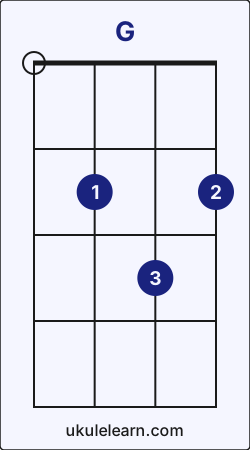 Ukulele G chord diagram
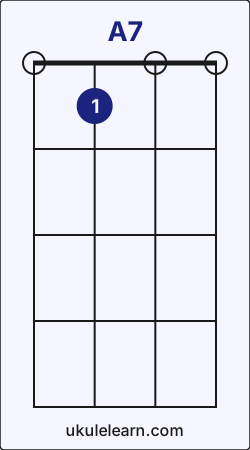 Ukulele A7 chord diagram
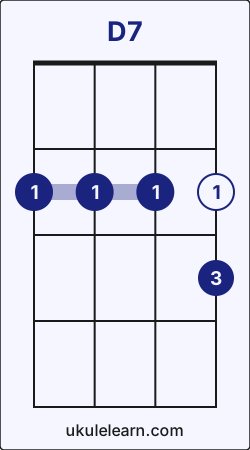 Ukulele D7 chord diagram
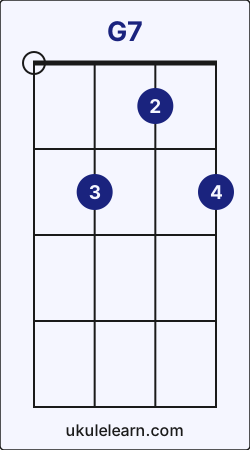 Ukulele G7 chord diagram
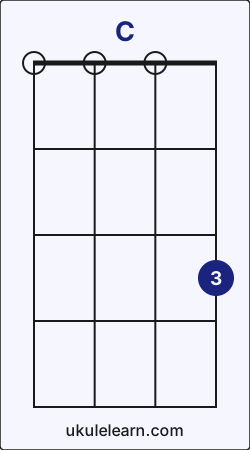 Ukulele C chord diagram
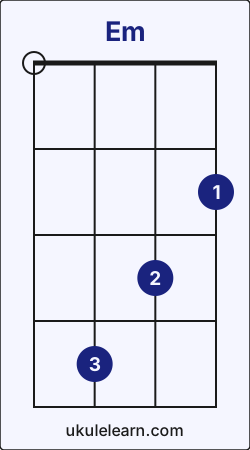 Ukulele Em chord diagram
[Opening]
[G]Button up your overcoat, [A7]when the wind is free
[D7]Take good care of yourself, you be[G]long to me.[D7]
[G]Eat an apple every day, [A7]get to bed by three,
[D7]Take good care of yourself, you be[G]long to me
[section 2]
[G7]Be careful [C]crossing streets oooh oooh
[G]Don’t eat meat, oooh oooh.
[Em]Cut out sweets, [A7]oooh oooh.
[D7]* You’ll get a pain and ruin your tum tum
[G]Keep away from bootleg hootch, [A7]when you’re on a spree.
[D7]Take good care of yourself, you be[G]long to me [D7]
[interlude]
[G] [A7] [D7] [G] [D7] [G] [A7] [D7] [G]
[section 3]
[G7]Don’t sit on [C]hornet’s tails, ooh ooh
[G]Or on nails, ooh ooh
[Em]Or third rails, [A7]ooh ooh
[D7]You’ll get a pain and ruin your tum tum
[section 4]
[G] [A7] [D7] [G]
[G]Button up your overcoat, [A7]when the wind is free,
[D7]Take good care of yourself, you be[G]long to me.[D7]
[G]Wear your flannel underwear, [A7]when you climb a tree [D7]
Take good care of yourself, you be[G]long to me.
[Closing]
Beware of [C]frozen ponds, ooh ooh
[G]Stocks and bonds, ooh ooh
[Em]Peroxide blondes, [A7]ooh ooh
[D7]You’ll get a pain and ruin your bankroll
[G]Keep the spoon out of your cup [A7]when you’re drinking tea
Oh, [D7]take good care of yourself you be[C]long to [G]me
How to play Button Up Your Overcoat on Ukulele (Step-by-step)
Ruth Etting - Button Up Your Overcoat on ukulele requires 6 chords and 9 core chord transitions. You can find the full step-by-step guide below. Before you start, tune your instrument. The song uses the ↓↑-↓↑-↓↑-↓↑ pattern; practice it muted first, or simplify to downstrokes while you learn the changes.
Button Up Your Overcoat uses these transitions most often: D7 → G (15), A7 → D7 (12), and G → A7 (9). These transitions may feel a little challenging at first, but with steady practice you can play this song quickly.When you are ready, begin with G - A7 chord transition.
1. G → A7 chord transition
To move from G to A7;
- While playing G, first lift your middle finger and ring finger.
- Slide your index finger on C string from fret 2 to fret 1.
2. A7 → D7 chord transition
To move from A7 to D7;
- Lift your index finger from C string fret 1 and place it on G string fret 2.
- Place ring finger on A string fret 3.
3. D7 → G chord transition
To move from D7 to G;
- Lift your index finger from G string fret 2 and place it on C string fret 2.
- Slide your ring finger from A string fret 3 to E string fret 3.
- Place middle finger on A string fret 2.
4. G → G7 chord transition
To move from G to G7;
- Lift your index finger from C string fret 2 and place it on E string fret 1.
- Slide your middle finger from A string fret 2 to C string fret 2.
- Lift your ring finger from E string fret 3 and place it on A string fret 2.
5. G7 → C chord transition
To move from G7 to C;
- While playing G7, first lift your index finger and middle finger.
- Slide your ring finger on A string from fret 2 to fret 3.
6. C → G chord transition
To move from C to G;
- Lift your ring finger from A string fret 3 and place it on E string fret 3.
- Place index finger on C string fret 2.
- Place middle finger on A string fret 2.
7. G → Em chord transition
To move from G to Em;
- Lift your index finger from C string fret 2 and place it on A string fret 2.
- Slide your middle finger from A string fret 2 to E string fret 3.
- Lift your ring finger from E string fret 3 and place it on C string fret 4.
8. Em → A7 chord transition
To move from Em to A7;
- While playing Em, first lift your middle finger and ring finger.
- Lift your index finger from A string fret 2 and place it on C string fret 1.
9. D7 → C chord transition
To move from D7 to C;
- While playing D7, lift your index finger from G string fret 2.
- Keep ring finger on A string fret 3.
Button Up Your Overcoat chord transition analysis
A short, data-driven summary of the chord flow in Button Up Your Overcoat.
- Button Up Your Overcoat includes 56 chord transitions, 9 of them unique.
- These transitions represent 0.01% of all chord transitions in Ukulelearn.
- Button Up Your Overcoat contains 1 of the top 10 transitions across Ukulelearn.
- These transition patterns show how Button Up Your Overcoat connects to the rest of Ukulelearn. Mastering them helps you move to similar songs faster.After G, the most likely next chords across Ukulelearn are C (25%), D (24%), and Am (13%).
- G → C: 25%
- G → Em: 9%
After D7, the most likely next chords across Ukulelearn are G (51%), G7 (18%), and C (6%).- D7 → G: 51%
- D7 → C: 6%