
REO Speedwagon - Can’t Fight This Feeling Anymore Ukulele Chords
Before you play, tune your ukulele and use the tools below to set up your view and flow.
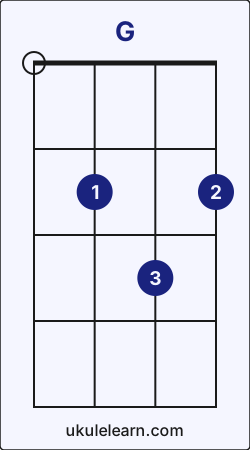 Ukulele G chord diagram
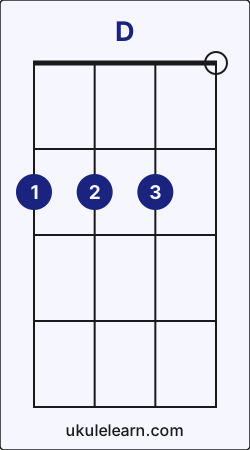 Ukulele D chord diagram
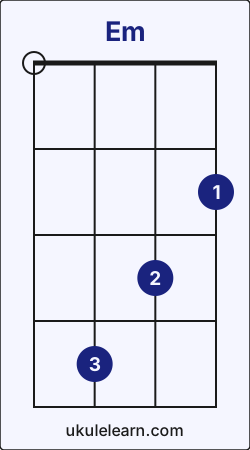 Ukulele Em chord diagram
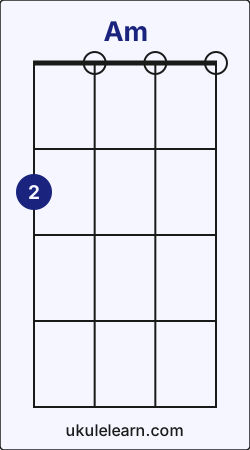 Ukulele Am chord diagram
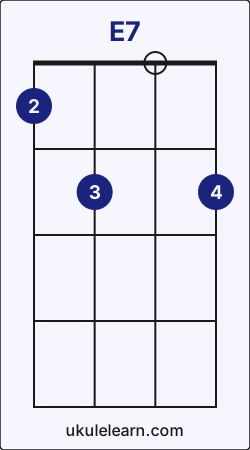 Ukulele E7 chord diagram
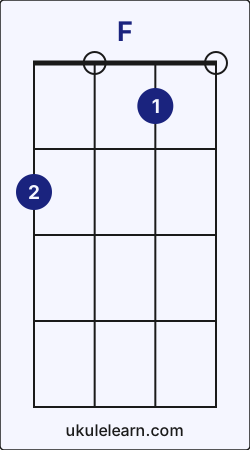 Ukulele F chord diagram
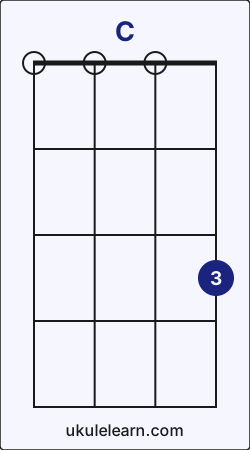 Ukulele C chord diagram
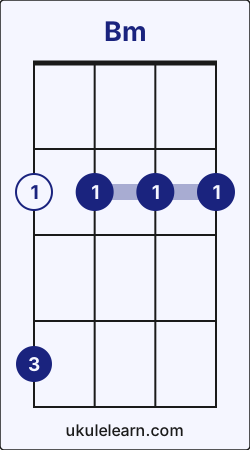 Ukulele Bm chord diagram
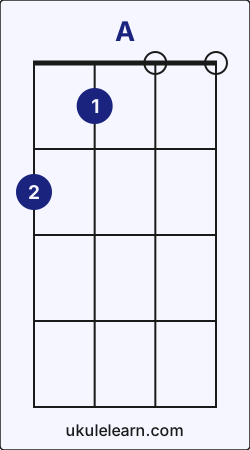 Ukulele A chord diagram
[Opening]
[G]I can’t fight this [D]feeling any [Em]longer
And [Am]yet I’m still a[E7]fraid to let it [D]flow
What [G]started out as [D]friendship, has grown [F]stro[E7]nger
I only [Am]wish I had the [C]strength to let it [D]show
[section 2]
[G]I tell myself that I [D]can’t hold out [Em]forever
I [Am]say there is no [E7]reason for my [D]fear
But [G]I feel so se[D]cure when were to[F]ge[E7]ther
[Am]You give my life di[G]rection
You make [C]everything so [D]clear
[chorus]
And [C]even as I wander, I’m [Bm]keeping you in sight
You’re a [C]candle in the window
On a [G]cold, dark winters [D]night
And [C]I’m getting closer than [Em]I ever thought I [D]might
[chorus]
And [C]I can’t fight this [G]feeling any[Am]more [C]
I’ve forgotten what I [G]started fighting [Am]for [C]
It’s time to bring this [G]ship into the [A]shore
And [C]throw away the oars, for[D]ever
[chorus]
Cause [C]I can’t fight this [G]feeling any[Am]more [C]
I’ve forgotten what I [G]started fighting [Am]for [C]
And if I have to [G]crawl upon the [Am]floor
Come [Bm]crashing through your [C]door
Baby, [C]I can’t fight this [D]feeling any[G]more
[Closing]
[G]My life has been such a [D]whirlwind since I [Em]saw you
I’ve been [Am]running round in [E7]circles in my [D]mind
And it [G]always seems that I’m [D]following [F]you, [E7]girl
Cause you [Am]take me to the [Bm]places that a[C]lone I’d never [D]find
[chorus]
And [C]even as I wander, I’m [Bm]keeping you in sight
You’re a [C]candle in the window
On a [G]cold, dark winters [D]night
And [C]I’m getting closer than [Em]I ever thought I [D]might
[chorus]
And [C]I can’t fight this [G]feeling any[Am]more [C]
I’ve forgotten what I [G]started fighting [Am]for [C]
It’s time to bring this [G]ship into the [Am]shore
And [C]throw away the oars, [D]forever
[chorus]
Cause [C]I can’t fight this [G]feeling any[Am]more [C]
I’ve forgotten what I [G]started fighting [Am]for [C]
And if I have to [G]crawl upon the [Am]floor
Come [Bm]crashing through your [C]door
Baby, [C]I can’t fight this [D]feeling any[G]more [Em] [C] [D] [G]
How to play Can't Fight This Feeling Anymore on Ukulele (Step-by-step)
REO Speedwagon - Can't Fight This Feeling Anymore on ukulele requires 9 chords and 17 core chord transitions. You can find the full step-by-step guide below. Before you start, tune your instrument. The song uses the ↓-↓↑-↓-↓↑-↓↑↓↑ pattern; practice it muted first, or simplify to downstrokes while you learn the changes.
Can't Fight This Feeling Anymore uses these transitions most often: C → G (14), G → Am (11), and Am → C (10). These transitions may feel a little challenging at first, but with steady practice you can play this song quickly.When you are ready, begin with G - D chord transition.
1. G → D chord transition
To move from G to D;
- Lift your index finger from C string fret 2 and place it on G string fret 2.
- Slide your middle finger from A string fret 2 to C string fret 2.
- Slide your ring finger on E string from fret 3 to fret 2.
2. D → Em chord transition
To move from D to Em;
- Lift your index finger from G string fret 2 and place it on A string fret 2.
- Slide your middle finger from C string fret 2 to E string fret 3.
- Lift your ring finger from E string fret 2 and place it on C string fret 4.
3. Em → Am chord transition
To move from Em to Am;
- While playing Em, first lift your index finger and ring finger.
- Lift your middle finger from E string fret 3 and place it on G string fret 2.
4. Am → E7 chord transition
To move from Am to E7;
- Lift your middle finger from G string fret 2 and place it on C string fret 2.
- Place index finger on G string fret 1.
- Place ring finger on A string fret 2.
5. E7 → D chord transition
To move from E7 to D;
- Slide your index finger on G string from fret 1 to fret 2.
- Keep middle finger on C string fret 2.
- Slide your ring finger from A string fret 2 to E string fret 2.
6. D → F chord transition
To move from D to F;
- While playing D, lift your ring finger from E string fret 2.
- Lift your index finger from G string fret 2 and place it on E string fret 1.
- Slide your middle finger from C string fret 2 to G string fret 2.
7. F → E7 chord transition
To move from F to E7;
- Lift your index finger from E string fret 1 and place it on G string fret 1.
- Slide your middle finger from G string fret 2 to C string fret 2.
- Place ring finger on A string fret 2.
8. Am → C chord transition
To move from Am to C;
- While playing Am, lift your middle finger from G string fret 2.
- Place ring finger on A string fret 3.
9. C → D chord transition
To move from C to D;
- Lift your ring finger from A string fret 3 and place it on E string fret 2.
- Place index finger on G string fret 2.
- Place middle finger on C string fret 2.
10. Am → G chord transition
To move from Am to G;
- Lift your middle finger from G string fret 2 and place it on A string fret 2.
- Place index finger on C string fret 2.
- Place ring finger on E string fret 3.
11. G → C chord transition
To move from G to C;
- While playing G, first lift your index finger and middle finger.
- Lift your ring finger from E string fret 3 and place it on A string fret 3.
12. C → Bm chord transition
To move from C to Bm;
- Lift your ring finger from A string fret 3 and place it on G string fret 4.
- Place index finger on C string fret 2.
13. C → Em chord transition
To move from C to Em;
- Lift your ring finger from A string fret 3 and place it on C string fret 4.
- Place index finger on A string fret 2.
- Place middle finger on E string fret 3.
14. G → A chord transition
To move from G to A;
- While playing G, lift your ring finger from E string fret 3.
- Slide your index finger on C string from fret 2 to fret 1.
- Slide your middle finger from A string fret 2 to G string fret 2.
15. A → C chord transition
To move from A to C;
- While playing A, first lift your index finger and middle finger.
- Place ring finger on A string fret 3.
16. Am → Bm chord transition
To move from Am to Bm;
- While playing Am, lift your middle finger from G string fret 2.
- Place index finger on C string fret 2.
- Place ring finger on G string fret 4.
17. G → Em chord transition
To move from G to Em;
- Lift your index finger from C string fret 2 and place it on A string fret 2.
- Slide your middle finger from A string fret 2 to E string fret 3.
- Lift your ring finger from E string fret 3 and place it on C string fret 4.
Can't Fight This Feeling Anymore chord transition analysis
A short, data-driven summary of the chord flow in Can't Fight This Feeling Anymore.
- Can't Fight This Feeling Anymore includes 107 chord transitions, 17 of them unique.
- These transitions represent 0.03% of all chord transitions in Ukulelearn.
- Can't Fight This Feeling Anymore contains 6 of the top 10 transitions across Ukulelearn.
- These transition patterns show how Can't Fight This Feeling Anymore connects to the rest of Ukulelearn. Mastering them helps you move to similar songs faster.After C, the most likely next chords across Ukulelearn are G (35%), F (16%), and D (11%).
- C → G: 35%
- C → D: 11%
After G, the most likely next chords across Ukulelearn are C (25%), D (24%), and Am (13%).- G → C: 25%
- G → D: 24%