
Kenny Rogers - Coward Of The County Ukulele Chords
Before you play, tune your ukulele and use the tools below to set up your view and flow.
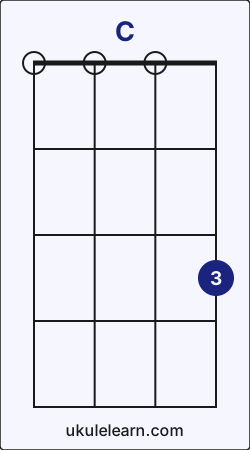 Ukulele C chord diagram
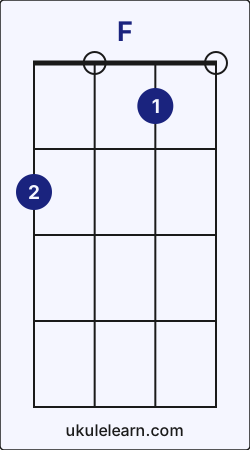 Ukulele F chord diagram
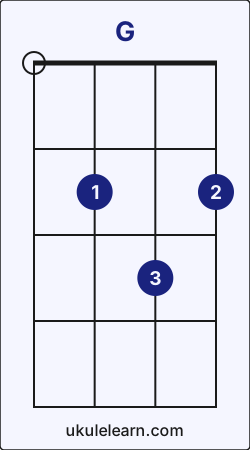 Ukulele G chord diagram
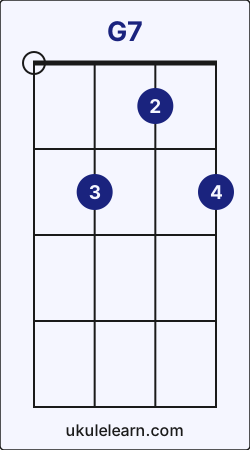 Ukulele G7 chord diagram
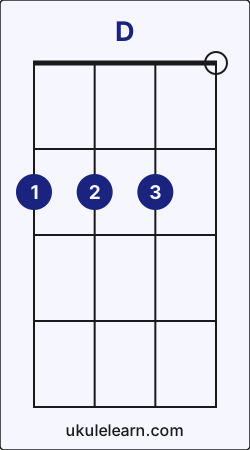 Ukulele D chord diagram
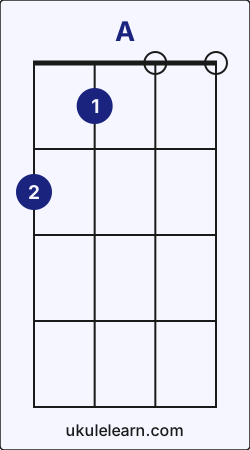 Ukulele A chord diagram
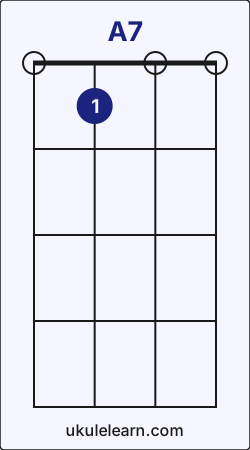 Ukulele A7 chord diagram
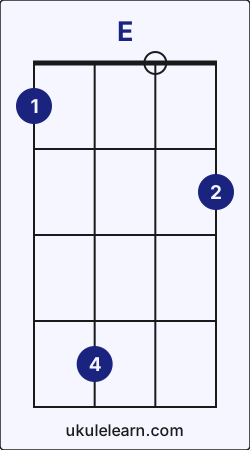 Ukulele E chord diagram
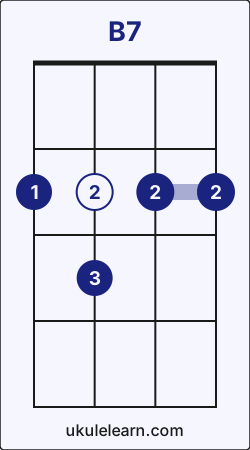 Ukulele B7 chord diagram
[Opening]
[C]Everyone considered him the [F]coward of the [C]county,
he’d never stood one single time to prove the county [G]wrong.
His [C]mama named him Tommy, the [F]folks just called him “[C]Yellow”,
but something always told me they were [G]reading Tommy [C]wrong.
[section 2]
[C]He was only ten years old when his [F]daddy died in [C]prison,
I looked after Tommy ’cause he was my brother’s [G]son.
I [C]still recall the final words my [F]brother said to [C]Tommy:
“Son, my life is over, but [G]your’s has just be[C]gun.
[chorus]
[C]“Promise me, son, not to [F]do the things I’ve [C]done,
[F]walk away from [C]trouble if you [G]can.
[C]It won’t mean you’re weak if you [F]turn the other [C]cheek,
I hope you’re old e[F]nough to under[G]stand
Son, you don’t have to [G7]fight to be a [C]man.”
[section 3]
[D]There’s someone for everyone and [G]Tommy’s love was [D]Becky,
in her arms he didn’t have to prove he was a [A]man.
One [D]day while he was working the [G]Gatlin boys came [D]calling,
they took turns at Becky, [A]there was three of [D]them!
[section 4]
[D]Tommy opened up the door and [G]saw his Becky [D]crying,
the torn dress, the shattered look was more than he could [A]stand.
He [D]reached above the fireplace and took [G]down his daddy’s [D]picture,
as his tears fell on his daddy’s face, he [A]heard these words a[D]gain
[chorus]
[D]“Promise me, son, not to [G]do the things I’ve [D]done,
[G]walk away from [D]trouble if you [A]can.
[D]It won’t mean you’re weak if you [G]turn the other [D]cheek,
I hope you’re old e[G]nough to under[A]stand
Son, you don’t have to [A7]fight to be a [D]man.”
[section 5]
The [E]Gatlin boys just laughed at him when he [A]walked into the [E]barroom,
one of them got up and met him halfway ‘cross the [B7]floor.
When [E]Tommy turned around they said, “Hey [A]look! Old Yellow’s [E]leaving.”
But you coulda heard a pin drop, when Tommy [B7]stopped and blocked the [E]door.
[section 6]
[E]Twenty years of crawling was [A]bottled up in[E]side him,
he wasn’t holding nothing back, he let ’em have it [B7]all.
When [E]Tommy left the barroom not a [A]Gatlin boy was [E]standing,
he said, “This one’s for Becky,” as he [B7]watched the last one [E]fall.
And I heard him say
[Closing]
“I [E]promised you, Dad, not to [A]do the things you [E]done,
I [A]walk away from [E]trouble when I [B7]can.
Now [E]please don’t think I’m weak, I didn’t [A]turn the other [E]cheek,
and Papa, I sure [A]hope you under[B7]stand
Sometimes you gotta [B7]fight when you’re a [E]man.”
[E]Everyone considered him the [A]coward of the county [E]
How to play Coward Of The County on Ukulele (Step-by-step)
Kenny Rogers - Coward Of The County on ukulele requires 9 chords and 15 core chord transitions. You can find the full step-by-step guide below. Before you start, tune your instrument. The song uses the ↓-↓↑-↑↓↑ pattern; practice it muted first, or simplify to downstrokes while you learn the changes.
Coward Of The County uses these transitions most often: E → A (9), A → E (8), and C → F (8). These transitions may feel a little challenging at first, but with steady practice you can play this song quickly.When you are ready, begin with C - F chord transition.
1. C → F chord transition
To move from C to F;
- While playing C, lift your ring finger from A string fret 3.
- Place index finger on E string fret 1.
- Place middle finger on G string fret 2.
2. C → G chord transition
To move from C to G;
- Lift your ring finger from A string fret 3 and place it on E string fret 3.
- Place index finger on C string fret 2.
- Place middle finger on A string fret 2.
3. F → G chord transition
To move from F to G;
- Lift your index finger from E string fret 1 and place it on C string fret 2.
- Slide your middle finger from G string fret 2 to A string fret 2.
- Place ring finger on E string fret 3.
4. G → G7 chord transition
To move from G to G7;
- Lift your index finger from C string fret 2 and place it on E string fret 1.
- Slide your middle finger from A string fret 2 to C string fret 2.
- Lift your ring finger from E string fret 3 and place it on A string fret 2.
5. G7 → C chord transition
To move from G7 to C;
- While playing G7, first lift your index finger and middle finger.
- Slide your ring finger on A string from fret 2 to fret 3.
6. C → D chord transition
To move from C to D;
- Lift your ring finger from A string fret 3 and place it on E string fret 2.
- Place index finger on G string fret 2.
- Place middle finger on C string fret 2.
7. D → G chord transition
To move from D to G;
- Lift your index finger from G string fret 2 and place it on C string fret 2.
- Slide your middle finger from C string fret 2 to A string fret 2.
- Slide your ring finger on E string from fret 2 to fret 3.
8. D → A chord transition
To move from D to A;
- While playing D, lift your ring finger from E string fret 2.
- Lift your index finger from G string fret 2 and place it on C string fret 1.
- Slide your middle finger from C string fret 2 to G string fret 2.
9. G → A chord transition
To move from G to A;
- While playing G, lift your ring finger from E string fret 3.
- Slide your index finger on C string from fret 2 to fret 1.
- Slide your middle finger from A string fret 2 to G string fret 2.
10. A → A7 chord transition
To move from A to A7;
- While playing A, lift your middle finger from G string fret 2.
- Keep index finger on C string fret 1.
11. A7 → D chord transition
To move from A7 to D;
- Lift your index finger from C string fret 1 and place it on G string fret 2.
- Place middle finger on C string fret 2.
- Place ring finger on E string fret 2.
12. D → E chord transition
To move from D to E;
- While playing D, lift your ring finger from E string fret 2.
- Slide your index finger on G string from fret 2 to fret 4.
- Slide your middle finger from C string fret 2 to A string fret 2.
13. E → A chord transition
To move from E to A;
- Lift your index finger from G string fret 4 and place it on C string fret 1.
- Slide your middle finger from A string fret 2 to G string fret 2.
14. E → B7 chord transition
To move from E to B7;
- Slide your index finger on G string from fret 4 to fret 2.
- Slide your middle finger from A string fret 2 to C string fret 3.
15. A → B7 chord transition
To move from A to B7;
- Lift your index finger from C string fret 1 and place it on G string fret 2.
- Slide your middle finger from G string fret 2 to C string fret 3.
Coward Of The County chord transition analysis
A short, data-driven summary of the chord flow in Coward Of The County.
- Coward Of The County includes 87 chord transitions, 15 of them unique.
- These transitions represent 0.02% of all chord transitions in Ukulelearn.
- Coward Of The County contains 6 of the top 10 transitions across Ukulelearn.
- These transition patterns show how Coward Of The County connects to the rest of Ukulelearn. Mastering them helps you move to similar songs faster.After E, the most likely next chords across Ukulelearn are A (25%), D (14%), and B (11%).
- E → A: 25%
- E → B7: 0%
After C, the most likely next chords across Ukulelearn are G (35%), F (16%), and D (11%).- C → G: 35%
- C → F: 16%