
John Hiatt - Crossing Muddy Waters Ukulele Chords
Before you play, tune your ukulele and use the tools below to set up your view and flow.
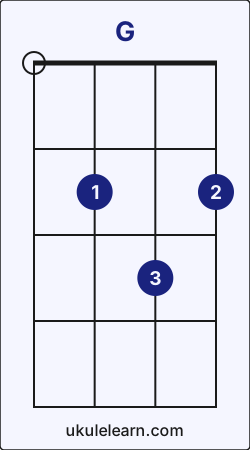 Ukulele G chord diagram
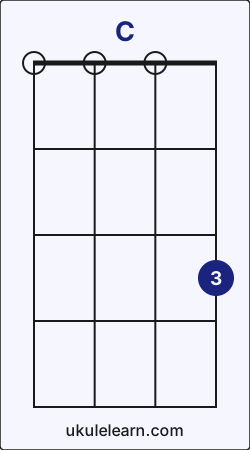 Ukulele C chord diagram
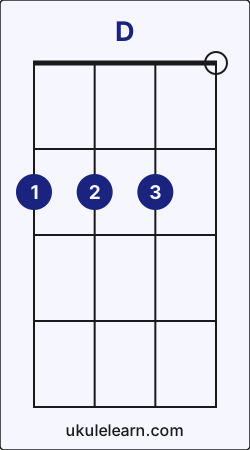 Ukulele D chord diagram
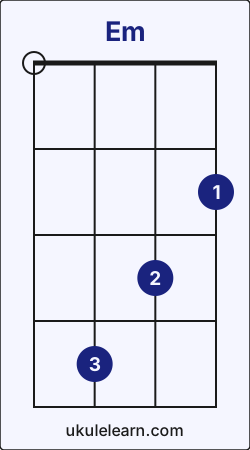 Ukulele Em chord diagram
[Opening]
[G][C][D][Em][C][D][G]
[G]Baby’s gone and i don’t know [C]why, she [D]headed out this [Em]morning
Like a rusty shot in a hollow [C]sky, she [D]left me without [G]warning
[section 2]
[G]Sooner than the dogs could [C]bark, [D]faster than the [Em]sun rose
Down to the banks in an old [C]mule cart, she [D]took a flat boat [G]across the shallows
Left me in my [C]tears to drown, she [D]left a baby [Em]daughter
Now the river’s wide and deep and [C]brown, she’s [D]crossing muddy [G]waters
[section 3]
[G]Tobacco standing in the [C]fields, be [D]rotten come [Em]November
And a bitter heart will not [C]reveal, a [D]spring that love [G]remembers
[section 4]
[G]When that sweet brown girl of [C]mine, hair [D]black as a [Em]raven
We broke the bread and drank the [C]wine, from a [D]jug that she’d been [G]saving
Left me in my [C]tears to drown, she [D]left a baby [Em]daughter
Now the river’s wide and deep and [C]brown, she’s [D]crossing muddy [G]waters
[section 5]
[G]Baby’s crying and the daylight’s [C]gone, that [D]big oak tree is [Em]groaning
In a rush of wind and a river [C]song, i can [D]hear my true love [G]moaning
[Closing]
[G]Crying for her baby [C]child, oh [D]crying for her [Em]husband
Crying for that rivers [C]wild, to take [D]her from her loved [G]ones
Left me in my [C]tears to drown, she [D]left a baby [Em]daughter
Now the river’s wide and deep and [C]brown, she’s [D]crossing muddy [G]waters
How to play Crossing Muddy Waters on Ukulele (Step-by-step)
John Hiatt - Crossing Muddy Waters on ukulele requires 4 chords and 5 core chord transitions. You can find the full step-by-step guide below. Before you start, tune your instrument. The song uses the ↓-↓↑-↑↓↑ pattern; practice it muted first, or simplify to downstrokes while you learn the changes.
Crossing Muddy Waters uses these transitions most often: C → D (20), D → Em (10), and D → G (10). These transitions may feel a little challenging at first, but with steady practice you can play this song quickly.When you are ready, begin with G - C chord transition.
1. G → C chord transition
To move from G to C;
- While playing G, first lift your index finger and middle finger.
- Lift your ring finger from E string fret 3 and place it on A string fret 3.
2. C → D chord transition
To move from C to D;
- Lift your ring finger from A string fret 3 and place it on E string fret 2.
- Place index finger on G string fret 2.
- Place middle finger on C string fret 2.
3. D → Em chord transition
To move from D to Em;
- Lift your index finger from G string fret 2 and place it on A string fret 2.
- Slide your middle finger from C string fret 2 to E string fret 3.
- Lift your ring finger from E string fret 2 and place it on C string fret 4.
4. Em → C chord transition
To move from Em to C;
- While playing Em, first lift your index finger and middle finger.
- Lift your ring finger from C string fret 4 and place it on A string fret 3.
5. D → G chord transition
To move from D to G;
- Lift your index finger from G string fret 2 and place it on C string fret 2.
- Slide your middle finger from C string fret 2 to A string fret 2.
- Slide your ring finger on E string from fret 2 to fret 3.
Crossing Muddy Waters chord transition analysis
A short, data-driven summary of the chord flow in Crossing Muddy Waters.
- Crossing Muddy Waters includes 60 chord transitions, 5 of them unique.
- These transitions represent 0.02% of all chord transitions in Ukulelearn.
- Crossing Muddy Waters contains 5 of the top 10 transitions across Ukulelearn.
- These transition patterns show how Crossing Muddy Waters connects to the rest of Ukulelearn. Mastering them helps you move to similar songs faster.After C, the most likely next chords across Ukulelearn are G (35%), F (16%), and D (11%).
- C → D: 11%
After D, the most likely next chords across Ukulelearn are G (29%), A (17%), and Em (17%).- D → G: 29%
- D → Em: 17%