
Sebastián Yatra - Dos Oruguitas Ukulele Chords
Before you play, tune your ukulele and use the tools below to set up your view and flow.
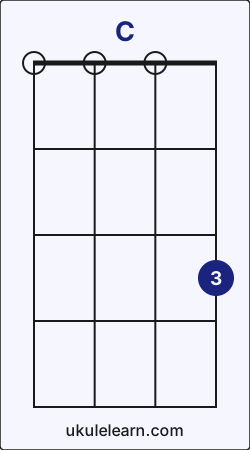 Ukulele C chord diagram
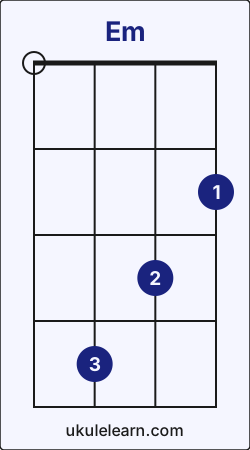 Ukulele Em chord diagram
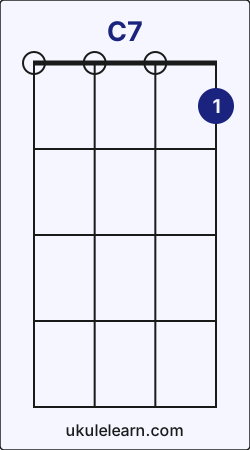 Ukulele C7 chord diagram
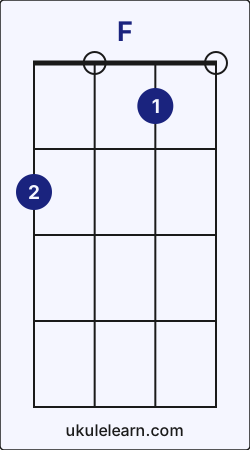 Ukulele F chord diagram
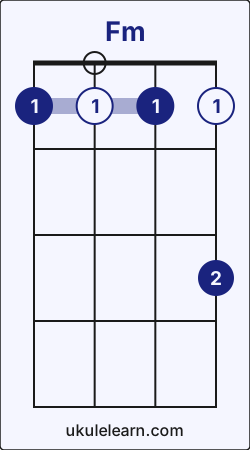 Ukulele Fm chord diagram
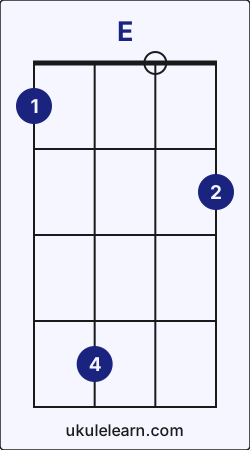 Ukulele E chord diagram
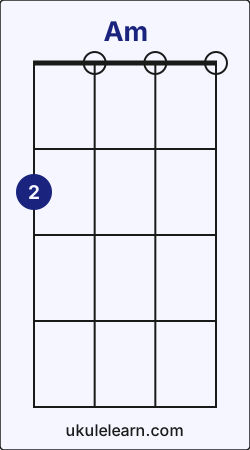 Ukulele Am chord diagram
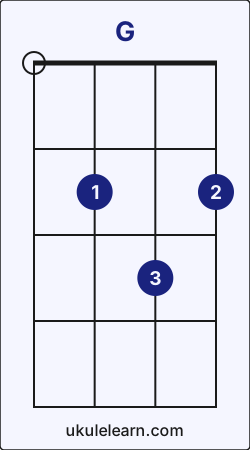 Ukulele G chord diagram
[Opening]
[C]Dos oruguitas [Em]enamoradas, [C7]pasan sus noches [F]y madrugadas
[Fm]Llenas de hambre, [C]siguen andando y [E]navegando un [Am]mundo
Que [F]cambia y sigue [C]cambiando, [E]navegando un [Am]mundo
Que [G]cambia y sigue [C]cambiando
[section 2]
[C]Dos oruguitas [Em]paran el viento, [C7]mientras se abrazan [F]con sentimiento
[Fm]Siguen creciendo, [C]no saben cuándo, [E]buscar algún [Am]rincón
[F]El tiempo sigue [C]cambiando, [E]inseparables [Am]son
[G]El tiempo sigue [C]cambiando
[chorus]
[C]Ay oruguitas, [G]no se aguanten [Am]más, hay que [F]crecer a parte y [Fm]volver
Hacia [G]adelante seguirás, [C]vienen milagros, [G]vienen [Am]crisálidas
Hay quе [F]partir y construir [Fm]su propio [F]futuro [G]
[C]Ay oruguitas, [G]no se aguanten [Am]más, hay que [F]crecer a parte y [Fm]volver
Hacia [G]adelante seguirás, [C]vienen milagros, [G]vienen [Am]crisálidas
Hay quе [F]partir y construir [Fm]su propio [F]futuro [G]
[section 3]
[C] [G] [Am] [F] [Fm] [F] [G] [C] [C] [G] [Am] [F]
[C]Dos oruguitas [Em]desorientadas, [C7]en dos capullos [F]bien abrigadas
[Fm]Con sueños nuevos, [C]ya solo falta [E]hacer lo [Am]necesario
En el [F]mundo que sigue [C]cambiando, [E]tumbando sus [Am]paredes
Ahí [G]viene nuestro [C]milagro, [C]nuestro milagro
[C]Nuestro milagro, [C]nuestro milagro
[chorus]
[C]Ay oruguitas, [G]no se aguanten [Am]más, hay que [F]crecer a parte y [Fm]volver
Hacia [G]adelante seguirás, [C]vienen milagros, [G]vienen [Am]crisálidas
Hay quе [F]partir y construir [Fm]su propio [F]futuro [G]
[C]Ay oruguitas, [G]no se aguanten [Am]más, hay que [F]crecer a parte y [Fm]volver
Hacia [G]adelante seguirás, [C]vienen milagros, [G]vienen [Am]crisálidas
Hay quе [F]partir y construir [Fm]su propio [F]futuro [G]
[Closing]
[C]Ay mariposas, [G]no se aguanten [Am]más, hay que [F]crecer a parte y [Fm]volver
Hacia [G]adelante seguirás, [C]ya son milagro, [G]rompiendo [Am]crisálidas
Hay que [F]volar, hay que encontrar, su propio [C]futuro
How to play Dos Oruguitas on Ukulele (Step-by-step)
Sebastián Yatra - Dos Oruguitas on ukulele requires 8 chords and 13 core chord transitions. You can find the full step-by-step guide below. Before you start, tune your instrument. The song uses the ↓-↓↑-↑↓↑ pattern; practice it muted first, or simplify to downstrokes while you learn the changes.
Dos Oruguitas uses these transitions most often: Am → F (15), F → Fm (13), and G → C (13). These transitions may feel a little challenging at first, but with steady practice you can play this song quickly.When you are ready, begin with C - Em chord transition.
1. C → Em chord transition
To move from C to Em;
- Lift your ring finger from A string fret 3 and place it on C string fret 4.
- Place index finger on A string fret 2.
- Place middle finger on E string fret 3.
2. Em → C7 chord transition
To move from Em to C7;
- While playing Em, first lift your middle finger and ring finger.
- Slide your index finger on A string from fret 2 to fret 1.
3. C7 → F chord transition
To move from C7 to F;
- Lift your index finger from A string fret 1 and place it on E string fret 1.
- Place middle finger on G string fret 2.
4. F → Fm chord transition
To move from F to Fm;
- Lift your index finger from E string fret 1 and place it on G string fret 1.
- Slide your middle finger from G string fret 2 to E string fret 1.
- Place pinky on A string fret 3.
5. Fm → C chord transition
To move from Fm to C;
- While playing Fm, first lift your index finger, middle finger, and pinky.
- Place ring finger on A string fret 3.
6. C → E chord transition
To move from C to E;
- While playing C, lift your ring finger from A string fret 3.
- Place index finger on G string fret 4.
- Place middle finger on A string fret 2.
7. E → Am chord transition
To move from E to Am;
- While playing E, lift your index finger from G string fret 4.
- Lift your middle finger from A string fret 2 and place it on G string fret 2.
8. Am → F chord transition
To move from Am to F;
- Keep middle finger on G string fret 2.
- Place index finger on E string fret 1.
9. F → C chord transition
To move from F to C;
- While playing F, first lift your index finger and middle finger.
- Place ring finger on A string fret 3.
10. Am → G chord transition
To move from Am to G;
- Lift your middle finger from G string fret 2 and place it on A string fret 2.
- Place index finger on C string fret 2.
- Place ring finger on E string fret 3.
11. G → C chord transition
To move from G to C;
- While playing G, first lift your index finger and middle finger.
- Lift your ring finger from E string fret 3 and place it on A string fret 3.
12. Fm → G chord transition
To move from Fm to G;
- While playing Fm, lift your pinky from A string fret 3.
- Lift your index finger from G string fret 1 and place it on C string fret 2.
- Slide your middle finger from E string fret 1 to A string fret 2.
- Place ring finger on E string fret 3.
13. F → G chord transition
To move from F to G;
- Lift your index finger from E string fret 1 and place it on C string fret 2.
- Slide your middle finger from G string fret 2 to A string fret 2.
- Place ring finger on E string fret 3.
Dos Oruguitas chord transition analysis
A short, data-driven summary of the chord flow in Dos Oruguitas.
- Dos Oruguitas includes 112 chord transitions, 13 of them unique.
- These transitions represent 0.03% of all chord transitions in Ukulelearn.
- Dos Oruguitas contains 6 of the top 10 transitions across Ukulelearn.
- These transition patterns show how Dos Oruguitas connects to the rest of Ukulelearn. Mastering them helps you move to similar songs faster.After C, the most likely next chords across Ukulelearn are G (35%), F (16%), and D (11%).
- C → G: 35%
- C → Em: 8%
After G, the most likely next chords across Ukulelearn are C (25%), D (24%), and Am (13%).- G → C: 25%
- G → Am: 13%