
Chris Stapleton - Either Way Ukulele Chords
Before you play, tune your ukulele and use the tools below to set up your view and flow.
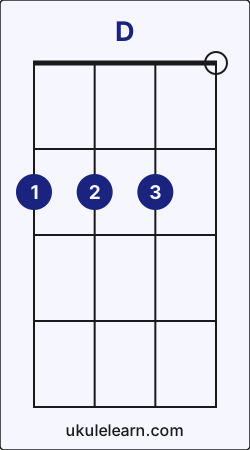 Ukulele D chord diagram
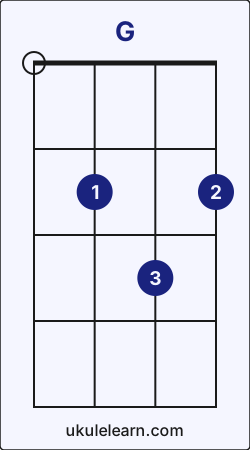 Ukulele G chord diagram
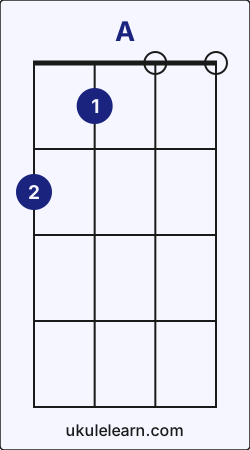 Ukulele A chord diagram
[Opening]
[D]
[D]We pass in the hall, [D]on our way to separate rooms
[D]The only time we ever talk, is when the monthly bills are [G]due
[G]We go work, we go to church, [G]we fake the perfect [D]life
I’m [G]past the point of give a damn, and all my tears are [A]cried
[chorus]
We can just go [D]on like this, say the word we’ll [G]call it quits
Baby you can [A]go or you can [G]stay, I won’t love you either [D]way
[section 2]
[D]It’s been so long since I felt, [D]anything inside these walls
[D]You can’t hate and you can’t hurt, when you don’t feel at [G]all
[G]I used to cry and stay up nights, [G]and wonder what went [D]wrong
[Closing]
[G]It’s been hard but hearts can only, [G]do that for so [A]long
We can just go [D]on like this, say the word we’ll [G]call it quits
Baby you can [A]go or you can [G]stay, I won’t love you either [D]way
[chorus]
[D] [D] [D] [G] [G] [A]
We can just go [D]on like this, say the word we’ll [G]call it quits
Baby you can [A]go or you can [G]stay, I won’t love you either [D]way
How to play Either Way on Ukulele (Step-by-step)
Chris Stapleton - Either Way on ukulele requires 3 chords and 3 core chord transitions. You can find the full step-by-step guide below. Before you start, tune your instrument. The song uses the ↓-↓↑-↑↓↑ pattern; practice it muted first, or simplify to downstrokes while you learn the changes.
Either Way uses these transitions most often: D → G (8), G → A (6), and G → D (5). These transitions may feel a little challenging at first, but with steady practice you can play this song quickly.When you are ready, begin with D - G chord transition.
1. D → G chord transition
To move from D to G;
- Lift your index finger from G string fret 2 and place it on C string fret 2.
- Slide your middle finger from C string fret 2 to A string fret 2.
- Slide your ring finger on E string from fret 2 to fret 3.
2. G → A chord transition
To move from G to A;
- While playing G, lift your ring finger from E string fret 3.
- Slide your index finger on C string from fret 2 to fret 1.
- Slide your middle finger from A string fret 2 to G string fret 2.
3. A → D chord transition
To move from A to D;
- Lift your index finger from C string fret 1 and place it on G string fret 2.
- Slide your middle finger from G string fret 2 to C string fret 2.
- Place ring finger on E string fret 2.
Either Way chord transition analysis
A short, data-driven summary of the chord flow in Either Way.
- Either Way includes 25 chord transitions, 3 of them unique.
- These transitions represent 0.01% of all chord transitions in Ukulelearn.
- Either Way contains 2 of the top 10 transitions across Ukulelearn.
- These transition patterns show how Either Way connects to the rest of Ukulelearn. Mastering them helps you move to similar songs faster.After D, the most likely next chords across Ukulelearn are G (29%), A (17%), and Em (17%).
- D → G: 29%
After G, the most likely next chords across Ukulelearn are C (25%), D (24%), and Am (13%).- G → D: 24%
- G → A: 6%