
Long John Baldry - Everything Stops For Tea Ukulele Chords
Before you play, tune your ukulele and use the tools below to set up your view and flow.
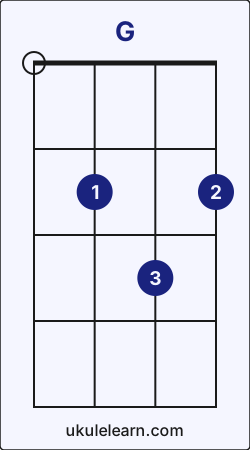 Ukulele G chord diagram
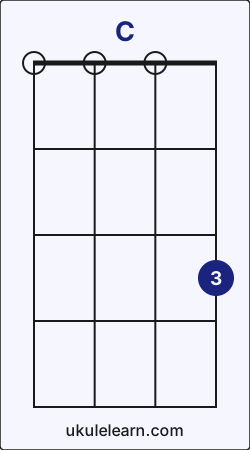 Ukulele C chord diagram
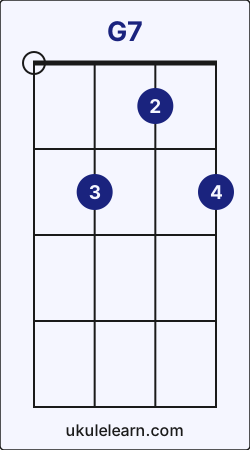 Ukulele G7 chord diagram
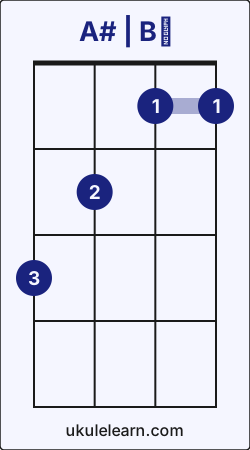 Ukulele A# | B♭ chord diagram
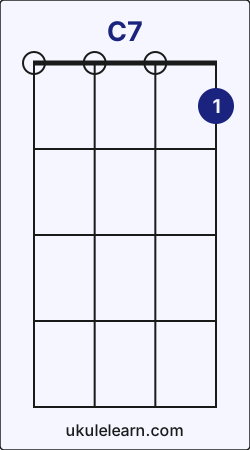 Ukulele C7 chord diagram
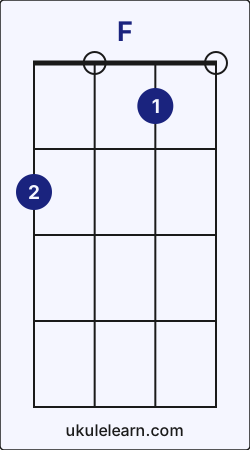 Ukulele F chord diagram
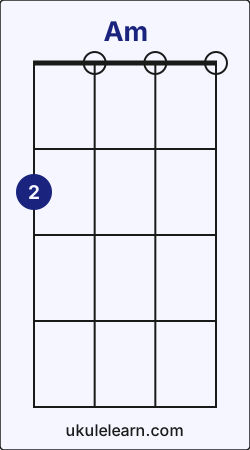 Ukulele Am chord diagram
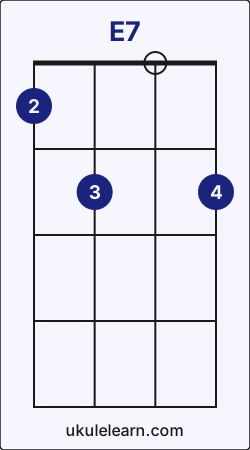 Ukulele E7 chord diagram
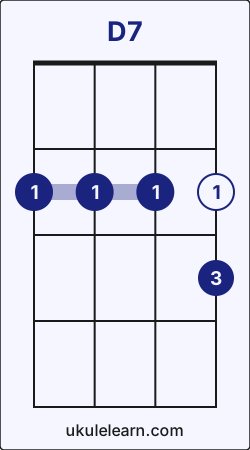 Ukulele D7 chord diagram
[Opening]
[G]Oh the [C]factories may be [G7]roaring,
With a [C]booma lacka, [Bb]zooma lacka [G7]wee.
But there [C]isn’t any [C7]roar when the [F]clock strikes [C]four,
Everything [G7]stops for [C]tea.
[section 2]
Oh a [C]lawyer [G7]in the [C]courtroom,
In the [C]middle of [Bb]an alimony [G7]plea.
Has to [C]stop and help ’em [C7]pour, when the [F]clock strikes [C]four.
Everything [G7]stops for [C]tea.
[section 3]
It’s a [Am]very good [E7]English [Am]custom,
Though [Am]the weather be [E7]cold or [Am]hot.
When you [D7]need a little pickup, you’ll [G]find a little teacup,
Will [D7]always hit the [G]spot.
[section 4]
[C]You remember [G7]Cleo[C]patra
Had a [C]date to meet [Bb]Mark Anthony at [G7]3.
When he [C]came an hour [C7]late , she said you’ll [F]have to [C]wait.
Everything [G7]stops for [C]tea.
[section 5]
Oh they [C]may be [G7]playing [C]football,
And the [C]crowd is yelling, [Bb]Kill the [G7]referee!
But no [C]matter what the [C7]score, when the [F]clock strikes [C]four.
Everything [G7]stops for [C]tea.
[section 6]
Oh the [C]golfer [G7]may be [C]golfing,
And be [C]just about to [Bb]make a hole in [G7]three.
But it [C]always gets them [C7]sore when the [F]clock yells [C]four.
Everything [G7]stops for [C]tea.
[section 7]
It’s a [Am]very good [E7]English [Am]custom,
And a [Am]stimulant [E7]for the [Am]brain.
When you [D7]feel a little weary, a [G]cup will make you cheery
And it’s [D7]cheaper than [G]champagne.
[Closing]
Now I [C]know just [G7]why Franz [C]Schubert
Didn’t [C]finish his un[Bb]finished [G7]symphony.
He [C]might have written [C7]more, but the [F]clock struck [C]four.
And everything [G7]stops for [C]tea!
[outro]
[G7] [C]
How to play Everything Stops For Tea on Ukulele (Step-by-step)
John Baldry - Everything Stops For Tea on ukulele requires 9 chords and 11 core chord transitions. You can find the full step-by-step guide below. Before you start, tune your instrument. The song uses the ↓-↓↑-↓↑-↓↑ pattern; practice it muted first, or simplify to downstrokes while you learn the changes.
Everything Stops For Tea uses these transitions most often: G7 → C (19), C → G7 (13), and Bb → G7 (6). These transitions may feel a little challenging at first, but with steady practice you can play this song quickly.When you are ready, begin with G - C chord transition.
1. G → C chord transition
To move from G to C;
- While playing G, first lift your index finger and middle finger.
- Lift your ring finger from E string fret 3 and place it on A string fret 3.
2. C → G7 chord transition
To move from C to G7;
- Slide your ring finger on A string from fret 3 to fret 2.
- Place index finger on E string fret 1.
- Place middle finger on C string fret 2.
3. C → Bb chord transition
To move from C to Bb;
- Lift your ring finger from A string fret 3 and place it on G string fret 3.
- Place index finger on E string fret 1.
- Place middle finger on C string fret 2.
4. Bb → G7 chord transition
To move from Bb to G7;
- Keep index finger on E string fret 1.
- Keep middle finger on C string fret 2.
- Lift your ring finger from G string fret 3 and place it on A string fret 2.
5. C → C7 chord transition
To move from C to C7;
- While playing C, lift your ring finger from A string fret 3.
- Place index finger on A string fret 1.
6. C7 → F chord transition
To move from C7 to F;
- Lift your index finger from A string fret 1 and place it on E string fret 1.
- Place middle finger on G string fret 2.
7. F → C chord transition
To move from F to C;
- While playing F, first lift your index finger and middle finger.
- Place ring finger on A string fret 3.
8. C → Am chord transition
To move from C to Am;
- While playing C, lift your ring finger from A string fret 3.
- Place middle finger on G string fret 2.
9. Am → E7 chord transition
To move from Am to E7;
- Lift your middle finger from G string fret 2 and place it on C string fret 2.
- Place index finger on G string fret 1.
- Place ring finger on A string fret 2.
10. Am → D7 chord transition
To move from Am to D7;
- While playing Am, lift your middle finger from G string fret 2.
- Place index finger on G string fret 2.
- Place ring finger on A string fret 3.
11. D7 → G chord transition
To move from D7 to G;
- Lift your index finger from G string fret 2 and place it on C string fret 2.
- Slide your ring finger from A string fret 3 to E string fret 3.
- Place middle finger on A string fret 2.
Everything Stops For Tea chord transition analysis
A short, data-driven summary of the chord flow in Everything Stops For Tea.
- Everything Stops For Tea includes 83 chord transitions, 11 of them unique.
- These transitions represent 0.02% of all chord transitions in Ukulelearn.
- Everything Stops For Tea contains 2 of the top 10 transitions across Ukulelearn.
- These transition patterns show how Everything Stops For Tea connects to the rest of Ukulelearn. Mastering them helps you move to similar songs faster.After C, the most likely next chords across Ukulelearn are G (35%), F (16%), and D (11%).
- C → Am: 10%
- C → G7: 2%
After G7, the most likely next chords across Ukulelearn are C (69%), C7 (5%), and F (5%).- G7 → C: 69%