
George Formby - Fanlight Fanny Ukulele Chords
Before you play, tune your ukulele and use the tools below to set up your view and flow.
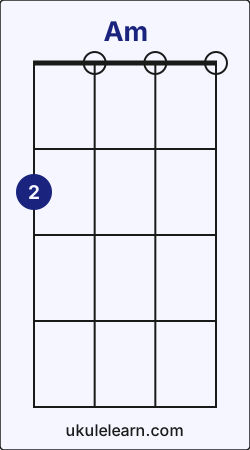 Ukulele Am chord diagram
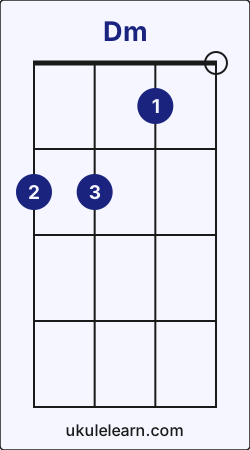 Ukulele Dm chord diagram
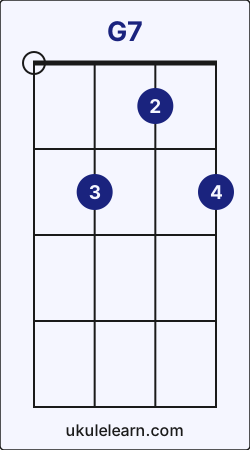 Ukulele G7 chord diagram
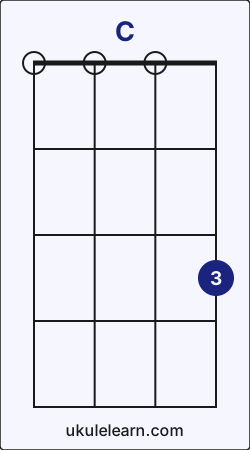 Ukulele C chord diagram
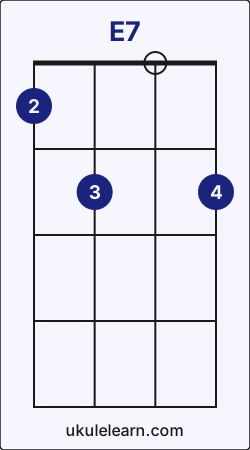 Ukulele E7 chord diagram
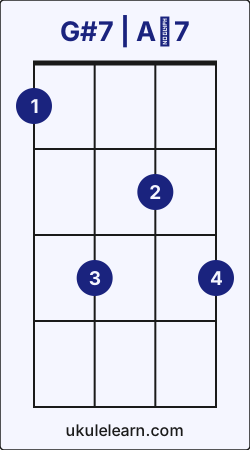 Ukulele G#7 | A♭7 chord diagram
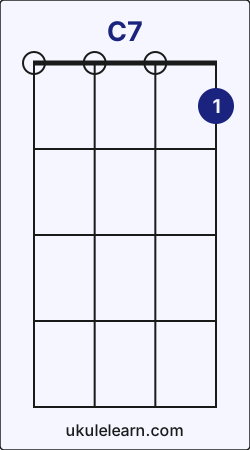 Ukulele C7 chord diagram
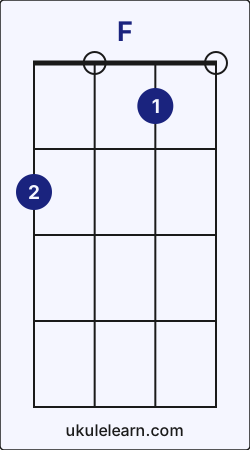 Ukulele F chord diagram
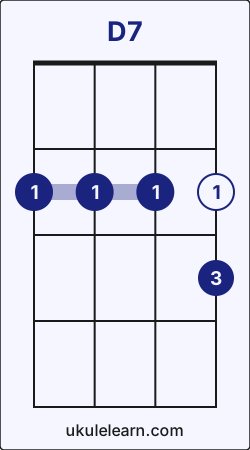 Ukulele D7 chord diagram
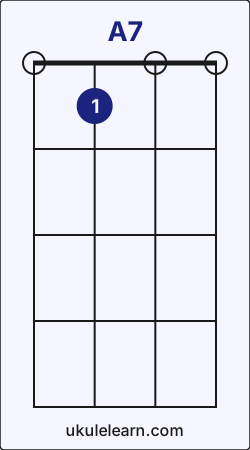 Ukulele A7 chord diagram
[Opening]
[Am]Up the [Dm]west end, [Am]that’s the [Dm]best end,
[Am] where the night clubs thrive
[G7]Down into a dive you [C]go. [E7]
[Am]There’s a [Dm]jazz queen, [Am]she’s a [Dm]has been,
[Am]has been Lord knows what
[G7]Every night she’s there on [C]show. [G#7] [G7] [C]
She [C7]dances underneath a magic [F]spell
She’s [D7]full of charm and beer and stout as [G7]well. [E7]
[section 2]
She’s [Am]66 but looks sixteen, her friends don’t know her now her face is clean
[G7]Fanlight Fanny the frowsy [G#7]night [G7]club [C]queen. [E7]
[Am]See her glide around the floor, then glide around into the pub next door.
[G7]Fanlight Fanny the frowsy [G#7]night [G7]club [C]queen. [E7]
[section 3]
She looks [Am]swell in the [G#7]lime, a [Am]queen all the [G#7] time,
You [Am]get your money’s [E7]worth.
[D7]By [G#7]day [A7]you’ll [D7]say “[G7]It’s her second time on earth”.
She [Am]waltzes in the west end shops, then waltzes out in between two cops.
[G7]Fanlight Fanny the frowsy [G#7]night [G7]club [C]queen. [E7]
[section 4]
By [Am]tecs she’s followed and when she’s collared the judge she always cheats,
[G7]Twice a month two weeks she’ll [C]do. [E7]
She’s [Am]often boasted she’s been toasted, toasted by her friends.
She [G7]ought to be cremated [C]too. [G#7] [G7] [C]
You [C7]can’t tell if she’s brunette or a [F]blonde,
She’s [D7]like something you drag out of a [G7]pond. [E7]
[Am]She’s a peach but understand, She’s called a peach because she’s always canned.
[G7]Fanlight Fanny the frowsy [G#7]night [G7]club [C]queen. [G#7] [G7] [C]
[section 5]
[Am]When she’s dressed she’s like May West, She wears two saucepan lids upon her chest.
[G7]Fanlight Fanny the frowsy [G#7]night [G7]club [C]queen. [E7]
[section 6]
She looks [Am]well in the [G#7]lime, a [Am]queen all the [G#7] time,
You [Am]get your money’s [E7]worth.
[D7]By [G#7]day [A7]you’ll [D7]say “[G7]It’s her second time on earth”.
[Closing]
[Am]Every morning at the break of day, they call for the empties and they cart away
[G7]Fanlight Fanny the frowsy [G#7]night [G7]club [C]queen. [E7]
How to play Fanlight Fanny on Ukulele (Step-by-step)
George Formby - Fanlight Fanny on ukulele requires 10 chords and 18 core chord transitions. You can find the full step-by-step guide below. Before you start, tune your instrument. The song uses the ↓-↓↑-↑↓↑ pattern; practice it muted first, or simplify to downstrokes while you learn the changes.
Fanlight Fanny uses these transitions most often: G7 → C (13), Am → G7 (10), and G#7 → G7 (9). These transitions may feel a little challenging at first, but with steady practice you can play this song quickly.When you are ready, begin with Am - Dm chord transition.
1. Am → Dm chord transition
To move from Am to Dm;
- Keep middle finger on G string fret 2.
- Place index finger on E string fret 1.
- Place ring finger on C string fret 2.
2. Am → G7 chord transition
To move from Am to G7;
- Lift your middle finger from G string fret 2 and place it on C string fret 2.
- Place index finger on E string fret 1.
- Place ring finger on A string fret 2.
3. G7 → C chord transition
To move from G7 to C;
- While playing G7, first lift your index finger and middle finger.
- Slide your ring finger on A string from fret 2 to fret 3.
4. C → E7 chord transition
To move from C to E7;
- Slide your ring finger on A string from fret 3 to fret 2.
- Place index finger on G string fret 1.
- Place middle finger on C string fret 2.
5. E7 → Am chord transition
To move from E7 to Am;
- While playing E7, first lift your index finger and ring finger.
- Lift your middle finger from C string fret 2 and place it on G string fret 2.
6. C → G#7 chord transition
To move from C to G#7;
- Lift your ring finger from A string fret 3 and place it on C string fret 3.
- Place index finger on G string fret 1.
- Place middle finger on E string fret 2.
- Place pinky on A string fret 3.
7. G#7 → G7 chord transition
To move from G#7 to G7;
- While playing G#7, lift your pinky from A string fret 3.
- Lift your index finger from G string fret 1 and place it on E string fret 1.
- Slide your middle finger from E string fret 2 to C string fret 2.
- Lift your ring finger from C string fret 3 and place it on A string fret 2.
8. C → C7 chord transition
To move from C to C7;
- While playing C, lift your ring finger from A string fret 3.
- Place index finger on A string fret 1.
9. C7 → F chord transition
To move from C7 to F;
- Lift your index finger from A string fret 1 and place it on E string fret 1.
- Place middle finger on G string fret 2.
10. F → D7 chord transition
To move from F to D7;
- While playing F, lift your middle finger from G string fret 2.
- Lift your index finger from E string fret 1 and place it on G string fret 2.
- Place ring finger on A string fret 3.
11. D7 → G7 chord transition
To move from D7 to G7;
- Lift your index finger from G string fret 2 and place it on E string fret 1.
- Slide your ring finger on A string from fret 3 to fret 2.
- Place middle finger on C string fret 2.
12. G7 → E7 chord transition
To move from G7 to E7;
- Lift your index finger from E string fret 1 and place it on G string fret 1.
- Keep middle finger on C string fret 2.
- Keep ring finger on A string fret 2.
13. Am → G#7 chord transition
To move from Am to G#7;
- Lift your middle finger from G string fret 2 and place it on E string fret 2.
- Place index finger on G string fret 1.
- Place ring finger on C string fret 3.
- Place pinky on A string fret 3.
14. E7 → D7 chord transition
To move from E7 to D7;
- While playing E7, lift your middle finger from C string fret 2.
- Slide your index finger on G string from fret 1 to fret 2.
- Slide your ring finger on A string from fret 2 to fret 3.
15. D7 → G#7 chord transition
To move from D7 to G#7;
- Slide your index finger on G string from fret 2 to fret 1.
- Slide your ring finger from A string fret 3 to C string fret 3.
- Place middle finger on E string fret 2.
- Place pinky on A string fret 3.
16. G#7 → A7 chord transition
To move from G#7 to A7;
- While playing G#7, first lift your middle finger, ring finger, and pinky.
- Lift your index finger from G string fret 1 and place it on C string fret 1.
17. A7 → D7 chord transition
To move from A7 to D7;
- Lift your index finger from C string fret 1 and place it on G string fret 2.
- Place ring finger on A string fret 3.
18. C → Am chord transition
To move from C to Am;
- While playing C, lift your ring finger from A string fret 3.
- Place middle finger on G string fret 2.
Fanlight Fanny chord transition analysis
A short, data-driven summary of the chord flow in Fanlight Fanny.
- Fanlight Fanny includes 97 chord transitions, 18 of them unique.
- These transitions represent 0.03% of all chord transitions in Ukulelearn.
- Fanlight Fanny contains 3 of the top 25 transitions across Ukulelearn.
- These transition patterns show how Fanlight Fanny connects to the rest of Ukulelearn. Mastering them helps you move to similar songs faster.After G7, the most likely next chords across Ukulelearn are C (69%), C7 (5%), and F (5%).
- G7 → C: 69%
- G7 → Am: 3%
After Am, the most likely next chords across Ukulelearn are F (26%), G (21%), and C (16%).- Am → Dm: 8%
- Am → E7: 1%