
Cat Stevens - Father and Son Ukulele Chords
Before you play, tune your ukulele and use the tools below to set up your view and flow.
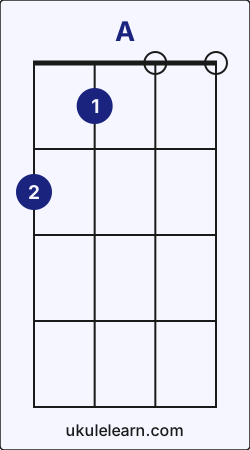 Ukulele A chord diagram
 Ukulele Asus4 chord diagram
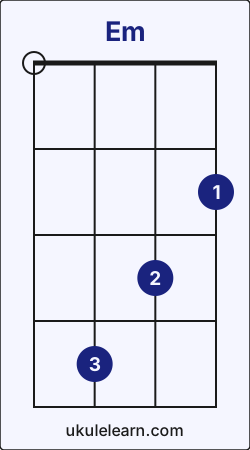 Ukulele Em chord diagram
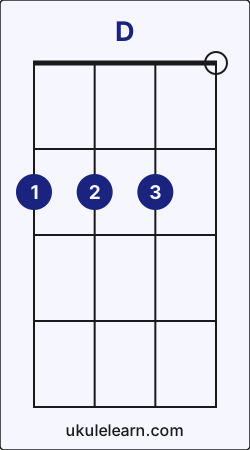 Ukulele D chord diagram
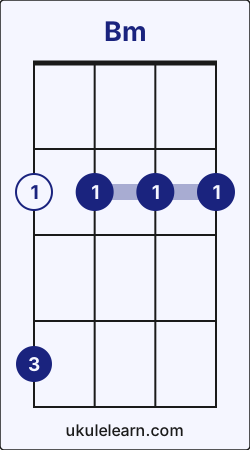 Ukulele Bm chord diagram
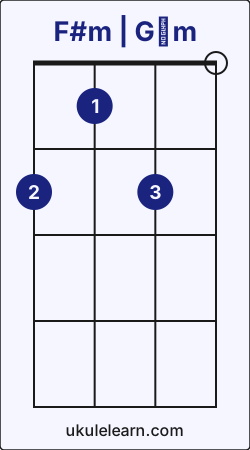 Ukulele F#m | G♭m chord diagram
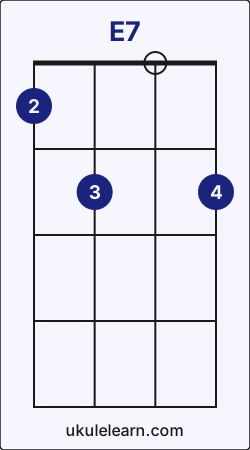 Ukulele E7 chord diagram
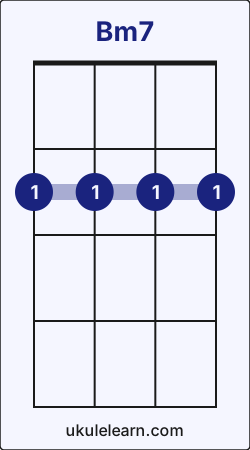 Ukulele Bm7 chord diagram
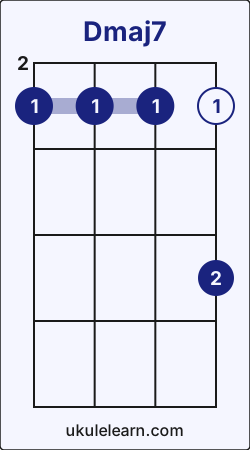 Ukulele Dmaj7 chord diagram
[intro]
[A] [Asus4]
[A] [Asus4]
[Opening]
It’s not [A]time to make a [Em]change just re[D]lax take it [Bm]easy
You’re still [A]young that’s your [F#m]fault
There’s so [Bm]much you have to [E7]know
Find a [A]girl settle [Em]down if you [D]want you can [Bm]marry
Look at [A]me I am [F#m]old but I’m [Bm]happy [E7]
[section 2]
I was [A]once like you are [Em]now
And I [D]know that it’s not [Bm7]easy
To be [A]calm when you’ve [F#m]found something going [Bm]on [E7]
But take your [A]time think a [Em]lot
Why think of [D]everything you’ve [Bm7]got
For you will [A]still be here to[F#m]morrow
But your [D]dreams may [A]not [Asus4] [A] [Asus4]
[section 3]
How can [A]I try to ex[Em]plain
When I [D]do he turns a[Bm7]way again
It’s [A]always been the [F#m]same same old [Bm]story [E7]
From the [A]moment I could [Em]talk
I was [D]ordered to [Bm7]listen now
There’s a [A]way and I [F#m]know that I [D]have to go a[A]way
I [E7]know I [D]have to [A]go [Asus4] [A] [Asus4]
[section 4]
It’s not [A]time to make a [Em]change
Just sit [Dmaj7]down take it [Bm7]slowly
You’re still [A]young that’s your [F#m]fault
There’s so [Bm]much you have to go [E7]through
Find a [A]girl settle [Em]down if you [D]want you can [Bm7]marry
Look at [A]me I am [F#m]old but I’m [Bm]happy [E7]
[Closing]
All the [A]times that I [Em]cried
Keeping [D]all the things I [Bm7]knew inside
It’s [A]hard but it’s [F#m]harder to ig[Bm]nore it [E7]
If they were [A]right I’d a[Em]gree
But it’s [D]them they know not [Bm7]me now
There’s a [A]way and I [F#m]know
That I [D]have to go a[A]way I [E7]know I [D]have to [A]go
How to play Father and Son on Ukulele (Step-by-step)
Cat Stevens - Father and Son on ukulele requires 9 chords and 16 core chord transitions. You can find the full step-by-step guide below. Before you start, tune your instrument. The song uses the ↓-↓↑-↑↓↑ pattern; practice it muted first, or simplify to downstrokes while you learn the changes.
Father and Son uses these transitions most often: A → Em (10), A → F#m (10), and Em → D (9). These transitions may feel a little challenging at first, but with steady practice you can play this song quickly.When you are ready, begin with A - Asus4 chord transition.
1. A → Asus4 chord transition
To move from A to Asus4;
- While playing A, lift your index finger from C string fret 1.
- Keep middle finger on G string fret 2.
- Place ring finger on C string fret 2.
2. A → Em chord transition
To move from A to Em;
- Lift your index finger from C string fret 1 and place it on A string fret 2.
- Slide your middle finger from G string fret 2 to E string fret 3.
- Place ring finger on C string fret 4.
3. Em → D chord transition
To move from Em to D;
- Lift your index finger from A string fret 2 and place it on G string fret 2.
- Slide your middle finger from E string fret 3 to C string fret 2.
- Lift your ring finger from C string fret 4 and place it on E string fret 2.
4. D → Bm chord transition
To move from D to Bm;
- While playing D, lift your middle finger from C string fret 2.
- Lift your index finger from G string fret 2 and place it on C string fret 2.
- Slide your ring finger from E string fret 2 to G string fret 4.
5. Bm → A chord transition
To move from Bm to A;
- While playing Bm, lift your ring finger from G string fret 4.
- Slide your index finger on C string from fret 2 to fret 1.
- Place middle finger on G string fret 2.
6. A → F#m chord transition
To move from A to F#m;
- Keep index finger on C string fret 1.
- Keep middle finger on G string fret 2.
- Place ring finger on E string fret 2.
7. F#m → Bm chord transition
To move from F#m to Bm;
- While playing F#m, lift your middle finger from G string fret 2.
- Slide your index finger on C string from fret 1 to fret 2.
- Slide your ring finger from E string fret 2 to G string fret 4.
8. Bm → E7 chord transition
To move from Bm to E7;
- Lift your index finger from C string fret 2 and place it on G string fret 1.
- Slide your ring finger from G string fret 4 to A string fret 2.
- Place middle finger on C string fret 2.
9. E7 → A chord transition
To move from E7 to A;
- While playing E7, lift your ring finger from A string fret 2.
- Lift your index finger from G string fret 1 and place it on C string fret 1.
- Slide your middle finger from C string fret 2 to G string fret 2.
10. D → Bm7 chord transition
To move from D to Bm7;
- While playing D, first lift your middle finger and ring finger.
- Keep index finger on G string fret 2.
11. Bm7 → A chord transition
To move from Bm7 to A;
- Lift your index finger from G string fret 2 and place it on C string fret 1.
- Place middle finger on G string fret 2.
12. F#m → D chord transition
To move from F#m to D;
- Lift your index finger from C string fret 1 and place it on G string fret 2.
- Slide your middle finger from G string fret 2 to C string fret 2.
- Keep ring finger on E string fret 2.
13. D → A chord transition
To move from D to A;
- While playing D, lift your ring finger from E string fret 2.
- Lift your index finger from G string fret 2 and place it on C string fret 1.
- Slide your middle finger from C string fret 2 to G string fret 2.
14. E7 → D chord transition
To move from E7 to D;
- Slide your index finger on G string from fret 1 to fret 2.
- Keep middle finger on C string fret 2.
- Slide your ring finger from A string fret 2 to E string fret 2.
15. Em → Dmaj7 chord transition
To move from Em to Dmaj7;
- While playing Em, lift your middle finger from E string fret 3.
- Lift your index finger from A string fret 2 and place it on G string fret 2.
- Slide your ring finger from C string fret 4 to A string fret 4.
16. Dmaj7 → Bm7 chord transition
To move from Dmaj7 to Bm7;
- While playing Dmaj7, lift your ring finger from A string fret 4.
- Keep index finger on G string fret 2.
Father and Son chord transition analysis
A short, data-driven summary of the chord flow in Father and Son.
- Father and Son includes 95 chord transitions, 16 of them unique.
- These transitions represent 0.03% of all chord transitions in Ukulelearn.
- Father and Son contains 2 of the top 10 transitions across Ukulelearn.
- These transition patterns show how Father and Son connects to the rest of Ukulelearn. Mastering them helps you move to similar songs faster.After A, the most likely next chords across Ukulelearn are D (29%), G (13%), and E (12%).
- A → Em: 7%
- A → F#m: 6%
After D, the most likely next chords across Ukulelearn are G (29%), A (17%), and Em (17%).- D → A: 17%
- D → Bm: 5%