
Fred Astaire & Ginger Rogers - A Fine Romance Ukulele Chords
Before you play, tune your ukulele and use the tools below to set up your view and flow.
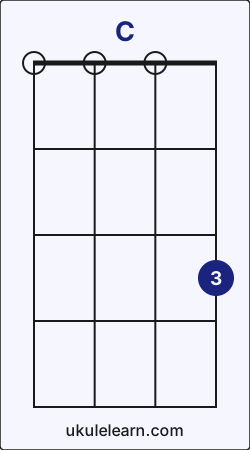 Ukulele C chord diagram
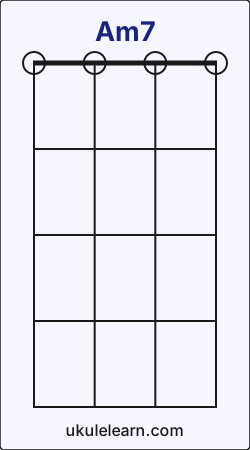 Ukulele Am7 chord diagram
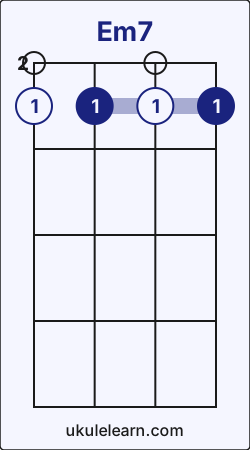 Ukulele Em7 chord diagram
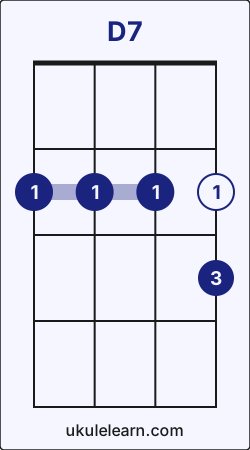 Ukulele D7 chord diagram
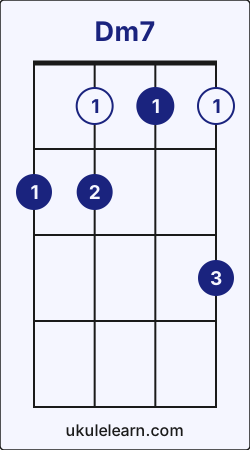 Ukulele Dm7 chord diagram
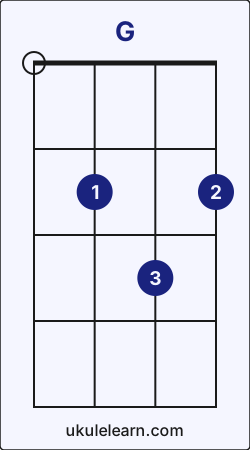 Ukulele G chord diagram
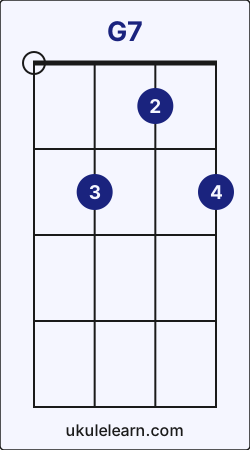 Ukulele G7 chord diagram
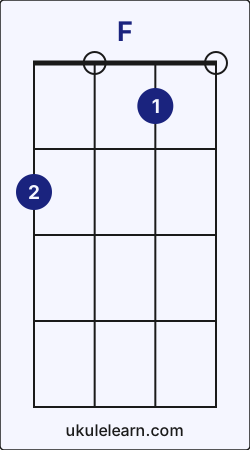 Ukulele F chord diagram
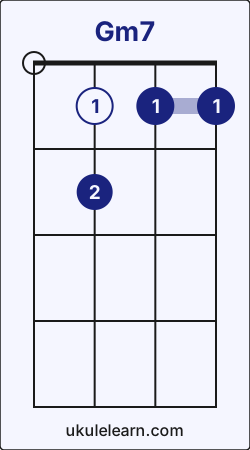 Ukulele Gm7 chord diagram
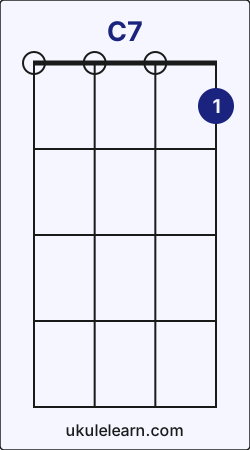 Ukulele C7 chord diagram
[Opening]
[C]A fine [Am7]romance, with [Em7]no [D7]kisses
[Em7]a fine [Am7]romance, my [Dm7]friend [G]this is
We [C]should be like a [Em7]couple of [D7]hot to[Dm7]matoes [G7]
But [C]you’re as cold as [D7]yesterday’s mashed [F]potatoes [G]
[section 2]
A [C]fine [Am7]romance, [Em7]you won’t [D7]nestle ,
A [Em7]fine [Am7]romance, you [Dm7]won’t [G]wrestle
I [C]might as well play [Gm7]bridge with [C7]my old maid [F]aunt
[D7]I haven’t got a [Em7]chance
[Dm7]This is a [G7]fine ro[C]mance [Dm7] [G7]
[section 3]
[C]A fine [Am7]romance, [Em7]my good [D7]fellow
[Em7]You take [Am7]romance, [Dm7]I’ll take [G]jello
You’re [C]calmer than the [Em7]seals in the [D7]Arctic [Dm7]Ocean [G7]
At [C]least they flap their [D7]fins to ex[F]press e[Dm7]motion [G]
[section 4]
[C]A fine [Am7]romance with [Em7]no [D7]quarrels,
[Em7]With no [Am7]insults and [Dm7]all [G]morals
[C]I’ve never mussed the [Gm7]crease in your [C7]blue serge [F]pants
[D7]I never get the [Em7]chance
[Dm7]This is a [G7]fine ro[C]mance [Dm7] [G7]
[section 5]
[C]A fine [Am7]romance, with [Em7]no [D7]kisses
[Em7]a fine [Am7]romance, my [Dm7]friend [G]this is
We [C]should be like [Em7]clams in a [D7]dish of [Dm7]chowder [G7]
But [C]we just fizz like [D7]parts of Seidlitz [F]powder [G]
[section 6]
A [C]fine [Am7]romance, [Em7]with no [D7]clinches,
A [Em7]fine [Am7]romance, with [Dm7]no [G]pinches
You’re [C]just as hard to [Gm7]land as the [C7]Ile de [F]France!
[D7]I haven’t got a [Em7]chance
[Dm7]This is a [G7]fine ro[C]mance [Dm7] [G7]
[section 7]
[C]A fine [Am7]romance, with [Em7]no [D7]kisses
[Em7]a fine [Am7]romance, my [Dm7]friend [G]this is
True [C]love should have the [Em7]thrills that a [D7]healthy [Dm7]mind has [G]
We [C]don’t have half the [D7]thrills that the march of [F]time has [G7]
[Closing]
A [C]fine [Am7]romance, [Em7]with no [D7]clinches ,
A [Em7]fine [Am7]romance, with [Dm7]no [G]pinches
[C]You never give the [Gm7]orchids I [C7]sent a [F]glance
[D7]No! You like cac[Em7]us plants
[Dm7]this is a [G7]fine ro[C]mance [Dm7] [G7] [C]
How to play A Fine Romance on Ukulele (Step-by-step)
Fred Astaire & Ginger Rogers - A Fine Romance on ukulele requires 10 chords and 20 core chord transitions. You can find the full step-by-step guide below. Before you start, tune your instrument. The song uses the ↓-↓↑ pattern; practice it muted first, or simplify to downstrokes while you learn the changes.
A Fine Romance uses these transitions most often: D7 → Em7 (12), Em7 → D7 (12), and G → C (12). These transitions may feel a little challenging at first, but with steady practice you can play this song quickly.When you are ready, begin with C - Am7 chord transition.
1. C → Am7 chord transition
To move from C to Am7;
- While playing C, lift your ring finger from A string fret 3.
2. Am7 → Em7 chord transition
To move from Am7 to Em7;
- Place index finger on C string fret 2.
- Place middle finger on A string fret 2.
3. Em7 → D7 chord transition
To move from Em7 to D7;
- While playing Em7, lift your middle finger from A string fret 2.
- Lift your index finger from C string fret 2 and place it on G string fret 2.
- Place ring finger on A string fret 3.
4. Am7 → Dm7 chord transition
To move from Am7 to Dm7;
- Place index finger on E string fret 1.
- Place middle finger on G string fret 2.
- Place ring finger on A string fret 3.
5. Dm7 → G chord transition
To move from Dm7 to G;
- Lift your index finger from E string fret 1 and place it on C string fret 2.
- Slide your middle finger from G string fret 2 to A string fret 2.
- Lift your ring finger from A string fret 3 and place it on E string fret 3.
6. G → C chord transition
To move from G to C;
- While playing G, first lift your index finger and middle finger.
- Lift your ring finger from E string fret 3 and place it on A string fret 3.
7. C → Em7 chord transition
To move from C to Em7;
- While playing C, lift your ring finger from A string fret 3.
- Place index finger on C string fret 2.
- Place middle finger on A string fret 2.
8. D7 → Dm7 chord transition
To move from D7 to Dm7;
- Lift your index finger from G string fret 2 and place it on E string fret 1.
- Keep ring finger on A string fret 3.
- Place middle finger on G string fret 2.
9. Dm7 → G7 chord transition
To move from Dm7 to G7;
- Keep index finger on E string fret 1.
- Lift your middle finger from G string fret 2 and place it on C string fret 2.
- Slide your ring finger on A string from fret 3 to fret 2.
10. G7 → C chord transition
To move from G7 to C;
- While playing G7, first lift your index finger and middle finger.
- Slide your ring finger on A string from fret 2 to fret 3.
11. C → D7 chord transition
To move from C to D7;
- Keep ring finger on A string fret 3.
- Place index finger on G string fret 2.
12. D7 → F chord transition
To move from D7 to F;
- While playing D7, lift your ring finger from A string fret 3.
- Lift your index finger from G string fret 2 and place it on E string fret 1.
- Place middle finger on G string fret 2.
13. F → G chord transition
To move from F to G;
- Lift your index finger from E string fret 1 and place it on C string fret 2.
- Slide your middle finger from G string fret 2 to A string fret 2.
- Place ring finger on E string fret 3.
14. C → Gm7 chord transition
To move from C to Gm7;
- While playing C, lift your ring finger from A string fret 3.
- Place index finger on E string fret 1.
- Place middle finger on C string fret 2.
15. Gm7 → C7 chord transition
To move from Gm7 to C7;
- While playing Gm7, lift your middle finger from C string fret 2.
- Lift your index finger from E string fret 1 and place it on A string fret 1.
16. C7 → F chord transition
To move from C7 to F;
- Lift your index finger from A string fret 1 and place it on E string fret 1.
- Place middle finger on G string fret 2.
17. Em7 → Dm7 chord transition
To move from Em7 to Dm7;
- Lift your index finger from C string fret 2 and place it on E string fret 1.
- Slide your middle finger from A string fret 2 to G string fret 2.
- Place ring finger on A string fret 3.
18. C → Dm7 chord transition
To move from C to Dm7;
- Keep ring finger on A string fret 3.
- Place index finger on E string fret 1.
- Place middle finger on G string fret 2.
19. F → Dm7 chord transition
To move from F to Dm7;
- Keep index finger on E string fret 1.
- Keep middle finger on G string fret 2.
- Place ring finger on A string fret 3.
20. F → G7 chord transition
To move from F to G7;
- Keep index finger on E string fret 1.
- Lift your middle finger from G string fret 2 and place it on C string fret 2.
- Place ring finger on A string fret 2.
A Fine Romance chord transition analysis
A short, data-driven summary of the chord flow in A Fine Romance.
- A Fine Romance includes 145 chord transitions, 20 of them unique.
- These transitions represent 0.04% of all chord transitions in Ukulelearn.
- A Fine Romance contains 2 of the top 10 transitions across Ukulelearn.
- These transition patterns show how A Fine Romance connects to the rest of Ukulelearn. Mastering them helps you move to similar songs faster.After C, the most likely next chords across Ukulelearn are G (35%), F (16%), and D (11%).
- C → D7: 1%
- C → Am7: 0%
After Em7, the most likely next chords across Ukulelearn are C (17%), D (15%), and A7 (13%).- Em7 → Am7: 5%
- Em7 → Dm7: 2%