
Green Day - Forever Now Ukulele Chords
Before you play, tune your ukulele and use the tools below to set up your view and flow.
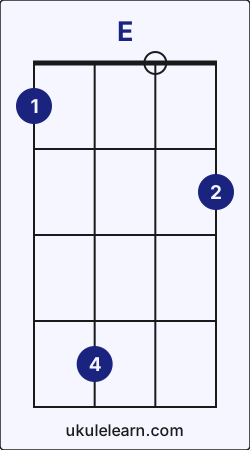 Ukulele E chord diagram
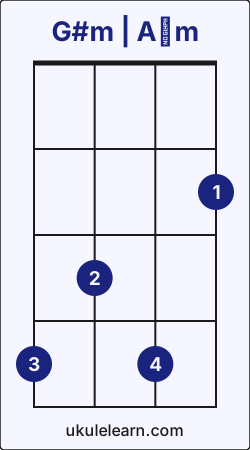 Ukulele G#m | A♭m chord diagram
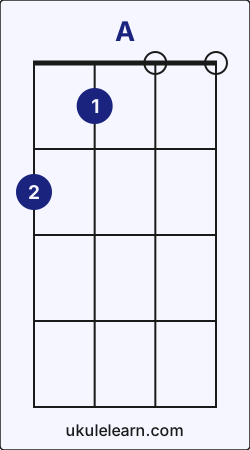 Ukulele A chord diagram
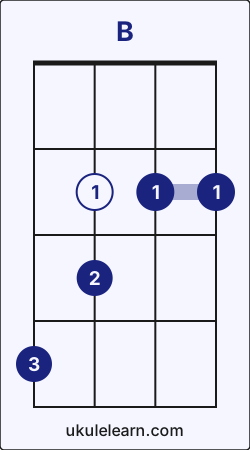 Ukulele B chord diagram
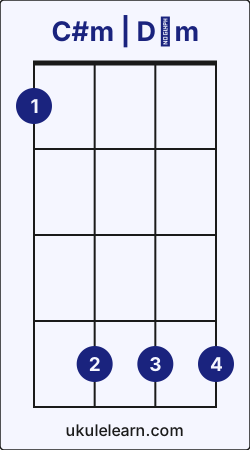 Ukulele C#m | D♭m chord diagram
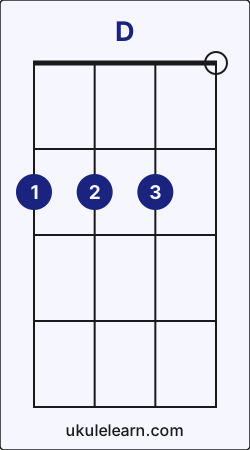 Ukulele D chord diagram
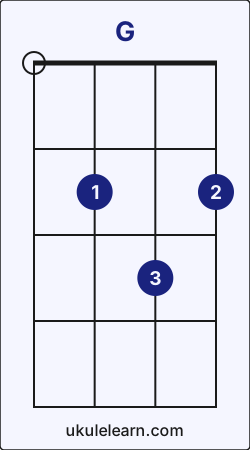 Ukulele G chord diagram
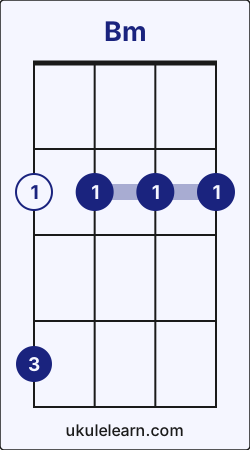 Ukulele Bm chord diagram
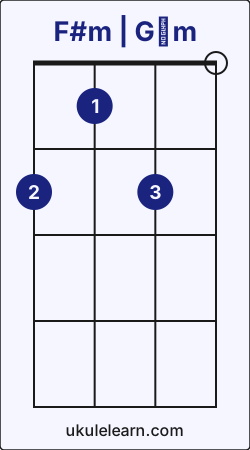 Ukulele F#m | G♭m chord diagram
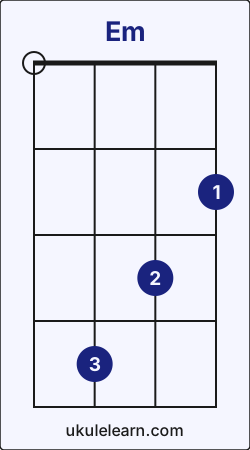 Ukulele Em chord diagram
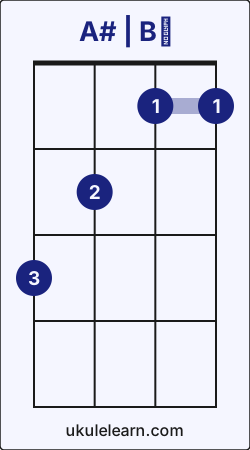 Ukulele A# | B♭ chord diagram
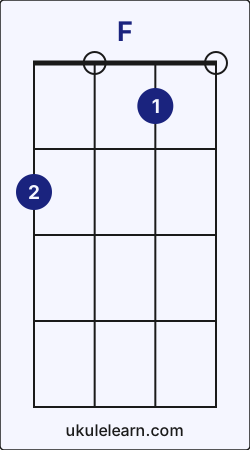 Ukulele F chord diagram
[Opening]
[E]My name is Billie, And I’m freaking out
[E]I thought [G#m]before I was
And I [A]can’t get it figured [B]out [E] [B]
[E]I sit [A]alone with my [E]thoughts and prayers
[E]Screaming my [G#m]memories
As [A]if I was never [B]there [E] [B]
[chorus]
[C#m]Standing at the [E]edge of the world [B]
[C#m]Its giving me the [E]chills [B]
[C#m]Looking down the [E]edge of the world [B]
[A]Lost in a [B]tangle, it’s [E]freaking me [A]out
[A]Burning [B]lights and [E]Blackouts [B] [A]
[B]From the edge of the world [E] [B] [A]
[B]From the edge of the world
[section 2]
[E]I’m like a punk rocker on labor day
[E]How the hell did I [G#m]work so hard
[A]To be born this [B]way? [E] [B]
[E]I never [A]learned to read or [E]write so well
[E]But I can [G#m]play the guitar
[A]Until it hurts like [B]hell [E] [B]
[chorus]
[C#m]Standing at the [E]edge of the world [B]
[C#m]Its giving me the [E]chills [B]
[C#m]Looking down the [E]edge of the world [B]
[A]Lost in a [B]tangle, it’s [E]freaking me [A]out
[A]Burning [B]lights and [E]Blackouts [B] [A]
[B]From the edge of the world [E] [B] [A]
[B]From the edge of the world
[section 3]
[D] [A] [G] [A] [D] [A] [G] [A]
[D] [A] [G] [A] [D] [A] [G] [A]
[D] [A] [Bm]
[Bm]If this is [G]what you call the [D]good life [A]
[Bm]I want a [G]better way to [D]die [A]
[Bm]If this is [G]what you call the [D]good life [A]
[Bm]I want a [G]better way to [D]die
[section 4]
[D] [F#m] [Em] [G] [Bm] [A]
[D] [F#m] [Em] [G] [Bm] [A]
Oh, [D]I [F#m] [Em] [G]don’t [Bm]wanna think [A]about [D]tomorrow[F#m][Em] [G]
Don’t [Bm]wanna [A]think about this [D]road[F#m] [Em] [G]
It [Bm]doesn’t [A]matter any[D]way [F#m] [Em] [G] [Bm] [A]
Oh [D]I, [F#m] [Em] [G]I [Bm]wanna [A]start a [D]revolution [F#m] [Em] [G]
I [Bm]wanna [A]hear it on my [D]radio [F#m] [Em] [G]
I’ll put it [Bm]off [A]another [D]day [F#m] [Em] [G] [Bm] [A]
[G]I want a new [A]conspiracy
And the [D]silence of a thousand [G]cries [A]
[G]So hurry up, I [A]want a better way to [D]die.
[section 5]
[D] [F#m] [Em] [G] [Bm] [A]
[D] [F#m] [Em] [G] [Bm] [A]
[D]
[D] [D] [D] [A] [A]
[D]I’m running late to [D]somewhere now,
[D]I don’t want to [A] [G]be. [Bm] [G]
[D]Where the future and [D]promises,
[D]Ain’t what it used to [A] [G]be. [Bb] [G]
[D]I never wanted to [D]compromise,
Or [D]bargain with my [A]soul. [G] [Bb] [G]
[D]How did life on the [D]wild side,
[D]Ever get so [A]full.
[Closing]
[D] [G] [A] [D] [G] [A]
[D] [G] [A] [D] [G] [A]
Somewhere [D]now [G]
Don’t wanna [A]think about [D]tomorrow [G]
Don’t wanna [A]think about the [D]road [G]
It doesn’t [A]matter [D]anyway [G] [A]
Oh [D] [G]I, I wanna [A]start a [D]revolution [G]
I wanna [A]hear it on my [D]radio [G]
I’ll put it [A]off another [D]day [G] [A]
Oh [D]I, [G] [D]don’t wanna [A]think about [D]to[G]morrow!
[D]Don’t wanna [A]think about the [D]road [G]
[D]It doesn’t [A]matter [D]anyway [G] [D] [A]
Oh [D] [G]I, [D]I want to [A]start a [D]revolution [G]
[D]I want to [A]hear my on the [D]radio [G]
[D]And put it [A]off another [D]day [G] [D] [A]
[outro]
[D] [G] [Bb]
[D] [G] [Bb] [D] [F] [A]
[outro]
[D] [F#m] [Em] [G] [Bm] [A]
[D] [D] [D] [A] [A]
[D]
How to play Forever Now on Ukulele (Step-by-step)
Green Day - Forever Now on ukulele requires 12 chords and 20 core chord transitions. You can find the full step-by-step guide below. Before you start, tune your instrument. The song uses the ↓-↓↑-↓↑-↓↑ pattern; practice it muted first, or simplify to downstrokes while you learn the changes.
Forever Now uses these transitions most often: A → D (42), D → G (23), and D → A (22). These transitions may feel a little challenging at first, but with steady practice you can play this song quickly.When you are ready, begin with E - G#m chord transition.
1. E → G#m chord transition
To move from E to G#m;
- Lift your index finger from G string fret 4 and place it on A string fret 2.
- Slide your middle finger from A string fret 2 to C string fret 3.
- Place ring finger on G string fret 4.
- Place pinky on E string fret 4.
2. G#m → A chord transition
To move from G#m to A;
- While playing G#m, first lift your ring finger and pinky.
- Lift your index finger from A string fret 2 and place it on C string fret 1.
- Slide your middle finger from C string fret 3 to G string fret 2.
3. A → B chord transition
To move from A to B;
- Lift your index finger from C string fret 1 and place it on E string fret 2.
- Slide your middle finger from G string fret 2 to C string fret 3.
- Place ring finger on G string fret 4.
4. B → E chord transition
To move from B to E;
- While playing B, lift your ring finger from G string fret 4.
- Lift your index finger from E string fret 2 and place it on G string fret 4.
- Slide your middle finger from C string fret 3 to A string fret 2.
5. E → A chord transition
To move from E to A;
- Lift your index finger from G string fret 4 and place it on C string fret 1.
- Slide your middle finger from A string fret 2 to G string fret 2.
6. B → C#m chord transition
To move from B to C#m;
- Lift your index finger from E string fret 2 and place it on G string fret 1.
- Slide your middle finger on C string from fret 3 to fret 4.
- Lift your ring finger from G string fret 4 and place it on E string fret 4.
- Place pinky on A string fret 4.
7. C#m → E chord transition
To move from C#m to E;
- While playing C#m, first lift your ring finger and pinky.
- Slide your index finger on G string from fret 1 to fret 4.
- Slide your middle finger from C string fret 4 to A string fret 2.
8. B → D chord transition
To move from B to D;
- Lift your index finger from E string fret 2 and place it on G string fret 2.
- Slide your middle finger on C string from fret 3 to fret 2.
- Lift your ring finger from G string fret 4 and place it on E string fret 2.
9. D → A chord transition
To move from D to A;
- While playing D, lift your ring finger from E string fret 2.
- Lift your index finger from G string fret 2 and place it on C string fret 1.
- Slide your middle finger from C string fret 2 to G string fret 2.
10. A → G chord transition
To move from A to G;
- Slide your index finger on C string from fret 1 to fret 2.
- Slide your middle finger from G string fret 2 to A string fret 2.
- Place ring finger on E string fret 3.
11. A → Bm chord transition
To move from A to Bm;
- While playing A, lift your middle finger from G string fret 2.
- Slide your index finger on C string from fret 1 to fret 2.
- Place ring finger on G string fret 4.
12. Bm → G chord transition
To move from Bm to G;
- Keep index finger on C string fret 2.
- Lift your ring finger from G string fret 4 and place it on E string fret 3.
- Place middle finger on A string fret 2.
13. G → D chord transition
To move from G to D;
- Lift your index finger from C string fret 2 and place it on G string fret 2.
- Slide your middle finger from A string fret 2 to C string fret 2.
- Slide your ring finger on E string from fret 3 to fret 2.
14. D → F#m chord transition
To move from D to F#m;
- Lift your index finger from G string fret 2 and place it on C string fret 1.
- Slide your middle finger from C string fret 2 to G string fret 2.
- Keep ring finger on E string fret 2.
15. F#m → Em chord transition
To move from F#m to Em;
- Lift your index finger from C string fret 1 and place it on A string fret 2.
- Slide your middle finger from G string fret 2 to E string fret 3.
- Lift your ring finger from E string fret 2 and place it on C string fret 4.
16. Em → G chord transition
To move from Em to G;
- Lift your index finger from A string fret 2 and place it on C string fret 2.
- Slide your middle finger from E string fret 3 to A string fret 2.
- Lift your ring finger from C string fret 4 and place it on E string fret 3.
17. G → Bb chord transition
To move from G to Bb;
- Lift your index finger from C string fret 2 and place it on E string fret 1.
- Slide your middle finger from A string fret 2 to C string fret 2.
- Lift your ring finger from E string fret 3 and place it on G string fret 3.
18. Bb → D chord transition
To move from Bb to D;
- Lift your index finger from E string fret 1 and place it on G string fret 2.
- Keep middle finger on C string fret 2.
- Slide your ring finger from G string fret 3 to E string fret 2.
19. D → F chord transition
To move from D to F;
- While playing D, lift your ring finger from E string fret 2.
- Lift your index finger from G string fret 2 and place it on E string fret 1.
- Slide your middle finger from C string fret 2 to G string fret 2.
20. F → A chord transition
To move from F to A;
- Lift your index finger from E string fret 1 and place it on C string fret 1.
- Keep middle finger on G string fret 2.
Forever Now chord transition analysis
A short, data-driven summary of the chord flow in Forever Now.
- Forever Now includes 287 chord transitions, 20 of them unique.
- These transitions represent 0.08% of all chord transitions in Ukulelearn.
- Forever Now contains 2 of the top 10 transitions across Ukulelearn.
- These transition patterns show how Forever Now connects to the rest of Ukulelearn. Mastering them helps you move to similar songs faster.After D, the most likely next chords across Ukulelearn are G (29%), A (17%), and Em (17%).
- D → G: 29%
- D → A: 17%
After A, the most likely next chords across Ukulelearn are D (29%), G (13%), and E (12%).- A → D: 29%
- A → G: 13%