
Olivia Rodrigo - Good 4 You Ukulele Chords
Before you play, tune your ukulele and use the tools below to set up your view and flow. Using the Transpose tool, switch to C,F,G,A# keys to play this song with easier chords.
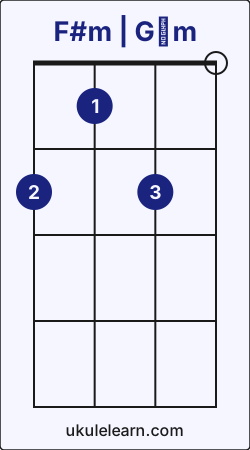 Ukulele F#m | G♭m chord diagram
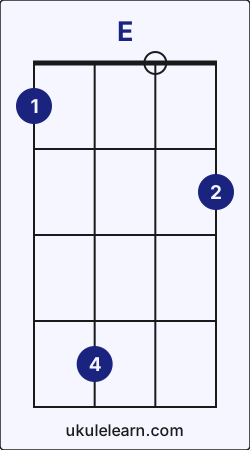 Ukulele E chord diagram
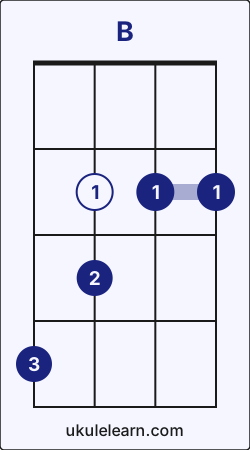 Ukulele B chord diagram
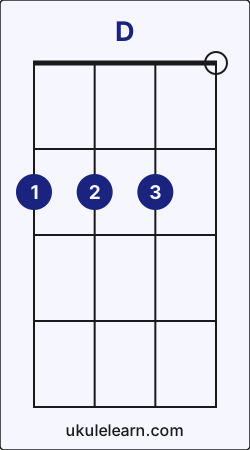 Ukulele D chord diagram
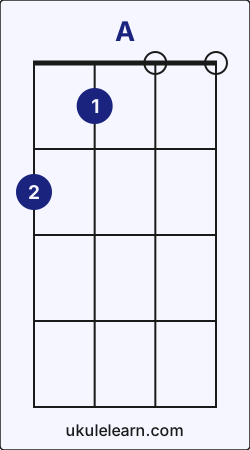 Ukulele A chord diagram
[Opening]
Well, good for you, I guess you moved on really easily
You found a new girl and it only took a couple weeks
Remember when you said that you wanted to give me the world?
(Ah-ah-ah-ah)
[section 2]
[F#m]And good for you, I guess that [E]you’ve been working on yourself
[F#m]I guess that therapist I [E]found for you, she really helped
[F#m]Now you can be a better [E]man for your brand new [B]girl
[chorus]
[D]Well, good for [A]you, you look happy and [E]healthy
Not me, if you ever [E]cared [F#m]to [D]ask
Good for [A]you, you’re doing great out there [E]without me
Baby, God, I wish that [E]I [F#m]could do [D]that
I’ve lost my [A]mind, I’ve spent the [E]night crying on the [E]floor [F#m]of my [D]bathroom
But you’re so [A]unaffected, I really don’t [E]get it
But I guess [E]good for you
[section 3]
[F#m] [E] [B]
Well, good for you, I guess you’re getting everything you want
You bought a new car and your career’s really taking off
It’s like we never even happened
[section 4]
Baby, what the fuck is up with that? (Huh?)
[F#m]And good for you, it’s like you [E]never even met me
[F#m]Remember when you swore to [E]God I was the only [F#m]person who ever got you?
Well, [E]screw that, and screw you
[B]You will never have to hurt the way you know that I do
[chorus]
[D]Well, good for [A]you, you look happy and [E]healthy
Not me, if you ever [E]cared [F#m]to [D]ask
Good for [A]you, you’re doing great out there [E]without me
Baby, God, I wish that [E]I [F#m]could do [D]that
I’ve lost my [A]mind, I’ve spent the [E]night crying on the [E]floor [F#m]of my [D]bathroom
But you’re so [A]unaffected, I really don’t [E]get it
But I guess [E]good for you
[section 5]
[F#m] [E] [B]
[D]Ah[A]-a[E]h-[E]ah[F#m]-ah [D]
[D]Ah[A]-a[E]h-[E]ah[F#m]-ah
[section 6]
[F#m]Maybe I’m too [E]e[B]motional
[F#m]But your [E]apathy’s [B]like a wound in salt
[F#m]Maybe I’m too [E]e[B]motional
[F#m]Or maybe you [E]never [B]cared at all
[F#m]Maybe I’m too [E]e[B]motional
Your [F#m]apathy is like a [E]wound in [B]salt
[F#m]Maybe I’m too [E]e[B]motional
Or ma[F#m]ybe you never car[E]ed at a[B]ll
[section 7]
[D]Well, good for [A]you, you look happy and [E]healthy
Not me, if you ever [E]cared [F#m]to [D]ask
Good for [A]you, you’re doing great out there [E]without me
[E]Baby, like a damn sociopath
[E]I’ve lost my m[A]ind, I’ve spent the
[E]Night crying on the [E]floor of[F#m]my [D]bathroom
But you’re so [A]unaffected, I really don’t [E]get it
But I guess [E]good for you
[Closing]
[F#m] [E] [B]
[F#m]Well, good for you, I guess [E]you moved on really [B]easily [F#m]
How to play Good 4 You on Ukulele (Step-by-step)
Olivia Rodrigo - Good 4 You on ukulele requires 5 chords and 7 core chord transitions. You can find the full step-by-step guide below. Before you start, tune your instrument. The song uses the ↓-↓↑-↑↓↑ pattern; practice it muted first, or simplify to downstrokes while you learn the changes.
Good 4 You uses these transitions most often: F#m → E (18), E → F#m (17), and A → E (14). These transitions may feel a little challenging at first, but with steady practice you can play this song quickly.When you are ready, begin with F#m - E chord transition.
1. F#m → E chord transition
To move from F#m to E;
- While playing F#m, lift your ring finger from E string fret 2.
- Lift your index finger from C string fret 1 and place it on G string fret 4.
- Slide your middle finger from G string fret 2 to A string fret 2.
2. E → B chord transition
To move from E to B;
- Lift your index finger from G string fret 4 and place it on E string fret 2.
- Slide your middle finger from A string fret 2 to C string fret 3.
- Place ring finger on G string fret 4.
3. B → D chord transition
To move from B to D;
- Lift your index finger from E string fret 2 and place it on G string fret 2.
- Slide your middle finger on C string from fret 3 to fret 2.
- Lift your ring finger from G string fret 4 and place it on E string fret 2.
4. D → A chord transition
To move from D to A;
- While playing D, lift your ring finger from E string fret 2.
- Lift your index finger from G string fret 2 and place it on C string fret 1.
- Slide your middle finger from C string fret 2 to G string fret 2.
5. A → E chord transition
To move from A to E;
- Lift your index finger from C string fret 1 and place it on G string fret 4.
- Slide your middle finger from G string fret 2 to A string fret 2.
6. F#m → D chord transition
To move from F#m to D;
- Lift your index finger from C string fret 1 and place it on G string fret 2.
- Slide your middle finger from G string fret 2 to C string fret 2.
- Keep ring finger on E string fret 2.
7. B → F#m chord transition
To move from B to F#m;
- Lift your index finger from E string fret 2 and place it on C string fret 1.
- Slide your middle finger from C string fret 3 to G string fret 2.
- Lift your ring finger from G string fret 4 and place it on E string fret 2.
Good 4 You chord transition analysis
A short, data-driven summary of the chord flow in Good 4 You.
- Good 4 You includes 100 chord transitions, 7 of them unique.
- These transitions represent 0.03% of all chord transitions in Ukulelearn.
- Good 4 You contains 1 of the top 10 transitions across Ukulelearn.
- These transition patterns show how Good 4 You connects to the rest of Ukulelearn. Mastering them helps you move to similar songs faster.After E, the most likely next chords across Ukulelearn are A (25%), D (14%), and B (11%).
- E → A: 25%
- E → B: 11%
After F#m, the most likely next chords across Ukulelearn are D (22%), A (19%), and E (14%).- F#m → D: 22%
- F#m → E: 14%