
Bon Jovi - I’ll Be There For You Ukulele Chords
Before you play, tune your ukulele and use the tools below to set up your view and flow.
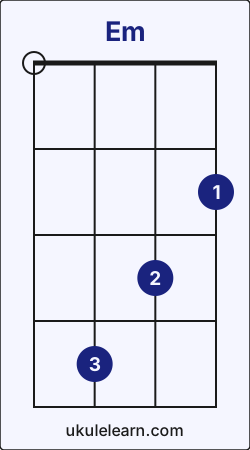 Ukulele Em chord diagram
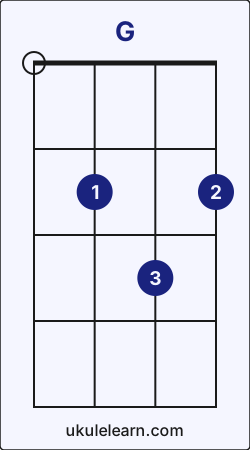 Ukulele G chord diagram
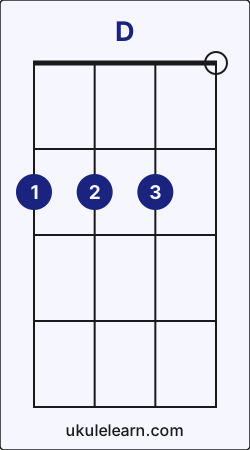 Ukulele D chord diagram
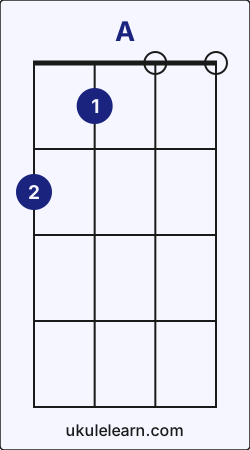 Ukulele A chord diagram
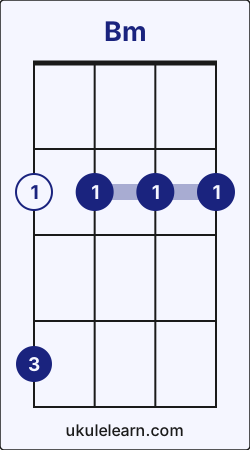 Ukulele Bm chord diagram
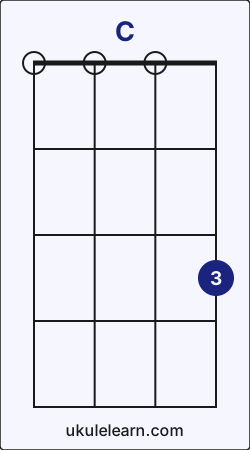 Ukulele C chord diagram
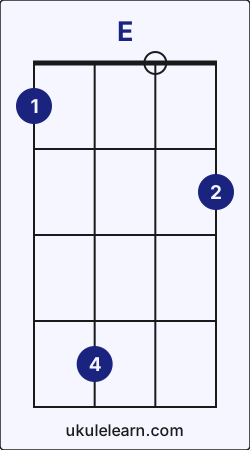 Ukulele E chord diagram
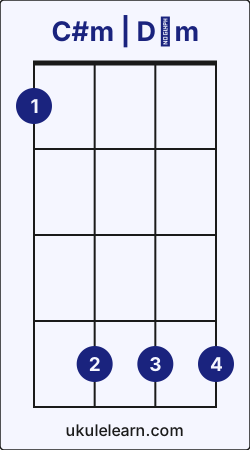 Ukulele C#m | D♭m chord diagram
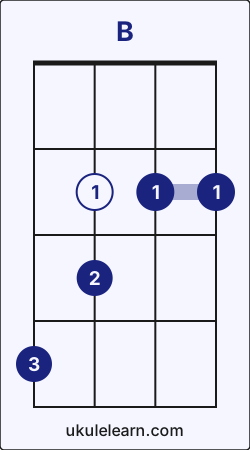 Ukulele B chord diagram
[Opening]
I guess this time you’re [Em]really leaving, [G]I heard your suitcase say [D]goodbye
Well as my broken heart lies [Em]bleeding, [G]you say true love, it’s [D]suicide
You say you cried a thousand [Em]rivers, [G]and now you’re swimming [D]for the shore
You left me drowning in my [Em]tears, [G]and you won’t save me [A]anymore
[A]I pray to God you’ll give me one more chance, girl
[chorus]
[D]I’ll be there for you , [D] [Bm]these five words I swear to you
When you [G]breathe I want to be the air for you, [A]I’ll be [C]there [G]for [D]you
I’d live and I’d die for you, [D] [Bm]steal the sun from the sky for you
[G]Words can’t say what a love can do, [A]I’ll be [C]there [G]for [D]you
[section 2]
I know you know, we’ve had some [Em]good times, [G]now they have their own [D]hiding place
I can’t promise you [Em]tomorrow, [G]but I can’t buy back [A]yesterday
And baby you know my hands are [G]dirty (oh woman you know my hands are [A]dirty)
But I wanted to be your [D]valentine, [Bm]I’ll be the water when [G]you get thirsty baby
When you get drunk I’ll be [A]the wine
[chorus]
[D]I’ll be there for you , [D] [Bm]these five words I swear to you
When you [G]breathe I want to be the air for you, [A]I’ll be [C]there [G]for [D]you
I’d live and I’d die for you, [D] [Bm]steal the sun from the sky for you
[G]Words can’t say what a love can do, [A]I’ll be [C]there [G]for [D]you
[section 3]
[D] [Bm] [G] [A] [D] [Bm] [G] [A]
[A]And I wasn’t there when you [G]were happy, (I wasn’t there to make you [A]happy)
I wasn’t there when you were [D]down, [Bm]I didn’t mean to miss your [G]birthday, baby
I wish I’d seen you blow those candles [A]out (Scream)
[chorus]
[D]I’ll be there for you , [D] [Bm]these five words I swear to you
When you [G]breathe I want to be the air for you, [A]I’ll be [C]there [G]for [D]you
I’d live and I’d die for you, [D] [Bm]steal the sun from the sky for you
[G]Words can’t say what a love can do, [A]I’ll be [C]there [G]for [D]you
[chorus]
[D]I’ll be there for you , [D] [Bm]these five words I swear to you
When you [G]breathe I want to be the air for you, [A]I’ll be [C]there [G]for [D]you
I’d live and I’d die for you, [D] [Bm]steal the sun from the sky for you
[G]Words can’t say what a love can do, [A]I’ll be [C]there [G]for [D]you
[Closing]
[E]Woooo, [C#m]woooo, [A]woo[B]ooo
[D]I’ll be [A]there for [E]you
How to play I'll Be There For You on Ukulele (Step-by-step)
Bon Jovi - I'll Be There For You on ukulele requires 9 chords and 15 core chord transitions. You can find the full step-by-step guide below. Before you start, tune your instrument. The song uses the ↓-↓↑-↑↓↑ pattern; practice it muted first, or simplify to downstrokes while you learn the changes.
I'll Be There For You uses these transitions most often: G → A (16), Bm → G (12), and D → Bm (12). These transitions may feel a little challenging at first, but with steady practice you can play this song quickly.When you are ready, begin with Em - G chord transition.
1. Em → G chord transition
To move from Em to G;
- Lift your index finger from A string fret 2 and place it on C string fret 2.
- Slide your middle finger from E string fret 3 to A string fret 2.
- Lift your ring finger from C string fret 4 and place it on E string fret 3.
2. G → D chord transition
To move from G to D;
- Lift your index finger from C string fret 2 and place it on G string fret 2.
- Slide your middle finger from A string fret 2 to C string fret 2.
- Slide your ring finger on E string from fret 3 to fret 2.
3. D → Em chord transition
To move from D to Em;
- Lift your index finger from G string fret 2 and place it on A string fret 2.
- Slide your middle finger from C string fret 2 to E string fret 3.
- Lift your ring finger from E string fret 2 and place it on C string fret 4.
4. G → A chord transition
To move from G to A;
- While playing G, lift your ring finger from E string fret 3.
- Slide your index finger on C string from fret 2 to fret 1.
- Slide your middle finger from A string fret 2 to G string fret 2.
5. A → D chord transition
To move from A to D;
- Lift your index finger from C string fret 1 and place it on G string fret 2.
- Slide your middle finger from G string fret 2 to C string fret 2.
- Place ring finger on E string fret 2.
6. D → Bm chord transition
To move from D to Bm;
- While playing D, lift your middle finger from C string fret 2.
- Lift your index finger from G string fret 2 and place it on C string fret 2.
- Slide your ring finger from E string fret 2 to G string fret 4.
7. Bm → G chord transition
To move from Bm to G;
- Keep index finger on C string fret 2.
- Lift your ring finger from G string fret 4 and place it on E string fret 3.
- Place middle finger on A string fret 2.
8. A → C chord transition
To move from A to C;
- While playing A, first lift your index finger and middle finger.
- Place ring finger on A string fret 3.
9. C → G chord transition
To move from C to G;
- Lift your ring finger from A string fret 3 and place it on E string fret 3.
- Place index finger on C string fret 2.
- Place middle finger on A string fret 2.
10. D → E chord transition
To move from D to E;
- While playing D, lift your ring finger from E string fret 2.
- Slide your index finger on G string from fret 2 to fret 4.
- Slide your middle finger from C string fret 2 to A string fret 2.
11. E → C#m chord transition
To move from E to C#m;
- Slide your index finger on G string from fret 4 to fret 1.
- Slide your middle finger from A string fret 2 to C string fret 4.
- Place ring finger on E string fret 4.
- Place pinky on A string fret 4.
12. C#m → A chord transition
To move from C#m to A;
- While playing C#m, first lift your ring finger and pinky.
- Lift your index finger from G string fret 1 and place it on C string fret 1.
- Slide your middle finger from C string fret 4 to G string fret 2.
13. A → B chord transition
To move from A to B;
- Lift your index finger from C string fret 1 and place it on E string fret 2.
- Slide your middle finger from G string fret 2 to C string fret 3.
- Place ring finger on G string fret 4.
14. B → D chord transition
To move from B to D;
- Lift your index finger from E string fret 2 and place it on G string fret 2.
- Slide your middle finger on C string from fret 3 to fret 2.
- Lift your ring finger from G string fret 4 and place it on E string fret 2.
15. A → E chord transition
To move from A to E;
- Lift your index finger from C string fret 1 and place it on G string fret 4.
- Slide your middle finger from G string fret 2 to A string fret 2.
I'll Be There For You chord transition analysis
A short, data-driven summary of the chord flow in I'll Be There For You.
- I'll Be There For You includes 94 chord transitions, 15 of them unique.
- These transitions represent 0.03% of all chord transitions in Ukulelearn.
- I'll Be There For You contains 4 of the top 10 transitions across Ukulelearn.
- These transition patterns show how I'll Be There For You connects to the rest of Ukulelearn. Mastering them helps you move to similar songs faster.After D, the most likely next chords across Ukulelearn are G (29%), A (17%), and Em (17%).
- D → A: 17%
- D → Em: 17%
After G, the most likely next chords across Ukulelearn are C (25%), D (24%), and Am (13%).- G → D: 24%
- G → A: 6%