
Dusty Springfield - If You Go Away Ukulele Chords
Before you play, tune your ukulele and use the tools below to set up your view and flow.
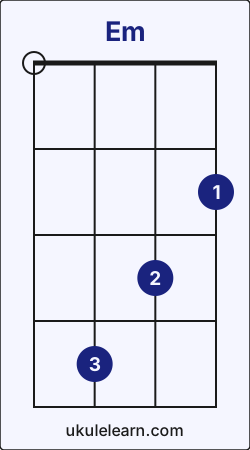 Ukulele Em chord diagram
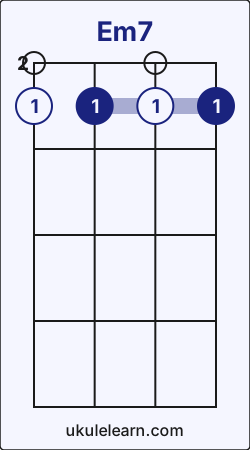 Ukulele Em7 chord diagram
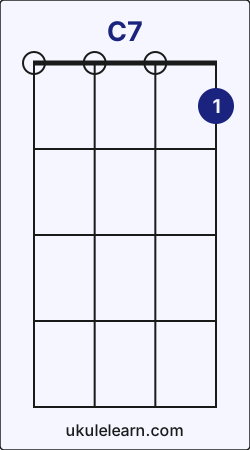 Ukulele C7 chord diagram
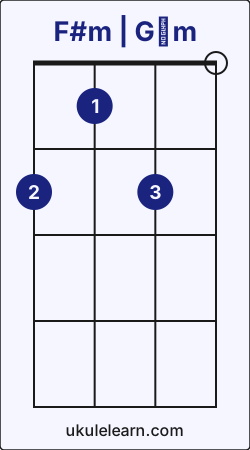 Ukulele F#m | G♭m chord diagram
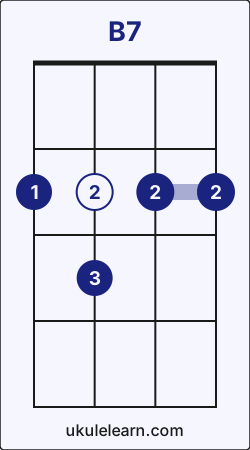 Ukulele B7 chord diagram
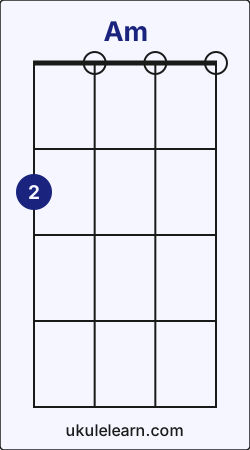 Ukulele Am chord diagram
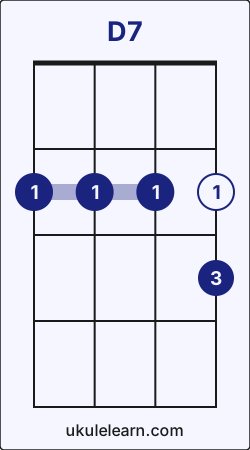 Ukulele D7 chord diagram
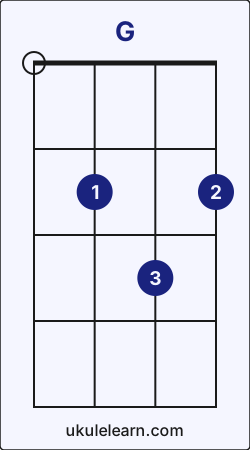 Ukulele G chord diagram
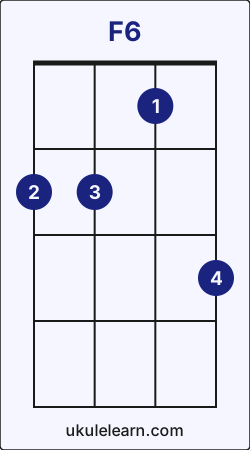 Ukulele F6 chord diagram
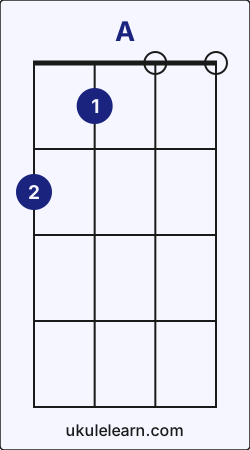 Ukulele A chord diagram
[Opening]
[Em] [Em7] [Em] [C7] [F#m] [B7] [B7]
If you go a[Em]way, on this summer day,
Then you [Am]might as well take the sun away,
All the [D7]birds that flew, in the summer sky,
When [G]our love was new, and our hearts were high,
[section 2]
When the [Am]day was young, and the [B7]night was long,
And the [Em]moon stood still, for the [Em7]nightbird’s song,
If you [Am]go away, if you [B7]go away,, if you [Em]go away!
[section 3]
But,, if you [Em]stay, I’ll [Em7]make you a [Em]day
Like no day has [B7]been, or will be a[Em]gain,
We’ll [B7]ride on the [Em]rain, we’ll [Em7]sail on the [Em]sun,
We’ll talk to the [D7]trees, and worship the [G]wind,
[chorus]
[B7]Then, if you [Em]go, I’ll under[F6]stand,
Leave me just [F#m]enough love to [B7]hold in my [Em]hand,
If you go a[G]way, if you go a[Am]way,
If you go a[B7]way! [B7]
[section 4]
Ne me quitte [Em]pas, il faut oublier,
Tout peut [Am]s’oblier, qui s’enfuit déja,
Oubli[D7]er le temps, des malentendus,
Et le [G]temp perdu, a savoir comment,
[section 5]
Oubli[Am]er ces heures, qui tuai[B7]ent parfois,
A [Em]coups de pourquoi, le [Em7]couer du Bonheur,
Ne me [Am]quitte pas, ne me [B7]quitte pas,
Ne me quitte [Em]pas! [A] [Em]
[section 6]
But,, if you [Em]stay, I’ll [Em7]make you a [Em]night
Like no night has [B7]been, or will be a[Em]gain,
We’ll [B7]ride on the [Em]rain, we’ll [Em7]ride on your [Em]touch,
I’ll talk to your [D7]eyes, that I love so [G]much,
[chorus]
[B7]Then, if you [Em]go, I’ll under[F6]stand,
Leave me just [F#m]enough love to [B7]hold in my [Em]hand,
If you go a[G]way, if you go a[Am]way,
If you go a[B7]way! [B7]
[section 7]
If you [Em]go away, as I know you must,
There’ll be [Am]nothing left in this world to trust,
Just an [D7]empty room, full of empty space,
Like the [G]empty look, I see on your face,
[Closing]
[Am]Oh, I’d have been the [B7]shadow of your shadow,
[Em]If it might have [Em7]kept me by your side,
If you [Am]go away, if you [B7]go away, if you go a[Em]way!
Please, don’t go away!
How to play If You Go Away on Ukulele (Step-by-step)
Dusty Springfield - If You Go Away on ukulele requires 10 chords and 17 core chord transitions. You can find the full step-by-step guide below. Before you start, tune your instrument. The song uses the ↓-↓↑-↓↑-↓↑ pattern; practice it muted first, or simplify to downstrokes while you learn the changes.
If You Go Away uses these transitions most often: B7 → Em (17), Am → B7 (8), and Em → Em7 (8). These transitions may feel a little challenging at first, but with steady practice you can play this song quickly.When you are ready, begin with Em - Em7 chord transition.
1. Em → Em7 chord transition
To move from Em to Em7;
- While playing Em, lift your ring finger from C string fret 4.
- Lift your index finger from A string fret 2 and place it on C string fret 2.
- Slide your middle finger from E string fret 3 to A string fret 2.
2. Em → C7 chord transition
To move from Em to C7;
- While playing Em, first lift your middle finger and ring finger.
- Slide your index finger on A string from fret 2 to fret 1.
3. C7 → F#m chord transition
To move from C7 to F#m;
- Lift your index finger from A string fret 1 and place it on C string fret 1.
- Place middle finger on G string fret 2.
- Place ring finger on E string fret 2.
4. F#m → B7 chord transition
To move from F#m to B7;
- While playing F#m, lift your ring finger from E string fret 2.
- Lift your index finger from C string fret 1 and place it on G string fret 2.
- Slide your middle finger from G string fret 2 to C string fret 3.
5. B7 → Em chord transition
To move from B7 to Em;
- Lift your index finger from G string fret 2 and place it on A string fret 2.
- Slide your middle finger from C string fret 3 to E string fret 3.
- Place ring finger on C string fret 4.
6. Em → Am chord transition
To move from Em to Am;
- While playing Em, first lift your index finger and ring finger.
- Lift your middle finger from E string fret 3 and place it on G string fret 2.
7. Am → D7 chord transition
To move from Am to D7;
- While playing Am, lift your middle finger from G string fret 2.
- Place index finger on G string fret 2.
- Place ring finger on A string fret 3.
8. D7 → G chord transition
To move from D7 to G;
- Lift your index finger from G string fret 2 and place it on C string fret 2.
- Slide your ring finger from A string fret 3 to E string fret 3.
- Place middle finger on A string fret 2.
9. G → Am chord transition
To move from G to Am;
- While playing G, first lift your index finger and ring finger.
- Lift your middle finger from A string fret 2 and place it on G string fret 2.
10. Am → B7 chord transition
To move from Am to B7;
- Lift your middle finger from G string fret 2 and place it on C string fret 3.
- Place index finger on G string fret 2.
11. Em7 → Am chord transition
To move from Em7 to Am;
- While playing Em7, lift your index finger from C string fret 2.
- Lift your middle finger from A string fret 2 and place it on G string fret 2.
12. Em → D7 chord transition
To move from Em to D7;
- While playing Em, lift your middle finger from E string fret 3.
- Lift your index finger from A string fret 2 and place it on G string fret 2.
- Slide your ring finger from C string fret 4 to A string fret 3.
13. G → B7 chord transition
To move from G to B7;
- While playing G, lift your ring finger from E string fret 3.
- Lift your index finger from C string fret 2 and place it on G string fret 2.
- Slide your middle finger from A string fret 2 to C string fret 3.
14. Em → F6 chord transition
To move from Em to F6;
- Lift your index finger from A string fret 2 and place it on E string fret 1.
- Slide your middle finger from E string fret 3 to G string fret 2.
- Slide your ring finger on C string from fret 4 to fret 2.
- Place pinky on A string fret 3.
15. F6 → F#m chord transition
To move from F6 to F#m;
- While playing F6, lift your pinky from A string fret 3.
- Lift your index finger from E string fret 1 and place it on C string fret 1.
- Keep middle finger on G string fret 2.
- Slide your ring finger from C string fret 2 to E string fret 2.
16. Em → G chord transition
To move from Em to G;
- Lift your index finger from A string fret 2 and place it on C string fret 2.
- Slide your middle finger from E string fret 3 to A string fret 2.
- Lift your ring finger from C string fret 4 and place it on E string fret 3.
17. Em → A chord transition
To move from Em to A;
- While playing Em, lift your ring finger from C string fret 4.
- Lift your index finger from A string fret 2 and place it on C string fret 1.
- Slide your middle finger from E string fret 3 to G string fret 2.
If You Go Away chord transition analysis
A short, data-driven summary of the chord flow in If You Go Away.
- If You Go Away includes 78 chord transitions, 17 of them unique.
- These transitions represent 0.02% of all chord transitions in Ukulelearn.
- If You Go Away contains 1 of the top 10 transitions across Ukulelearn.
- These transition patterns show how If You Go Away connects to the rest of Ukulelearn. Mastering them helps you move to similar songs faster.After Em, the most likely next chords across Ukulelearn are C (27%), G (18%), and D (17%).
- Em → G: 18%
- Em → Am: 12%
After B7, the most likely next chords across Ukulelearn are Em (58%), E7 (10%), and C (8%).- B7 → Em: 58%