
Radiohead - Jigsaw Falling Into Place Ukulele Chords
Before you play, tune your ukulele and use the tools below to set up your view and flow.
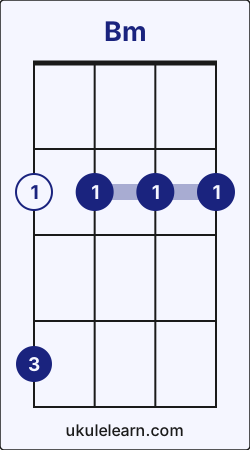 Ukulele Bm chord diagram
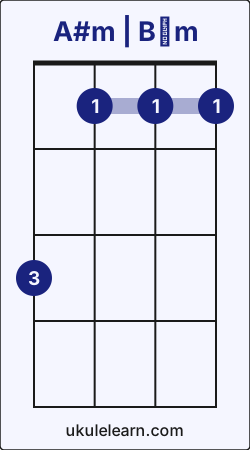 Ukulele A#m | B♭m chord diagram
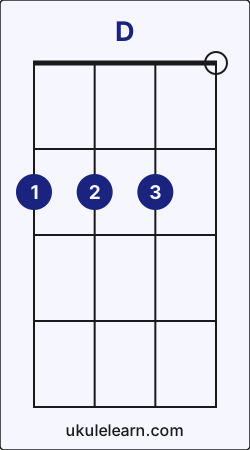 Ukulele D chord diagram
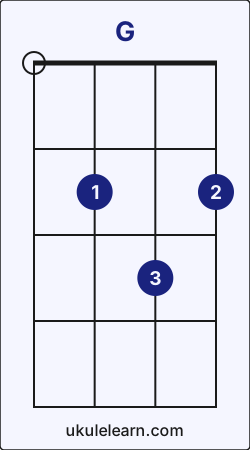 Ukulele G chord diagram
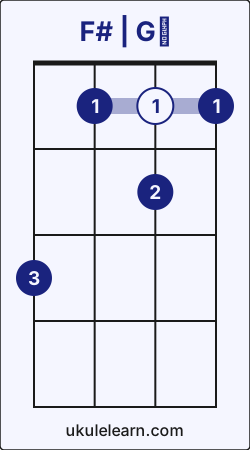 Ukulele F# | G♭ chord diagram
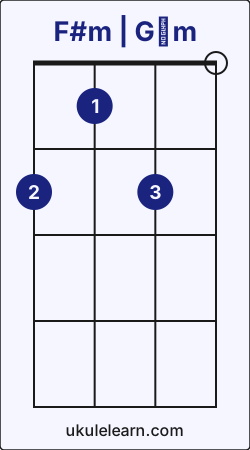 Ukulele F#m | G♭m chord diagram
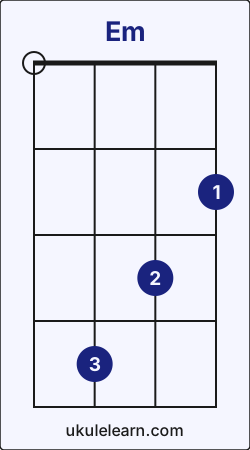 Ukulele Em chord diagram
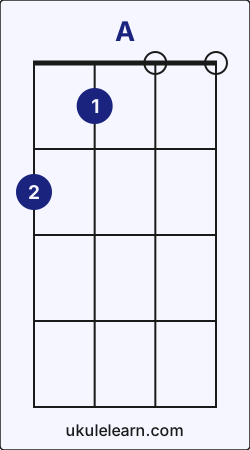 Ukulele A chord diagram
[Opening]
[Bm] [Bm] [Bm] [Bm] [Bbm] [Bbm] [D] [D] [G] [F#] [G] [F#]
[Bm]Just as you take my hand, [Bm]just as you write my number down
[Bm]Just as the drinks arrive, just as they play your favorite [G]song
As your blather disappears, [F#m]no longer wound up like a [Em]spring
Before you’ve had too much, [A]come back and focus again [Bm]
[section 2]
[Bm]The walls abandon shape, [Bm]you’ve got a cheshire cat grin
[Bm]All blurring into one, [Bm]this place is on a mission [G]
Before the night owl, [F#m]before the animal [Em]noises
Closed circuit cameras, [A]before you’re comatose [Bm]
[section 3]
[Bm]Before you run away from me, [Bm]before you’re lost between the notes
[Bm]The beat goes round and round, [Bm]the beat goes round and [G]round
I never really got there, [F#m]I just pretended that I [Em]had
Words are blunt instruments, [A]words are a sawed off shotguns [Bm]
[section 4]
[Bm]Come on and let it out, [Bm]come on and let it out
[Bm]Come on and let it out, [Bm]come on and let it [G]out
Before you run away from me, [F#m]before you’re lost between the notes [Em]
Before you take my mic, [A]just as you dance, dance, [Bm]dance
[Bm]Dance, dance, dance, dance
[section 5]
[Bbm] [Bbm] [D] [D] [G] [F#] [G] [F#]
[Bm]Jigsaws falling into place, [Bm]there is nothing to explain
You [Bbm]eye each other as you pass, [D]she looks back, [D]you look back
[G]Not just [F#]once, [G]not just [F#]twice
[Closing]
[Bm]Wish away the nightmare, [Bm]wish away the nightmare
You’ve got a [Bbm]light you can feel it on your back
A [D]light and you can feel it [D]on your back
[G]Jigsaws [F#]falling [G]into [F#]place [Bm]
How to play Jigsaw Falling Into Place on Ukulele (Step-by-step)
Radiohead - Jigsaw Falling Into Place on ukulele requires 8 chords and 10 core chord transitions. You can find the full step-by-step guide below. Before you start, tune your instrument. The song uses the ↓↑-↓↑-↓↑-↓↑ pattern; practice it muted first, or simplify to downstrokes while you learn the changes.
Jigsaw Falling Into Place uses these transitions most often: G → F# (8), A → Bm (4), and Bbm → D (4). These transitions may feel a little challenging at first, but with steady practice you can play this song quickly.When you are ready, begin with Bm - Bbm chord transition.
1. Bm → Bbm chord transition
To move from Bm to Bbm;
- Slide your index finger on C string from fret 2 to fret 1.
- Slide your ring finger on G string from fret 4 to fret 3.
2. Bbm → D chord transition
To move from Bbm to D;
- Lift your index finger from C string fret 1 and place it on G string fret 2.
- Slide your ring finger from G string fret 3 to E string fret 2.
- Place middle finger on C string fret 2.
3. D → G chord transition
To move from D to G;
- Lift your index finger from G string fret 2 and place it on C string fret 2.
- Slide your middle finger from C string fret 2 to A string fret 2.
- Slide your ring finger on E string from fret 2 to fret 3.
4. G → F# chord transition
To move from G to F#;
- Slide your index finger on C string from fret 2 to fret 1.
- Slide your middle finger from A string fret 2 to E string fret 2.
- Lift your ring finger from E string fret 3 and place it on G string fret 3.
5. F# → Bm chord transition
To move from F# to Bm;
- While playing F#, lift your middle finger from E string fret 2.
- Slide your index finger on C string from fret 1 to fret 2.
- Slide your ring finger on G string from fret 3 to fret 4.
6. Bm → G chord transition
To move from Bm to G;
- Keep index finger on C string fret 2.
- Lift your ring finger from G string fret 4 and place it on E string fret 3.
- Place middle finger on A string fret 2.
7. G → F#m chord transition
To move from G to F#m;
- Slide your index finger on C string from fret 2 to fret 1.
- Slide your middle finger from A string fret 2 to G string fret 2.
- Slide your ring finger on E string from fret 3 to fret 2.
8. F#m → Em chord transition
To move from F#m to Em;
- Lift your index finger from C string fret 1 and place it on A string fret 2.
- Slide your middle finger from G string fret 2 to E string fret 3.
- Lift your ring finger from E string fret 2 and place it on C string fret 4.
9. Em → A chord transition
To move from Em to A;
- While playing Em, lift your ring finger from C string fret 4.
- Lift your index finger from A string fret 2 and place it on C string fret 1.
- Slide your middle finger from E string fret 3 to G string fret 2.
10. A → Bm chord transition
To move from A to Bm;
- While playing A, lift your middle finger from G string fret 2.
- Slide your index finger on C string from fret 1 to fret 2.
- Place ring finger on G string fret 4.
Jigsaw Falling Into Place chord transition analysis
A short, data-driven summary of the chord flow in Jigsaw Falling Into Place.
- Jigsaw Falling Into Place includes 48 chord transitions, 10 of them unique.
- These transitions represent 0.01% of all chord transitions in Ukulelearn.
- Jigsaw Falling Into Place contains 1 of the top 10 transitions across Ukulelearn.
- These transition patterns show how Jigsaw Falling Into Place connects to the rest of Ukulelearn. Mastering them helps you move to similar songs faster.After Bm, the most likely next chords across Ukulelearn are G (25%), A (19%), and Em (13%).
- Bm → G: 25%
- Bm → Bbm: 0%
After G, the most likely next chords across Ukulelearn are C (25%), D (24%), and Am (13%).- G → F#m: 0%
- G → F#: 0%