
Disclosure - Latch Ukulele Chords
Before you play, tune your ukulele and use the tools below to set up your view and flow.
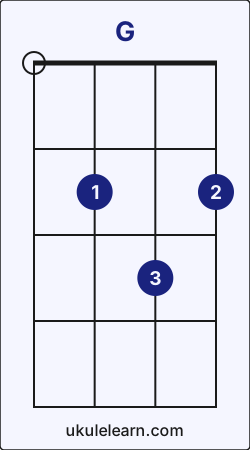 Ukulele G chord diagram
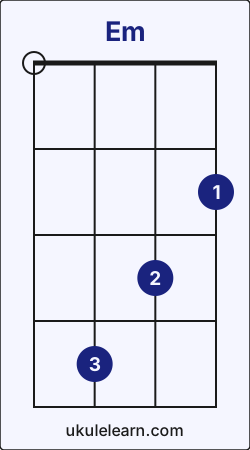 Ukulele Em chord diagram
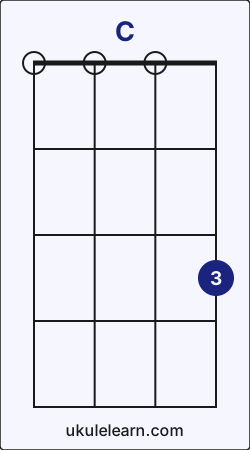 Ukulele C chord diagram
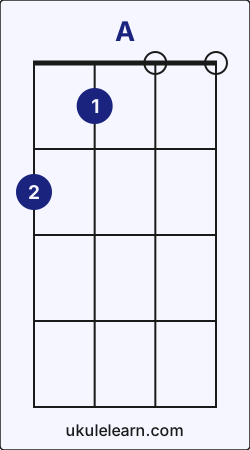 Ukulele A chord diagram
[Opening]
[G] [Em] [C] [G] [G] [Em] [C] [G]
[G]You, lift my [Em]heart up
When the [C]rest of me is [G]down
You, you [Em]enchant me
Even [C]when you’re not [G]around
If there are [Em]boundaries
I will [C]try to knock them [G]down
I’m latching [Em]on babe
Now I [C]know what I have [G]found
[chorus]
I feel we’re close [Em]enough
Could I lock in your [C]love [G]
I feel we’re close [Em]enough
Could I lock in your [C]love [G]
[chorus]
[G]Now I’ve got you [Em]in my space
I [C]won’t let go of [G]you
Got you shackled in [Em]my embrace
I’m [C]latching on to [G]you
[section 2]
[G]I’m so [Em]encaptured
Got me [C]wrapped up in your [G]touch
Feel so [Em]enamored
Hold me [C]tight within your [G]clutch
How do you [Em]do it
You got me [C]losing every [G]breath
What did you [Em]give me
To make my [C]heart beat out my [G]chest
[chorus]
I feel we’re close [Em]enough
Could I lock in your [C]love [G]
I feel we’re close [Em]enough
Could I lock in your [C]love [G]
[chorus]
[G]Now I’ve got you [Em]in my space
I [C]won’t let go of [G]you
Got you shackled in [Em]my embrace
I’m [C]latching on to [G]you
[chorus]
[G]Now I’ve got you [Em]in my space
I [C]won’t let go of [G]you
Got you shackled in [Em]my embrace
I’m [C]latching on to [G]you [A] [Em]
[Closing]
I’m [C]latching [G]on…
To [G] [Em]you… [C] [G]
How to play Latch on Ukulele (Step-by-step)
Disclosure - Latch on ukulele requires 4 chords and 5 core chord transitions. You can find the full step-by-step guide below. Before you start, tune your instrument. The song uses the ↓-↓↑-↑↓↑ pattern; practice it muted first, or simplify to downstrokes while you learn the changes.
Latch uses these transitions most often: C → G (22), Em → C (22), and G → Em (21). These transitions may feel a little challenging at first, but with steady practice you can play this song quickly.When you are ready, begin with G - Em chord transition.
1. G → Em chord transition
To move from G to Em;
- Lift your index finger from C string fret 2 and place it on A string fret 2.
- Slide your middle finger from A string fret 2 to E string fret 3.
- Lift your ring finger from E string fret 3 and place it on C string fret 4.
2. Em → C chord transition
To move from Em to C;
- While playing Em, first lift your index finger and middle finger.
- Lift your ring finger from C string fret 4 and place it on A string fret 3.
3. C → G chord transition
To move from C to G;
- Lift your ring finger from A string fret 3 and place it on E string fret 3.
- Place index finger on C string fret 2.
- Place middle finger on A string fret 2.
4. G → A chord transition
To move from G to A;
- While playing G, lift your ring finger from E string fret 3.
- Slide your index finger on C string from fret 2 to fret 1.
- Slide your middle finger from A string fret 2 to G string fret 2.
5. A → Em chord transition
To move from A to Em;
- Lift your index finger from C string fret 1 and place it on A string fret 2.
- Slide your middle finger from G string fret 2 to E string fret 3.
- Place ring finger on C string fret 4.
Latch chord transition analysis
A short, data-driven summary of the chord flow in Latch.
- Latch includes 67 chord transitions, 5 of them unique.
- These transitions represent 0.02% of all chord transitions in Ukulelearn.
- Latch contains 2 of the top 10 transitions across Ukulelearn.
- These transition patterns show how Latch connects to the rest of Ukulelearn. Mastering them helps you move to similar songs faster.After G, the most likely next chords across Ukulelearn are C (25%), D (24%), and Am (13%).
- G → Em: 9%
- G → A: 6%
After Em, the most likely next chords across Ukulelearn are C (27%), G (18%), and D (17%).- Em → C: 27%