
Loggins and Messina - Long Tailed Cat Ukulele Chords
Before you play, tune your ukulele and use the tools below to set up your view and flow.
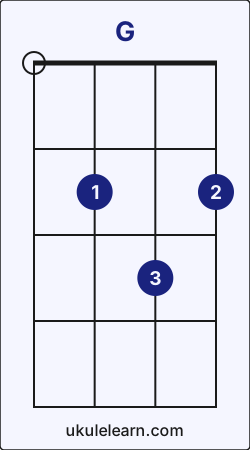 Ukulele G chord diagram
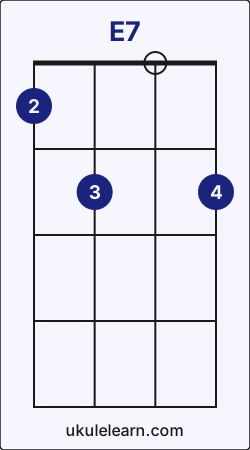 Ukulele E7 chord diagram
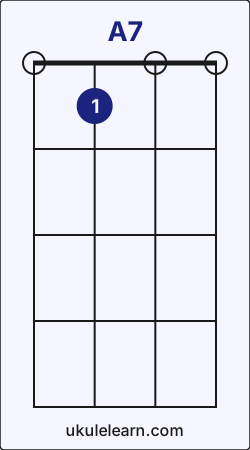 Ukulele A7 chord diagram
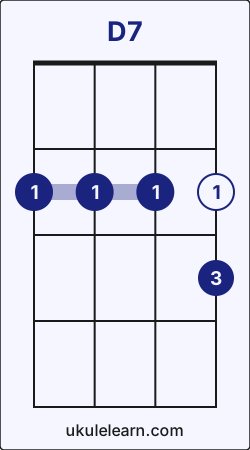 Ukulele D7 chord diagram
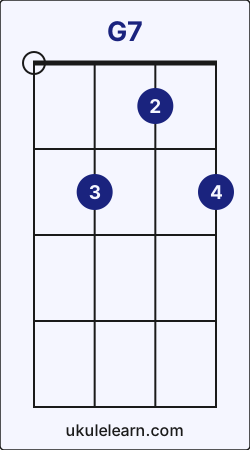 Ukulele G7 chord diagram
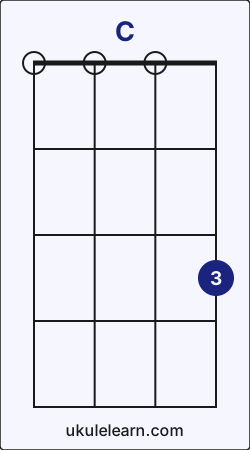 Ukulele C chord diagram
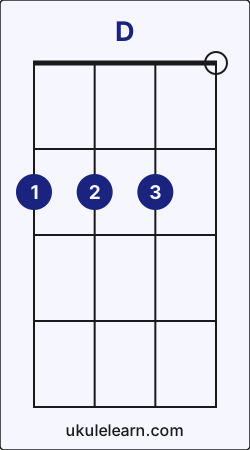 Ukulele D chord diagram
[Opening]
[G]Long tailed cat sitting by the old rocking chair
[G]Now he don’t realize that there’s a danger there
[G]But he don’t care no rock ‘n’ roll chair is gonna boogie on his day
[G]’Cause when his tail took a low down, syncopate, yeah
[section 2]
[E7]I’m going down to Orleans town on a [A7]Dixie holiday
[D7]To get myself a tonk of that harmo[G]ny, yeah
[E7]You may be a symphony, babe, but [A7]I believe in song
[D7]It’s got a catchy melody so you can [G]sing along
[interlude]
[G7]
[section 3]
[G]Oh, they say, you know they’re talking bout the girls that work up town
[G]I don’t realize the amount of danger now
[G]No swinging tail, no rock ‘n’ roll girl is gonna boogie woogie on my day
[G]’Cause I made my time on a Dixie holiday, yeah
[section 4]
[E7]I’m going down to Orleans town, to [A7]get a pound of feed
[D7]Be back home in just ’bout a half a [G]week, yeah
[E7]You may be a symphony, babe, but [A7]I believe in song
[D7]Got a catchy melody so you can [G]sing along
[section 5]
[G]Everybody sing along, along
[G]Don’t know what you sing along
[G]Well you’re gonna sing along, along
the next phrase, play and sing four times slow and fade on last pass
[Closing]
[G]All you sing is oh my, [C]oh my my
[D]Your daddy’s getting older and the [G]cows are going dry
[G]Gotta go bye, [C]go bye bye
On a [D]Dixie holi[G]day
How to play Long Tailed Cat on Ukulele (Step-by-step)
Loggins and Messina - Long Tailed Cat on ukulele requires 7 chords and 8 core chord transitions. You can find the full step-by-step guide below. Before you start, tune your instrument. The song uses the ↓-↓↑-↓↑-↓↑ pattern; practice it muted first, or simplify to downstrokes while you learn the changes.
Long Tailed Cat uses these transitions most often: A7 → D7 (4), D7 → G (4), and E7 → A7 (4). These transitions may feel a little challenging at first, but with steady practice you can play this song quickly.When you are ready, begin with G - E7 chord transition.
1. G → E7 chord transition
To move from G to E7;
- Lift your index finger from C string fret 2 and place it on G string fret 1.
- Slide your middle finger from A string fret 2 to C string fret 2.
- Lift your ring finger from E string fret 3 and place it on A string fret 2.
2. E7 → A7 chord transition
To move from E7 to A7;
- While playing E7, first lift your middle finger and ring finger.
- Lift your index finger from G string fret 1 and place it on C string fret 1.
3. A7 → D7 chord transition
To move from A7 to D7;
- Lift your index finger from C string fret 1 and place it on G string fret 2.
- Place ring finger on A string fret 3.
4. D7 → G chord transition
To move from D7 to G;
- Lift your index finger from G string fret 2 and place it on C string fret 2.
- Slide your ring finger from A string fret 3 to E string fret 3.
- Place middle finger on A string fret 2.
5. G → G7 chord transition
To move from G to G7;
- Lift your index finger from C string fret 2 and place it on E string fret 1.
- Slide your middle finger from A string fret 2 to C string fret 2.
- Lift your ring finger from E string fret 3 and place it on A string fret 2.
6. G → C chord transition
To move from G to C;
- While playing G, first lift your index finger and middle finger.
- Lift your ring finger from E string fret 3 and place it on A string fret 3.
7. C → D chord transition
To move from C to D;
- Lift your ring finger from A string fret 3 and place it on E string fret 2.
- Place index finger on G string fret 2.
- Place middle finger on C string fret 2.
8. D → G chord transition
To move from D to G;
- Lift your index finger from G string fret 2 and place it on C string fret 2.
- Slide your middle finger from C string fret 2 to A string fret 2.
- Slide your ring finger on E string from fret 2 to fret 3.
Long Tailed Cat chord transition analysis
A short, data-driven summary of the chord flow in Long Tailed Cat.
- Long Tailed Cat includes 24 chord transitions, 8 of them unique.
- These transitions represent 0.01% of all chord transitions in Ukulelearn.
- Long Tailed Cat contains 3 of the top 10 transitions across Ukulelearn.
- These transition patterns show how Long Tailed Cat connects to the rest of Ukulelearn. Mastering them helps you move to similar songs faster.After G, the most likely next chords across Ukulelearn are C (25%), D (24%), and Am (13%).
- G → C: 25%
- G → G7: 2%
After E7, the most likely next chords across Ukulelearn are A (31%), Am (28%), and A7 (7%).- E7 → A7: 7%