
Half Man Half Biscuit - Lord Hereford’s Knob Ukulele Chords
Before you play, tune your ukulele and use the tools below to set up your view and flow.
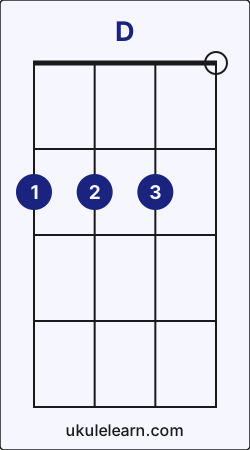 Ukulele D chord diagram
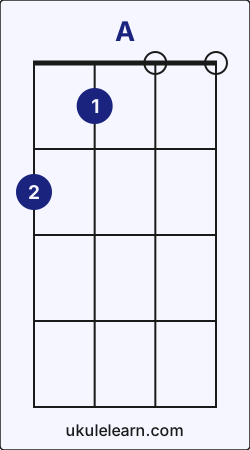 Ukulele A chord diagram
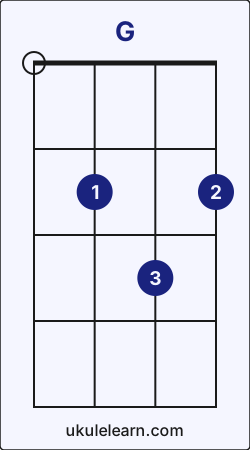 Ukulele G chord diagram
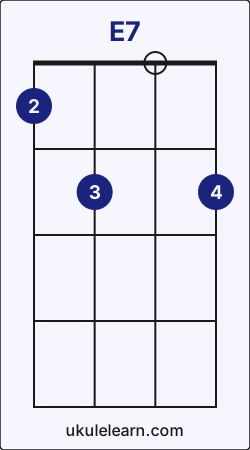 Ukulele E7 chord diagram
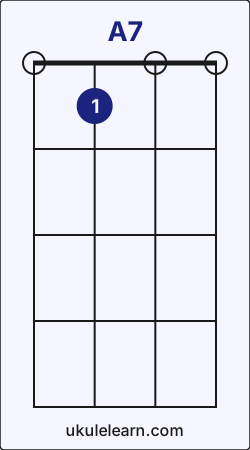 Ukulele A7 chord diagram
[Opening]
As [D]I camped out one evening to [A]take the midnight [D]air
I heard a maiden grieving from [G]somewhere over [A]there
Who [G]is it you are [D]mourning; for [G]whom do you wear [D]grey?
She [G]said I pine for [D]no one I [E7]just can’t pay my [A7]way.
[section 2]
Ever [G]since the chattering [D]classes in[A]vaded Hebden [D]Bridge
And [G]priced the likes of [D]me and mine to the [E7]pots of the Pennine [A]Ridge
To [G]South East Wales I was [D]forced to flee and [G]now I have no [D]job
That’s why tonight I’m [G]sitting on [A7]top of Lord Hereford’s [D]Knob.
[section 3]
For you I’d waive expenses to [A]try and help you [D]out
For your beauty influences the [G]landscape herea[A]bouts
Look [G]up my betrothed at [D]Three Cocks; be [G]sure she’ll see you [D]right
While [G]I go up to [D]Yorkshire and [E7]there avenge your [A7]plight.
[section 4]
Soon [G]reports were filtering [D]through to me the [A]pair were drowning in [D]bliss
I [G]can’t recall having [D]ever been cuck[E7]olded quite like [A]this
I [G]gave up hope [D]ironically for Lent, [G]
Come [D]see me living in a [G]bivvie if [A7]you’re ever up PenY[D]Ghent.
[section 5]
Although upon reflection I’ve [A]been a trifle [D]green
I still think with affection on [G]everything that’s [A]been
So pre[G]pare that fatted [D]calf and string [G]up the bunting [D]gay
Your [G]brisk and bonny [D]ploughboy is [E7]coming home to[A7]day.
And to[D]night he’ll be sitting on [A]top of Lord Hereford’s [D]Knob.
[A7]Tonight he’ll be sitting on top of Lord Hereford’s Knob.
[section 6]
On [D]touching the trig point [A]I found my thrill
To the [D]east Brokeback Mountain, to the [A]west Benny Hill
I’ll [G]give you the grid ref you [A]might like to go:
[D]S O 2 2 [D]4 3 5 0.
[D]Could this be heaven, would [A]that be the Severn?
[D]Tumpa, Tumpa, you’re [A]gonna need a jumper,
It [D]gets a bit chilly on [A]top of Lord Hereford’s [D]Knob.
[Closing]
To[D]night he’ll be sitting on [A]top of Lord Hereford’s [D]Knob.
[A7]All of our songs sound the [D]same;
Tonight he’ll be sitting on [A7]top of Lord Hereford’s [D]Knob.
I’m [A7]keeping two chevrons ap[D]art;
Tonight he’ll be sitting on [A7]top of Lord Hereford’s [D]Knob.
You’re the [A7]reason why paradise [D]lost;
Tonight he’ll be sitting on [A7]top of Lord Hereford’s [D]Knob.
How to play Lord Hereford's Knob on Ukulele (Step-by-step)
Half Man Half Biscuit - Lord Hereford's Knob on ukulele requires 5 chords and 8 core chord transitions. You can find the full step-by-step guide below. Before you start, tune your instrument. The song uses the ↓-↓↑-↓↑-↓↑ pattern; practice it muted first, or simplify to downstrokes while you learn the changes.
Lord Hereford's Knob uses these transitions most often: G → D (17), D → G (15), and A → D (12). These transitions may feel a little challenging at first, but with steady practice you can play this song quickly.When you are ready, begin with D - A chord transition.
1. D → A chord transition
To move from D to A;
- While playing D, lift your ring finger from E string fret 2.
- Lift your index finger from G string fret 2 and place it on C string fret 1.
- Slide your middle finger from C string fret 2 to G string fret 2.
2. D → G chord transition
To move from D to G;
- Lift your index finger from G string fret 2 and place it on C string fret 2.
- Slide your middle finger from C string fret 2 to A string fret 2.
- Slide your ring finger on E string from fret 2 to fret 3.
3. G → A chord transition
To move from G to A;
- While playing G, lift your ring finger from E string fret 3.
- Slide your index finger on C string from fret 2 to fret 1.
- Slide your middle finger from A string fret 2 to G string fret 2.
4. D → E7 chord transition
To move from D to E7;
- Slide your index finger on G string from fret 2 to fret 1.
- Keep middle finger on C string fret 2.
- Slide your ring finger from E string fret 2 to A string fret 2.
5. E7 → A7 chord transition
To move from E7 to A7;
- While playing E7, first lift your middle finger and ring finger.
- Lift your index finger from G string fret 1 and place it on C string fret 1.
6. A7 → G chord transition
To move from A7 to G;
- Slide your index finger on C string from fret 1 to fret 2.
- Place middle finger on A string fret 2.
- Place ring finger on E string fret 3.
7. E7 → A chord transition
To move from E7 to A;
- While playing E7, lift your ring finger from A string fret 2.
- Lift your index finger from G string fret 1 and place it on C string fret 1.
- Slide your middle finger from C string fret 2 to G string fret 2.
8. A7 → D chord transition
To move from A7 to D;
- Lift your index finger from C string fret 1 and place it on G string fret 2.
- Place middle finger on C string fret 2.
- Place ring finger on E string fret 2.
Lord Hereford's Knob chord transition analysis
A short, data-driven summary of the chord flow in Lord Hereford's Knob.
- Lord Hereford's Knob includes 97 chord transitions, 8 of them unique.
- These transitions represent 0.03% of all chord transitions in Ukulelearn.
- Lord Hereford's Knob contains 2 of the top 10 transitions across Ukulelearn.
- These transition patterns show how Lord Hereford's Knob connects to the rest of Ukulelearn. Mastering them helps you move to similar songs faster.After D, the most likely next chords across Ukulelearn are G (29%), A (17%), and Em (17%).
- D → G: 29%
- D → A: 17%
After G, the most likely next chords across Ukulelearn are C (25%), D (24%), and Am (13%).- G → D: 24%
- G → A: 6%