
Richard Harris - Macarthur Park Ukulele Chords
Before you play, tune your ukulele and use the tools below to set up your view and flow.
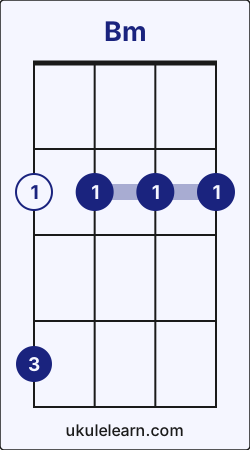 Ukulele Bm chord diagram
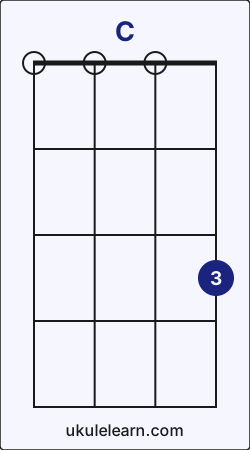 Ukulele C chord diagram
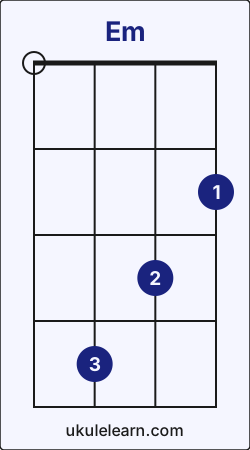 Ukulele Em chord diagram
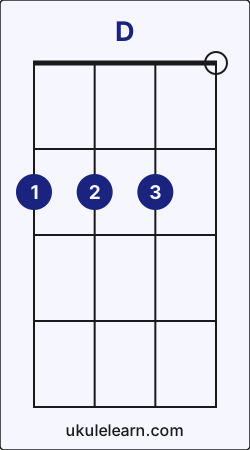 Ukulele D chord diagram
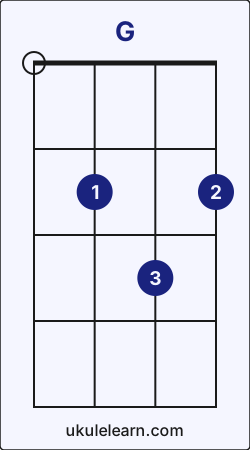 Ukulele G chord diagram
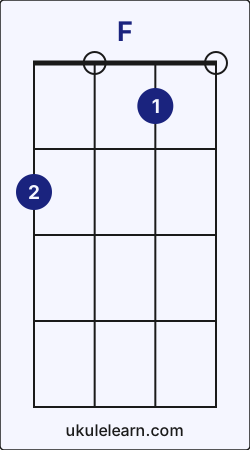 Ukulele F chord diagram
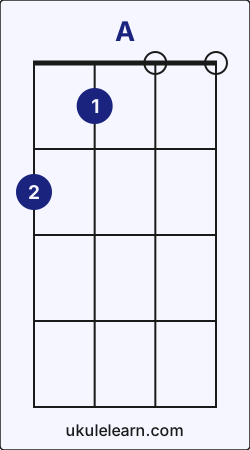 Ukulele A chord diagram
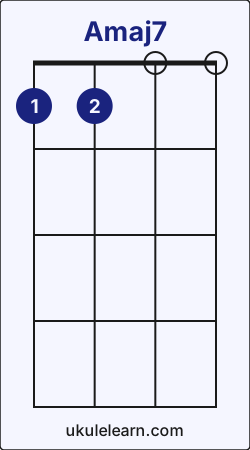 Ukulele Amaj7 chord diagram
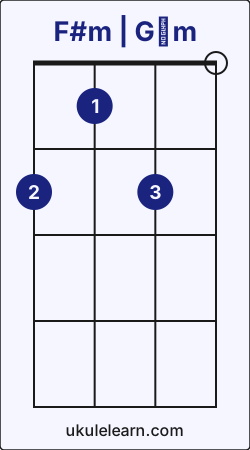 Ukulele F#m | G♭m chord diagram
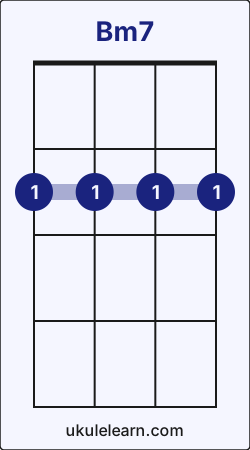 Ukulele Bm7 chord diagram
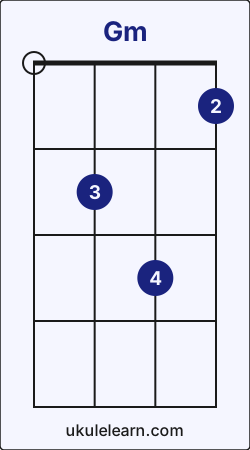 Ukulele Gm chord diagram
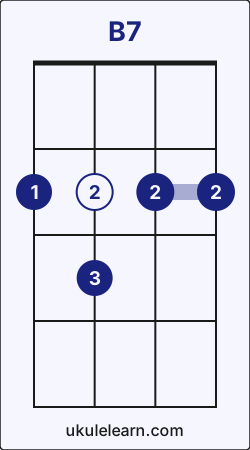 Ukulele B7 chord diagram
[Opening]
[Bm] [Bm] [C] [Em]
[Bm]Spring was never waiting for us, [D]girl, it [G]ran one step a[C]head
As we followed in the [Em]dance [G] [F] [Em]
[Bm]Between the parted pages and were [D]pressed,
In [G]love’s hot, fevered [C]iron like a striped pair of [Em]pants [G] [F] [Em]
[chorus]
Mac[A]arthur Park is melting in the [Amaj7]dark
All the sweet, green icing [Em]flowing down,
[D]Someone left the cake out in the [F#m]rain
and I don’t [A]think that I can take it
’cause it [Bm7]took so long to bake it
and I’ll [A]never have that [Amaj7]recipe a[D]gain, oh, [C]no!
[section 2]
[Bm]I recall the yellow cotton [D]dress, [G]foaming like a [C]wave
on the ground around your [Em]knees [G] [F] [Em]
The [Bm]birds, like tender babies in your [D]hands
and the old men playing [C]checkers by the [Em]trees [G] [F] [Em]
[chorus]
Mac[A]arthur Park is melting in the [Amaj7]dark
All the sweet, green icing [Em]flowing down,
[D]Someone left the cake out in the [F#m]rain
and I don’t [A]think that I can take it
’cause it [Bm7]took so long to bake it
and I’ll [A]never have that [Amaj7]recipe a[D]gain, oh, [C]no!
[section 3]
[D]There will be another song for [F#m]me
For I will [G]sing [Gm]it
[G]There will be another dream for me
Someone will [F#m]bring [D]it
[G]I will drink the wine while it is [Em]warm
and [F#m]never let you catch me looking at the [B7]sun
And [Em]after all the loves of my [D]life
[F#m]after all the loves of my [G]life
You’ll still be the [C]one. [D]
[Closing]
I will [D]take my life into my [F#m]hands
and I will [G]use [Gm]it
[G]I will win the worship in their eyes
and I will [F#m]lose [D]it
[G]I will have the things that I de[Em]sire
and my [F#m]passion flow like rivers through the [B7]sky.
And [Em]after all the loves of my life
[F#m]After all the loves of my [G]life
I’ll be thinking of [C]you
and wondering [Bm]why
[chorus]
Mac[A]arthur Park is melting in the [Amaj7]dark
All the sweet, green icing [Em]flowing down,
[D]Someone left the cake out in the [F#m]rain
and I don’t [A]think that I can take it
’cause it [Bm7]took so long to bake it
and I’ll [A]never have that [Amaj7]recipe a[D]gain, oh, [C]no!
How to play Macarthur Park on Ukulele (Step-by-step)
Richard Harris - Macarthur Park on ukulele requires 12 chords and 24 core chord transitions. You can find the full step-by-step guide below. Before you start, tune your instrument. The song uses the ↓-↓↑-↑↓↑ pattern; practice it muted first, or simplify to downstrokes while you learn the changes.
Macarthur Park uses these transitions most often: A → Amaj7 (6), D → F#m (6), and C → Em (5). These transitions may feel a little challenging at first, but with steady practice you can play this song quickly.When you are ready, begin with Bm - C chord transition.
1. Bm → C chord transition
To move from Bm to C;
- While playing Bm, lift your index finger from C string fret 2.
- Lift your ring finger from G string fret 4 and place it on A string fret 3.
2. C → Em chord transition
To move from C to Em;
- Lift your ring finger from A string fret 3 and place it on C string fret 4.
- Place index finger on A string fret 2.
- Place middle finger on E string fret 3.
3. Em → Bm chord transition
To move from Em to Bm;
- While playing Em, lift your middle finger from E string fret 3.
- Lift your index finger from A string fret 2 and place it on C string fret 2.
- Slide your ring finger from C string fret 4 to G string fret 4.
4. Bm → D chord transition
To move from Bm to D;
- Lift your index finger from C string fret 2 and place it on G string fret 2.
- Slide your ring finger from G string fret 4 to E string fret 2.
- Place middle finger on C string fret 2.
5. D → G chord transition
To move from D to G;
- Lift your index finger from G string fret 2 and place it on C string fret 2.
- Slide your middle finger from C string fret 2 to A string fret 2.
- Slide your ring finger on E string from fret 2 to fret 3.
6. G → C chord transition
To move from G to C;
- While playing G, first lift your index finger and middle finger.
- Lift your ring finger from E string fret 3 and place it on A string fret 3.
7. Em → G chord transition
To move from Em to G;
- Lift your index finger from A string fret 2 and place it on C string fret 2.
- Slide your middle finger from E string fret 3 to A string fret 2.
- Lift your ring finger from C string fret 4 and place it on E string fret 3.
8. G → F chord transition
To move from G to F;
- While playing G, lift your ring finger from E string fret 3.
- Lift your index finger from C string fret 2 and place it on E string fret 1.
- Slide your middle finger from A string fret 2 to G string fret 2.
9. F → Em chord transition
To move from F to Em;
- Lift your index finger from E string fret 1 and place it on A string fret 2.
- Slide your middle finger from G string fret 2 to E string fret 3.
- Place ring finger on C string fret 4.
10. Em → A chord transition
To move from Em to A;
- While playing Em, lift your ring finger from C string fret 4.
- Lift your index finger from A string fret 2 and place it on C string fret 1.
- Slide your middle finger from E string fret 3 to G string fret 2.
11. A → Amaj7 chord transition
To move from A to Amaj7;
- Lift your index finger from C string fret 1 and place it on G string fret 1.
- Slide your middle finger from G string fret 2 to C string fret 1.
12. Amaj7 → Em chord transition
To move from Amaj7 to Em;
- Lift your index finger from G string fret 1 and place it on A string fret 2.
- Slide your middle finger from C string fret 1 to E string fret 3.
- Place ring finger on C string fret 4.
13. Em → D chord transition
To move from Em to D;
- Lift your index finger from A string fret 2 and place it on G string fret 2.
- Slide your middle finger from E string fret 3 to C string fret 2.
- Lift your ring finger from C string fret 4 and place it on E string fret 2.
14. D → F#m chord transition
To move from D to F#m;
- Lift your index finger from G string fret 2 and place it on C string fret 1.
- Slide your middle finger from C string fret 2 to G string fret 2.
- Keep ring finger on E string fret 2.
15. F#m → A chord transition
To move from F#m to A;
- While playing F#m, lift your ring finger from E string fret 2.
- Keep index finger on C string fret 1.
- Keep middle finger on G string fret 2.
16. A → Bm7 chord transition
To move from A to Bm7;
- While playing A, lift your middle finger from G string fret 2.
- Lift your index finger from C string fret 1 and place it on G string fret 2.
17. Amaj7 → D chord transition
To move from Amaj7 to D;
- Slide your index finger on G string from fret 1 to fret 2.
- Slide your middle finger on C string from fret 1 to fret 2.
- Place ring finger on E string fret 2.
18. D → C chord transition
To move from D to C;
- While playing D, first lift your index finger and middle finger.
- Lift your ring finger from E string fret 2 and place it on A string fret 3.
19. F#m → G chord transition
To move from F#m to G;
- Slide your index finger on C string from fret 1 to fret 2.
- Slide your middle finger from G string fret 2 to A string fret 2.
- Slide your ring finger on E string from fret 2 to fret 3.
20. G → Gm chord transition
To move from G to Gm;
- Lift your index finger from C string fret 2 and place it on A string fret 1.
- Slide your middle finger from A string fret 2 to C string fret 2.
- Keep ring finger on E string fret 3.
21. Em → F#m chord transition
To move from Em to F#m;
- Lift your index finger from A string fret 2 and place it on C string fret 1.
- Slide your middle finger from E string fret 3 to G string fret 2.
- Lift your ring finger from C string fret 4 and place it on E string fret 2.
22. F#m → B7 chord transition
To move from F#m to B7;
- While playing F#m, lift your ring finger from E string fret 2.
- Lift your index finger from C string fret 1 and place it on G string fret 2.
- Slide your middle finger from G string fret 2 to C string fret 3.
23. B7 → Em chord transition
To move from B7 to Em;
- Lift your index finger from G string fret 2 and place it on A string fret 2.
- Slide your middle finger from C string fret 3 to E string fret 3.
- Place ring finger on C string fret 4.
24. Bm → A chord transition
To move from Bm to A;
- While playing Bm, lift your ring finger from G string fret 4.
- Slide your index finger on C string from fret 2 to fret 1.
- Place middle finger on G string fret 2.
Macarthur Park chord transition analysis
A short, data-driven summary of the chord flow in Macarthur Park.
- Macarthur Park includes 98 chord transitions, 24 of them unique.
- These transitions represent 0.03% of all chord transitions in Ukulelearn.
- Macarthur Park contains 6 of the top 10 transitions across Ukulelearn.
- These transition patterns show how Macarthur Park connects to the rest of Ukulelearn. Mastering them helps you move to similar songs faster.After Em, the most likely next chords across Ukulelearn are C (27%), G (18%), and D (17%).
- Em → G: 18%
- Em → D: 17%
After D, the most likely next chords across Ukulelearn are G (29%), A (17%), and Em (17%).- D → G: 29%
- D → C: 14%