
Stevie Wonder - Master Blaster (Jammin’) Ukulele Chords
Before you play, tune your ukulele and use the tools below to set up your view and flow.
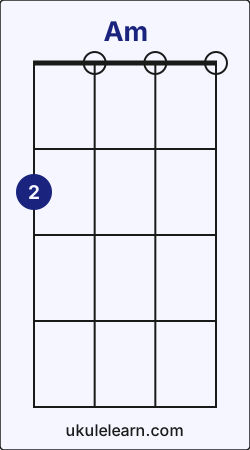 Ukulele Am chord diagram
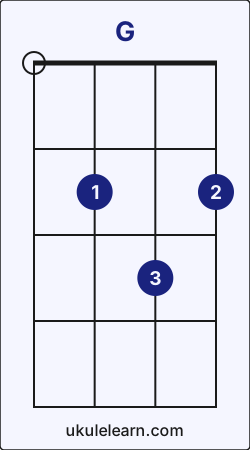 Ukulele G chord diagram
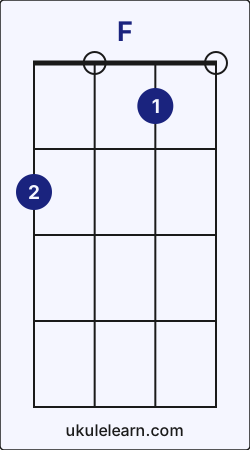 Ukulele F chord diagram
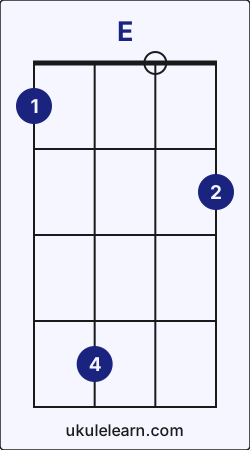 Ukulele E chord diagram
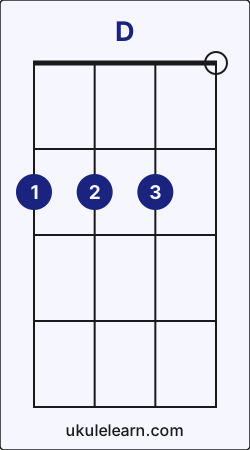 Ukulele D chord diagram
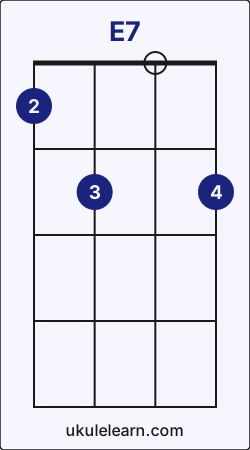 Ukulele E7 chord diagram
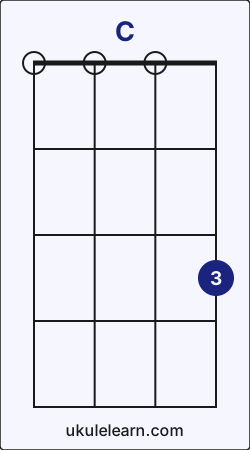 Ukulele C chord diagram
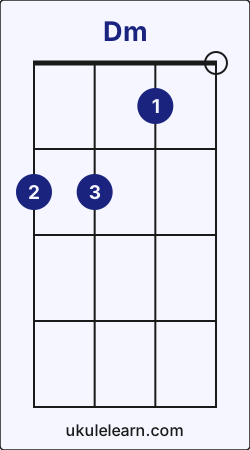 Ukulele Dm chord diagram
[Opening]
[Am] [G] [F] [E] [D] [Am] [G] [Am] [G] [F] [E] [D] [Am] [G] [Am] [G] [F] [E] [D] [Am] [G]
[Am]Everyone’s feeling pretty, [G] [F]it’s hotter than July, [E] [D]
Though the world’s full of problems, they couldn’t [Am]touch us even if they [G]tried.
[Am]From the park I hear rhythms, [G] [F]Marley’s hot on the box, [E] [D]
Tonight there will be a party on [Am]the corner at the end of [G]the block.
[section 2]
Didn’t know [Am]you would be [E7]jamming until the break of [D]dawn!
I [E7]bet you, nobody ever told you
That [Am]you would be [E7]jamming until the break [D]of dawn,
You would be jamming and jamming and jamming, [Am]jam on!
[section 3]
[Am] [C] [Dm] [Am] [Am] [C] [Dm]
[Am]They want us to join their fighting [G] [F]but our answer today [E] [D]
Is to let all our worries like the [Am]breeze through our fingers slip [G]away.
[Am]Peace has come to Zimbabwe, [G] [F]third World’s right on the one, [E] [D]
Now’s the time for celebration ’cause we’ve [Am]only just [G]begun.
[section 4]
Didn’t know [Am]you would be [E7]jamming until the break of [D]dawn!
I [E7]bet you, nobody ever told you
That [Am]you would be [E7]jamming until the break [D]of dawn,
[E7]Bet you, nobody ever told you
That [Am]you would be [E7]jamming until the break [D]of dawn,
[E7]I know, nobody told you
That [Am]you would be [E7]jamming until the break [D]of dawn,
We’re jamming, jamming, jam, [Am]jam on!
[section 5]
[Am] [C] [Dm] [Am] [Am] [C] [Dm] [Am] [G] [F] [E] [D] [Am] [G]
[Am]You ask me, am I happy, [G] [F]well, as a matter of fact, [E] [D]
I can say that I’m ecstatic, ’cause [Am]we all just made a [G]pact.
[Am]We’ve agreed to get together, [G] [F]joined as children in [E]Jah [D]
When you’re moving in the positive, your [Am]destination is the brightest [G]star.
[Closing]
You didn’t know that [Am]you would be [E7]jamming until the break of [D]dawn!
I [E7]bet you, nobody ever told you
That [Am]you would be [E7]jamming until the break of [D]dawn!
Oh, oh, oh, oh, [Am]you, would be [E7]jamming until the break of [D]dawn!
How to play Master Blaster (Jammin') on Ukulele (Step-by-step)
Stevie Wonder - Master Blaster (Jammin') on ukulele requires 8 chords and 10 core chord transitions. You can find the full step-by-step guide below. Before you start, tune your instrument. The song uses the ↓-↓↑-↓↑-↓↑ pattern; practice it muted first, or simplify to downstrokes while you learn the changes.
Master Blaster (Jammin') uses these transitions most often: Am → G (20), D → Am (13), and E → D (10). These transitions may feel a little challenging at first, but with steady practice you can play this song quickly.When you are ready, begin with Am - G chord transition.
1. Am → G chord transition
To move from Am to G;
- Lift your middle finger from G string fret 2 and place it on A string fret 2.
- Place index finger on C string fret 2.
- Place ring finger on E string fret 3.
2. G → F chord transition
To move from G to F;
- While playing G, lift your ring finger from E string fret 3.
- Lift your index finger from C string fret 2 and place it on E string fret 1.
- Slide your middle finger from A string fret 2 to G string fret 2.
3. F → E chord transition
To move from F to E;
- Lift your index finger from E string fret 1 and place it on G string fret 4.
- Slide your middle finger from G string fret 2 to A string fret 2.
4. E → D chord transition
To move from E to D;
- Slide your index finger on G string from fret 4 to fret 2.
- Slide your middle finger from A string fret 2 to C string fret 2.
- Place ring finger on E string fret 2.
5. D → Am chord transition
To move from D to Am;
- While playing D, first lift your index finger and ring finger.
- Lift your middle finger from C string fret 2 and place it on G string fret 2.
6. Am → E7 chord transition
To move from Am to E7;
- Lift your middle finger from G string fret 2 and place it on C string fret 2.
- Place index finger on G string fret 1.
- Place ring finger on A string fret 2.
7. E7 → D chord transition
To move from E7 to D;
- Slide your index finger on G string from fret 1 to fret 2.
- Keep middle finger on C string fret 2.
- Slide your ring finger from A string fret 2 to E string fret 2.
8. Am → C chord transition
To move from Am to C;
- While playing Am, lift your middle finger from G string fret 2.
- Place ring finger on A string fret 3.
9. C → Dm chord transition
To move from C to Dm;
- Lift your ring finger from A string fret 3 and place it on C string fret 2.
- Place index finger on E string fret 1.
- Place middle finger on G string fret 2.
10. Dm → Am chord transition
To move from Dm to Am;
- While playing Dm, first lift your index finger and ring finger.
- Keep middle finger on G string fret 2.
Master Blaster (Jammin') chord transition analysis
A short, data-driven summary of the chord flow in Master Blaster (Jammin').
- Master Blaster (Jammin') includes 113 chord transitions, 10 of them unique.
- These transitions represent 0.03% of all chord transitions in Ukulelearn.
- Master Blaster (Jammin') contains 2 of the top 10 transitions across Ukulelearn.
- These transition patterns show how Master Blaster (Jammin') connects to the rest of Ukulelearn. Mastering them helps you move to similar songs faster.After Am, the most likely next chords across Ukulelearn are F (26%), G (21%), and C (16%).
- Am → G: 21%
- Am → C: 16%
After G, the most likely next chords across Ukulelearn are C (25%), D (24%), and Am (13%).- G → Am: 13%
- G → F: 9%