
Phoebe Bridgers - Motion Sickness Ukulele Chords
Before you play, tune your ukulele and use the tools below to set up your view and flow.
 Ukulele C chord diagram
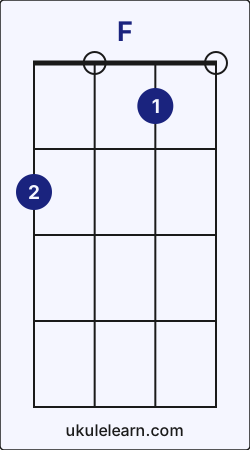 Ukulele F chord diagram
 Ukulele Am chord diagram
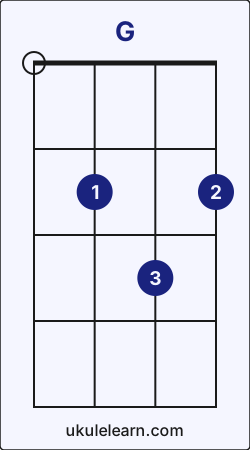 Ukulele G chord diagram
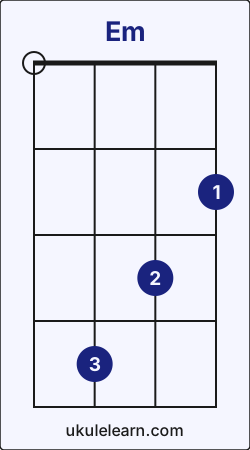 Ukulele Em chord diagram
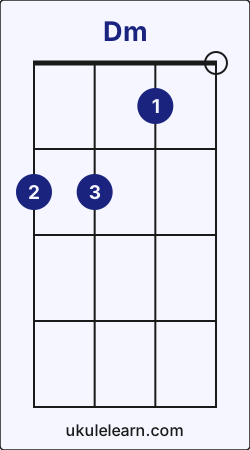 Ukulele Dm chord diagram
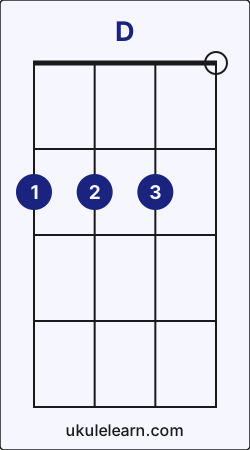 Ukulele D chord diagram
[Opening]
[C]
[F]I hate you for what [C]you did, and I [F]miss you like a [C]little kid
I [Am]faked it [C]every time but that’s [G]alright, I can [F]hardly feel anything
I hardly feel anything at all [G] [C]
[section 2]
You gave me [F]fifteen [C]hundred, to see [F]your [C]hypnotherapist
I only [Am]went [C]one time, you let it [G]slide
Fell on [F]hard times a year ago
Was hoping you would let it go and you did [G] [C]
[chorus]
[F]I have [C] [G]emotional motion [F]sickness
Somebody [Am]roll [Em]the [F]windows down
There are no [C]words in the [G]English [Dm]language
I could scream to [F]drown you out
[section 3]
[C]
I’m on [F]the outside [C]looking through
You’re [F]throwing rocks around [C]your room
And while you’r[Am]e bleeding on your[C]back in the g[G]lass
I’ll be [F]glad that I made it out
And sorry that it all went down like it did [G] [C]
[chorus]
[F]I have [C] [G]emotional motion [F]sickness
Somebody [Am]roll [Em]the [F]windows down
There are no [C]words in the [G]English [Dm]language
I could scream to [F]drown you out
[section 4]
And why do [C]you sing [G]with an [F]English accent
I guess it’s too [Am]late [Em]to change [F]it now
You know I’m [C]never [G]gonna let you have [Dm]it
But I will try to [F]drown you out
[section 5]
[G] [Am] [F] [G] [Am] [F] [G] [Am] [F] [G]
You said when you met me you were bored
You [Am]said [F]when you met me[G]yo[Am]u we[F]re bor[G]ed
And you you were [Dm]in a band [F]when I was [D]born
[Closing]
[F]I have[C]emotion[G]al motion [F]sickness
I try to stay [Am] [Em]clean; you [F]live without
And I [C]want to [G]know what would [Dm]happen
If I [F]surrender to the sound, surrender to the sound [F]
How to play Motion Sickness on Ukulele (Step-by-step)
Phoebe Bridgers - Motion Sickness on ukulele requires 7 chords and 11 core chord transitions. You can find the full step-by-step guide below. Before you start, tune your instrument. The song uses the ↓-↓↑-↓↑-↓↑ pattern; practice it muted first, or simplify to downstrokes while you learn the changes.
Motion Sickness uses these transitions most often: F → C (15), C → G (11), and F → G (9). These transitions may feel a little challenging at first, but with steady practice you can play this song quickly.When you are ready, begin with C - F chord transition.
1. C → F chord transition
To move from C to F;
- While playing C, lift your ring finger from A string fret 3.
- Place index finger on E string fret 1.
- Place middle finger on G string fret 2.
2. C → Am chord transition
To move from C to Am;
- While playing C, lift your ring finger from A string fret 3.
- Place middle finger on G string fret 2.
3. C → G chord transition
To move from C to G;
- Lift your ring finger from A string fret 3 and place it on E string fret 3.
- Place index finger on C string fret 2.
- Place middle finger on A string fret 2.
4. G → F chord transition
To move from G to F;
- While playing G, lift your ring finger from E string fret 3.
- Lift your index finger from C string fret 2 and place it on E string fret 1.
- Slide your middle finger from A string fret 2 to G string fret 2.
5. F → Am chord transition
To move from F to Am;
- While playing F, lift your index finger from E string fret 1.
- Keep middle finger on G string fret 2.
6. Am → Em chord transition
To move from Am to Em;
- Lift your middle finger from G string fret 2 and place it on E string fret 3.
- Place index finger on A string fret 2.
- Place ring finger on C string fret 4.
7. Em → F chord transition
To move from Em to F;
- While playing Em, lift your ring finger from C string fret 4.
- Lift your index finger from A string fret 2 and place it on E string fret 1.
- Slide your middle finger from E string fret 3 to G string fret 2.
8. G → Dm chord transition
To move from G to Dm;
- Lift your index finger from C string fret 2 and place it on E string fret 1.
- Slide your middle finger from A string fret 2 to G string fret 2.
- Lift your ring finger from E string fret 3 and place it on C string fret 2.
9. Dm → F chord transition
To move from Dm to F;
- While playing Dm, lift your ring finger from C string fret 2.
- Keep index finger on E string fret 1.
- Keep middle finger on G string fret 2.
10. G → Am chord transition
To move from G to Am;
- While playing G, first lift your index finger and ring finger.
- Lift your middle finger from A string fret 2 and place it on G string fret 2.
11. F → D chord transition
To move from F to D;
- Lift your index finger from E string fret 1 and place it on G string fret 2.
- Slide your middle finger from G string fret 2 to C string fret 2.
- Place ring finger on E string fret 2.
Motion Sickness chord transition analysis
A short, data-driven summary of the chord flow in Motion Sickness.
- Motion Sickness includes 93 chord transitions, 11 of them unique.
- These transitions represent 0.02% of all chord transitions in Ukulelearn.
- Motion Sickness contains 5 of the top 10 transitions across Ukulelearn.
- These transition patterns show how Motion Sickness connects to the rest of Ukulelearn. Mastering them helps you move to similar songs faster.After F, the most likely next chords across Ukulelearn are C (40%), G (21%), and Am (11%).
- F → C: 40%
- F → G: 21%
After C, the most likely next chords across Ukulelearn are G (35%), F (16%), and D (11%).- C → G: 35%
- C → F: 16%