
Bob Dylan - My Back Pages Ukulele Chords
Before you play, tune your ukulele and use the tools below to set up your view and flow.
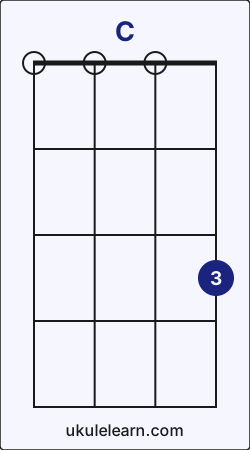 Ukulele C chord diagram
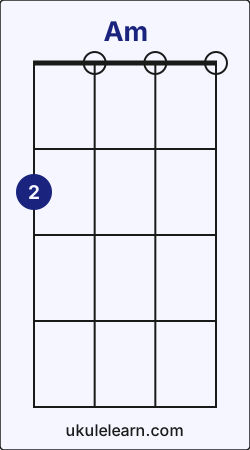 Ukulele Am chord diagram
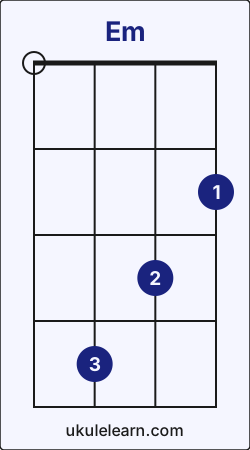 Ukulele Em chord diagram
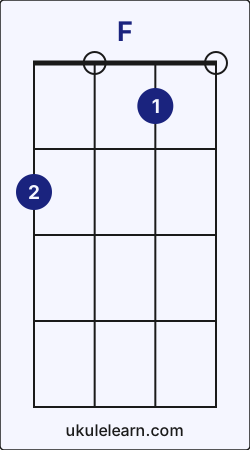 Ukulele F chord diagram
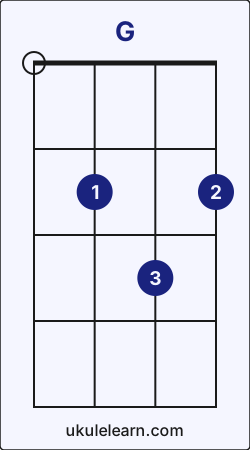 Ukulele G chord diagram
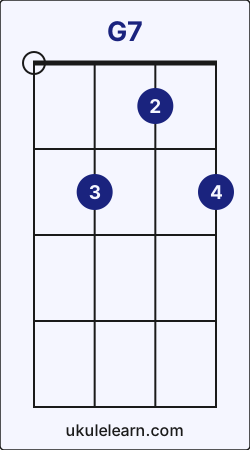 Ukulele G7 chord diagram
[Opening]
[C]Crimson [Am]flames tied [Em]through my ears
Rollin’ [F]high and [G]mighty [C]traps
[C]Pounced with [Am]fire on [Em]flaming [C]roads
Using [F]ideas [Em]as my [G]maps
[section 2]
“We’ll [F]meet on [Am]edges, [G]soon,” said [C]I
[Am]Proud ‘neath heated [F]brow. [G]
Ah, [C]but I was so much [Am]older [C]then,
I’m [F]younger [G]than that [C]now.
[interlude]
[G] [G] [G7] [G7]
[section 3]
[C]Half-wracked [Am]prejudice [Em]leaped forth
“[F]Rip down all [G]hate,” I [C]screamed
[C]Lies that [Am]life is [Em]black and white
[F]Spoke from my skull. I [G]dreamed
[section 4]
Ro[Am]mantic facts of [Em]musketeers
Foun[F]dationed deep, some[G]how.
Ah, but [C]I was [Am]so much [Em]older [F]then,
I’m [G]younger [G7]than that [C]now.
[section 5]
[C]Girls’ faces [Am]formed the [Em]forward path
From [F]phony [G]jealou[C]sy
[C]To memo[Am]rizing [Em]politics
Of [F]ancient [Am]histo[G]ry
[section 6]
Flung [Am]down by corpse e[Em]vangelists
Un[F]thought of, though, som[G]how.
Ah, [C]but I was so much [F]older [C]then,
I’m [F]younger [G]than that [C]now.
[section 7]
A [C]self-or-[Am]dained pro[Em]fessor’s tongue
Too [F]ser[G]ious to [C]fool
[C]Spouted [Am]out that [Em]liberty
Is [F]just equality in [G]school
[section 8]
“E[Am]quality,” I [Em]spoke the word
As [F]if a wedding [G]vow.
Ah, [C]but I was [Am]so much older then,
[F]I’m younger [G]than that [C]now.
[section 9]
In a [C]soldier’s [Am]stance, I [Em]aimed my hand
At the [F]mongrel [G]dogs who [C]teach
[C]Fearing not that I’d [Am]become my [Em]enemy
In the [F]instant that I [G]preach
[section 10]
My [Am]existence led by [F]confusion [C]boats
[Am]Mutiny from [Em]stern to [G]bow.
Ah, but [C]I was [Am]so much [F]older [C]then,
I’m [G]younger than that [C]now.
[section 11]
Yes, my [C]guard [Am]stood hard when [Em]abstract threats
Too [F]noble [G]to ne[C]glect
De[C]ceived me [Am]into [Em]thinking
I had [F]something to pro[G]tect
[Closing]
[Am]Good and bad, I de[Em]fine these terms
[F]Quite clear, no doubt, some[G]how.
Ah, but [C]I was [Am]so much [F]older [C]then,
I’m [G]younger than that [C]now.
How to play My Back Pages on Ukulele (Step-by-step)
Bob Dylan - My Back Pages on ukulele requires 6 chords and 12 core chord transitions. You can find the full step-by-step guide below. Before you start, tune your instrument. The song uses the ↓-↓↑-↑↓↑ pattern; practice it muted first, or simplify to downstrokes while you learn the changes.
My Back Pages uses these transitions most often: C → Am (19), F → G (19), and Am → Em (18). These transitions may feel a little challenging at first, but with steady practice you can play this song quickly.When you are ready, begin with C - Am chord transition.
1. C → Am chord transition
To move from C to Am;
- While playing C, lift your ring finger from A string fret 3.
- Place middle finger on G string fret 2.
2. Am → Em chord transition
To move from Am to Em;
- Lift your middle finger from G string fret 2 and place it on E string fret 3.
- Place index finger on A string fret 2.
- Place ring finger on C string fret 4.
3. Em → F chord transition
To move from Em to F;
- While playing Em, lift your ring finger from C string fret 4.
- Lift your index finger from A string fret 2 and place it on E string fret 1.
- Slide your middle finger from E string fret 3 to G string fret 2.
4. F → G chord transition
To move from F to G;
- Lift your index finger from E string fret 1 and place it on C string fret 2.
- Slide your middle finger from G string fret 2 to A string fret 2.
- Place ring finger on E string fret 3.
5. G → C chord transition
To move from G to C;
- While playing G, first lift your index finger and middle finger.
- Lift your ring finger from E string fret 3 and place it on A string fret 3.
6. Em → C chord transition
To move from Em to C;
- While playing Em, first lift your index finger and middle finger.
- Lift your ring finger from C string fret 4 and place it on A string fret 3.
7. C → F chord transition
To move from C to F;
- While playing C, lift your ring finger from A string fret 3.
- Place index finger on E string fret 1.
- Place middle finger on G string fret 2.
8. Em → G chord transition
To move from Em to G;
- Lift your index finger from A string fret 2 and place it on C string fret 2.
- Slide your middle finger from E string fret 3 to A string fret 2.
- Lift your ring finger from C string fret 4 and place it on E string fret 3.
9. F → Am chord transition
To move from F to Am;
- While playing F, lift your index finger from E string fret 1.
- Keep middle finger on G string fret 2.
10. Am → G chord transition
To move from Am to G;
- Lift your middle finger from G string fret 2 and place it on A string fret 2.
- Place index finger on C string fret 2.
- Place ring finger on E string fret 3.
11. G → G7 chord transition
To move from G to G7;
- Lift your index finger from C string fret 2 and place it on E string fret 1.
- Slide your middle finger from A string fret 2 to C string fret 2.
- Lift your ring finger from E string fret 3 and place it on A string fret 2.
12. G7 → C chord transition
To move from G7 to C;
- While playing G7, first lift your index finger and middle finger.
- Slide your ring finger on A string from fret 2 to fret 3.
My Back Pages chord transition analysis
A short, data-driven summary of the chord flow in My Back Pages.
- My Back Pages includes 125 chord transitions, 12 of them unique.
- These transitions represent 0.03% of all chord transitions in Ukulelearn.
- My Back Pages contains 6 of the top 10 transitions across Ukulelearn.
- These transition patterns show how My Back Pages connects to the rest of Ukulelearn. Mastering them helps you move to similar songs faster.After C, the most likely next chords across Ukulelearn are G (35%), F (16%), and D (11%).
- C → G: 35%
- C → F: 16%
After G, the most likely next chords across Ukulelearn are C (25%), D (24%), and Am (13%).- G → C: 25%
- G → Am: 13%