
Bon Jovi - Never Say Goodbye Ukulele Chords
Before you play, tune your ukulele and use the tools below to set up your view and flow.
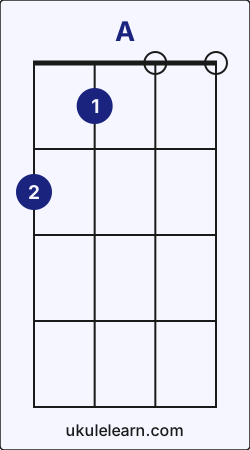 Ukulele A chord diagram
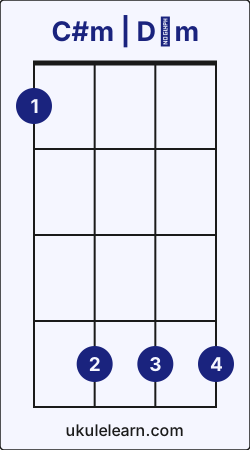 Ukulele C#m | D♭m chord diagram
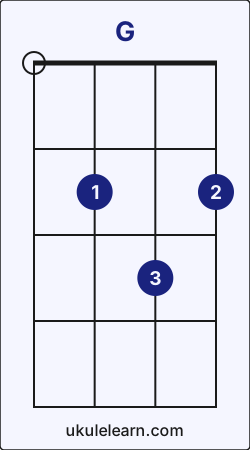 Ukulele G chord diagram
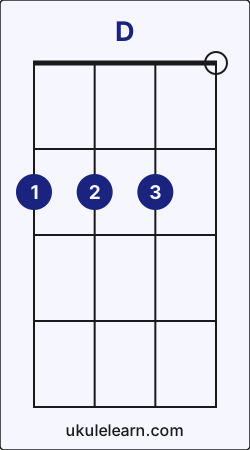 Ukulele D chord diagram
[Opening]
[A]As I sit in this smokey room, [C#m]the night about to end
[G]I pass my time with strangers, but this [D]bottle’s my only friend
[A]Remember when we used to park, [C#m]on Butler Street out in the dark
[G]Remember when we lost the keys, [D]and you lost more than that in my backseat
[section 2]
[A]Remember how we used to talk about, [C#m]busting out,
We’d break their hearts, to[G]get[D]her, for[G][D]ever
[chorus]
Never [A]say goodbye, never [C#m]say goodbye, [G]you and me and my old friends
[D]Hoping it would never end, [A]say goodbye, never [C#m]say goodbye
[G]Holding on, we got to try, [D]holding on to never say good[A]bye
[section 3]
[A]Remember days of skipping school, [C#m]racing cars and being cool
With a [G]six pack and the radio, [D]we didn’t need no place to go
[A]Remember at the prom that night, [C#m]you and me we had a fight
But the [G]band they played our favorite song, [D]and I held you in my arms so strong
[section 4]
[A]We danced so close, [A]we danced so slow
And I [C#m]swore I’d never let you go, to[G]get[D]her, for[G][D]ever
[chorus]
Never [A]say goodbye, never [C#m]say goodbye, [G]you and me and my old friends
[D]Hoping it would never end, [A]say goodbye, never [C#m]say goodbye
[G]Holding on, we got to try, [D]holding on to never say good[A]bye
[Closing]
[A]I guess you’d say we used to talk about, [C#m]busting out
We’d break their hearts, to[G]get[D]her, for[G][D]ever
How to play Never Say Goodbye on Ukulele (Step-by-step)
Bon Jovi - Never Say Goodbye on ukulele requires 4 chords and 4 core chord transitions. You can find the full step-by-step guide below. Before you start, tune your instrument. The song uses the ↓-↓↑-↓↑-↓↑ pattern; practice it muted first, or simplify to downstrokes while you learn the changes.
Never Say Goodbye uses these transitions most often: G → D (14), A → C#m (11), and C#m → G (11). These transitions may feel a little challenging at first, but with steady practice you can play this song quickly.When you are ready, begin with A - C#m chord transition.
1. A → C#m chord transition
To move from A to C#m;
- Lift your index finger from C string fret 1 and place it on G string fret 1.
- Slide your middle finger from G string fret 2 to C string fret 4.
- Place ring finger on E string fret 4.
- Place pinky on A string fret 4.
2. C#m → G chord transition
To move from C#m to G;
- While playing C#m, lift your pinky from A string fret 4.
- Lift your index finger from G string fret 1 and place it on C string fret 2.
- Slide your middle finger from C string fret 4 to A string fret 2.
- Slide your ring finger on E string from fret 4 to fret 3.
3. G → D chord transition
To move from G to D;
- Lift your index finger from C string fret 2 and place it on G string fret 2.
- Slide your middle finger from A string fret 2 to C string fret 2.
- Slide your ring finger on E string from fret 3 to fret 2.
4. D → A chord transition
To move from D to A;
- While playing D, lift your ring finger from E string fret 2.
- Lift your index finger from G string fret 2 and place it on C string fret 1.
- Slide your middle finger from C string fret 2 to G string fret 2.
Never Say Goodbye chord transition analysis
A short, data-driven summary of the chord flow in Never Say Goodbye.
- Never Say Goodbye includes 49 chord transitions, 4 of them unique.
- These transitions represent 0.01% of all chord transitions in Ukulelearn.
- Never Say Goodbye contains 2 of the top 10 transitions across Ukulelearn.
- These transition patterns show how Never Say Goodbye connects to the rest of Ukulelearn. Mastering them helps you move to similar songs faster.After A, the most likely next chords across Ukulelearn are D (29%), G (13%), and E (12%).
- A → C#m: 2%
After G, the most likely next chords across Ukulelearn are C (25%), D (24%), and Am (13%).- G → D: 24%