
One Direction - Night Changes Ukulele Chords
Before you play, tune your ukulele and use the tools below to set up your view and flow.
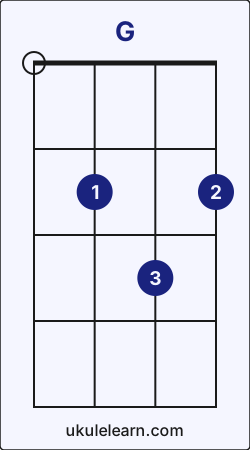 Ukulele G chord diagram
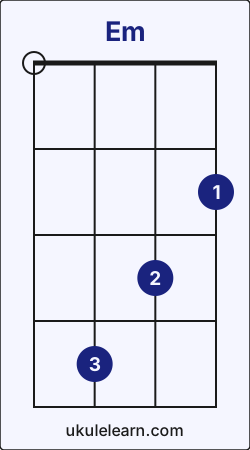 Ukulele Em chord diagram
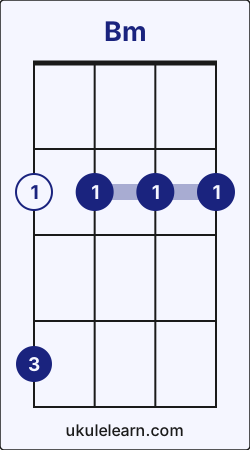 Ukulele Bm chord diagram
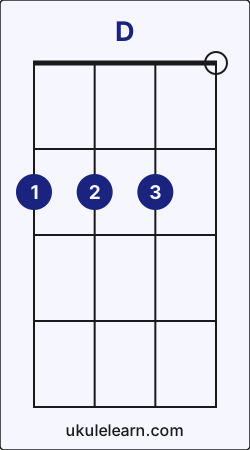 Ukulele D chord diagram
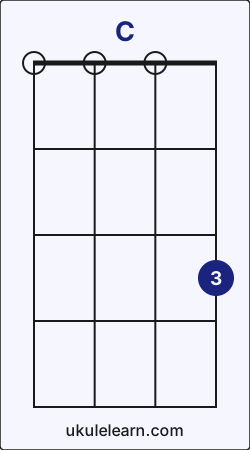 Ukulele C chord diagram
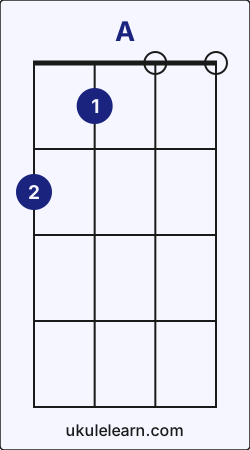 Ukulele A chord diagram
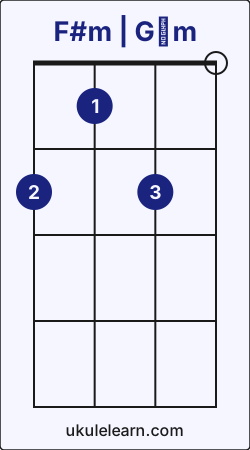 Ukulele F#m | G♭m chord diagram
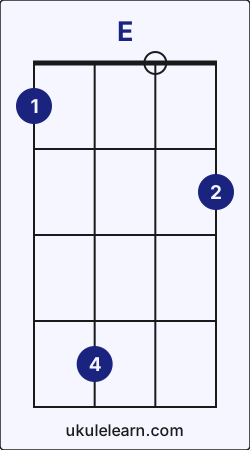 Ukulele E chord diagram
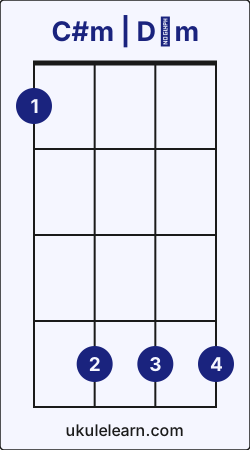 Ukulele C#m | D♭m chord diagram
[Opening]
[G]Going out tonight, changes into something red
[Em]Her mother doesn’t like that kind of dress
[Bm]Everything she never had
She’s showing [D]off
[G]Driving too fast, moon is breaking through her hair
[Em]She said it was something that she won’t forget
[Bm]Having no regrets is all that she really [D]wants
[chorus]
[C]We’re only getting [D]older baby
[C]And I’ve been thinking [D]about it lately
[C]Does it ever [D]drive you crazy
[G]Just how [D]fast the [Em]night changes
[C]Everything that you’ve [D]ever dreamed of
[C]Disappearing [D]when you wake up
[C]But there’s nothing to [D]be afraid of
[G]Even [D]when the [Em]night changes
[C]It will never [D]change me and [G]you
[section 2]
[G]Chasing her tonight, doubts are running ‘round her head
[Em]He’s waiting, hides behind his cigarette
[Bm]Heart is beating loud, she doesn’t want it to [D]stop
[G]Moving too fast, moon is lighting up her skin
[Em]She’s falling, doesn’t even know it yet
[Bm]Having no regrets is all that she really [D]wants
[chorus]
[C]We’re only getting [D]older baby
[C]And I’ve been thinking [D]about it lately
[C]Does it ever [D]drive you crazy
[G]Just how [D]fast the [Em]night changes
[C]Everything that you’ve [D]ever dreamed of
[C]Disappearing [D]when you wake up
[C]But there’s nothing to [D]be afraid of
[G]Even [D]when the [Em]night changes
[C]It will never [D]change me and [A]you
[interlude]
[A] [F#m] [D] [E]
[section 3]
[A]Going out tonight, changes into something red
[F#m]Her mother doesn’t like that kind of dress
[C#m]Reminds her of a missing piece of innocence she [E]lost
[chorus]
[D]We’re only getting [E]older baby
[D]And I’ve been thinking [E]about it lately
[D]Does it ever [E]drive you crazy
[A]Just how [E]fast the [F#m]night changes
[D]Everything that you’ve [E]ever dreamed of
[D]Disappearing [E]when you wake up
[D]But there’s nothing to [E]be afraid of
[A]Even [E]when the [F#m]night changes
[D]Everything that you’ve [E]ever dreamed of
[D]Disappearing [E]when you wake up
[D]But there’s nothing to [E]be afraid of
[A]Even [E]when the [F#m]night changes
[Closing]
[D]It will never [E]change, baby
[D]We will never [E]change, baby
[D]It will never [E]change me and [A]you
How to play Night Changes on Ukulele (Step-by-step)
One Direction - Night Changes on ukulele requires 9 chords and 15 core chord transitions. You can find the full step-by-step guide below. Before you start, tune your instrument. The song uses the ↓-↓↑-↑↓↑ pattern; practice it muted first, or simplify to downstrokes while you learn the changes.
Night Changes uses these transitions most often: C → D (14), D → E (13), and D → C (10). These transitions may feel a little challenging at first, but with steady practice you can play this song quickly.When you are ready, begin with G - Em chord transition.
1. G → Em chord transition
To move from G to Em;
- Lift your index finger from C string fret 2 and place it on A string fret 2.
- Slide your middle finger from A string fret 2 to E string fret 3.
- Lift your ring finger from E string fret 3 and place it on C string fret 4.
2. Em → Bm chord transition
To move from Em to Bm;
- While playing Em, lift your middle finger from E string fret 3.
- Lift your index finger from A string fret 2 and place it on C string fret 2.
- Slide your ring finger from C string fret 4 to G string fret 4.
3. Bm → D chord transition
To move from Bm to D;
- Lift your index finger from C string fret 2 and place it on G string fret 2.
- Slide your ring finger from G string fret 4 to E string fret 2.
- Place middle finger on C string fret 2.
4. D → G chord transition
To move from D to G;
- Lift your index finger from G string fret 2 and place it on C string fret 2.
- Slide your middle finger from C string fret 2 to A string fret 2.
- Slide your ring finger on E string from fret 2 to fret 3.
5. D → C chord transition
To move from D to C;
- While playing D, first lift your index finger and middle finger.
- Lift your ring finger from E string fret 2 and place it on A string fret 3.
6. D → Em chord transition
To move from D to Em;
- Lift your index finger from G string fret 2 and place it on A string fret 2.
- Slide your middle finger from C string fret 2 to E string fret 3.
- Lift your ring finger from E string fret 2 and place it on C string fret 4.
7. Em → C chord transition
To move from Em to C;
- While playing Em, first lift your index finger and middle finger.
- Lift your ring finger from C string fret 4 and place it on A string fret 3.
8. D → A chord transition
To move from D to A;
- While playing D, lift your ring finger from E string fret 2.
- Lift your index finger from G string fret 2 and place it on C string fret 1.
- Slide your middle finger from C string fret 2 to G string fret 2.
9. A → F#m chord transition
To move from A to F#m;
- Keep index finger on C string fret 1.
- Keep middle finger on G string fret 2.
- Place ring finger on E string fret 2.
10. F#m → D chord transition
To move from F#m to D;
- Lift your index finger from C string fret 1 and place it on G string fret 2.
- Slide your middle finger from G string fret 2 to C string fret 2.
- Keep ring finger on E string fret 2.
11. D → E chord transition
To move from D to E;
- While playing D, lift your ring finger from E string fret 2.
- Slide your index finger on G string from fret 2 to fret 4.
- Slide your middle finger from C string fret 2 to A string fret 2.
12. E → A chord transition
To move from E to A;
- Lift your index finger from G string fret 4 and place it on C string fret 1.
- Slide your middle finger from A string fret 2 to G string fret 2.
13. F#m → C#m chord transition
To move from F#m to C#m;
- Lift your index finger from C string fret 1 and place it on G string fret 1.
- Slide your middle finger from G string fret 2 to C string fret 4.
- Slide your ring finger on E string from fret 2 to fret 4.
- Place pinky on A string fret 4.
14. C#m → E chord transition
To move from C#m to E;
- While playing C#m, first lift your ring finger and pinky.
- Slide your index finger on G string from fret 1 to fret 4.
- Slide your middle finger from C string fret 4 to A string fret 2.
15. E → F#m chord transition
To move from E to F#m;
- Lift your index finger from G string fret 4 and place it on C string fret 1.
- Slide your middle finger from A string fret 2 to G string fret 2.
- Place ring finger on E string fret 2.
Night Changes chord transition analysis
A short, data-driven summary of the chord flow in Night Changes.
- Night Changes includes 97 chord transitions, 15 of them unique.
- These transitions represent 0.03% of all chord transitions in Ukulelearn.
- Night Changes contains 5 of the top 10 transitions across Ukulelearn.
- These transition patterns show how Night Changes connects to the rest of Ukulelearn. Mastering them helps you move to similar songs faster.After D, the most likely next chords across Ukulelearn are G (29%), A (17%), and Em (17%).
- D → G: 29%
- D → A: 17%
After E, the most likely next chords across Ukulelearn are A (25%), D (14%), and B (11%).- E → A: 25%
- E → D: 14%