
Bob Seger - Night Moves Ukulele Chords
Before you play, tune your ukulele and use the tools below to set up your view and flow.
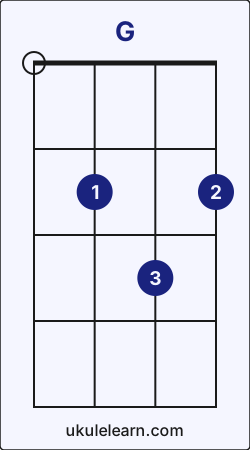 Ukulele G chord diagram
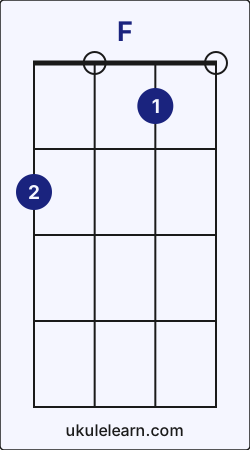 Ukulele F chord diagram
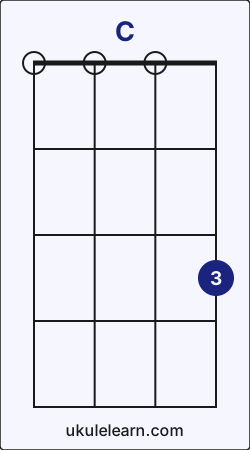 Ukulele C chord diagram
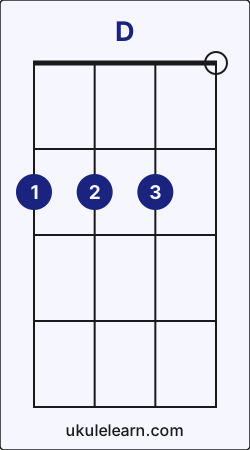 Ukulele D chord diagram
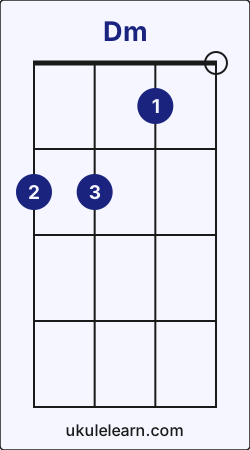 Ukulele Dm chord diagram
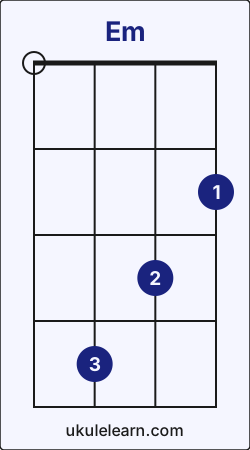 Ukulele Em chord diagram
[Opening]
[G]I was a little too tall, could’ve used a few pounds [F]
Tight [C]pants points hardly reknown [F]
[G]She was a black haired beauty with big dark eyes [F]
[C]And points all her own sitting way up high [D][G][Dm]
[C]Way up firm and high [F]
[section 2]
[G]Out past the cornfields where the woods got heavy [F]
[C]Out in the back seat of my ’60 Chevy [F]
[G]Working on mysteries without any clues [D]
[C]Working on our [Em]night moves [C]
[C]Tryingg to make some [Em]front page drive-in [C]news
Working on our [Em]night moves [C][G]in the summertime [F]
[C]Oooh [F][G]In the sweet summertime [F][C]
[section 3]
[G]We weren’t in love oh no far from it
[C]We weren’t searching for some pie in the sky summit
[G]We were just young and restless and bored
[C]Living by the sword
[G]And we’d steal away every chance we could
[G]To the backroom, the alley, the trusty woods [F]
[G]I used her she used me
[G]But neither one cared
[C]We were getting our share
[section 4]
Working on our [Em]night moves
[C]Trying to lose the [Em]awkward teenage blues
[C]Working on out [Em]night moves [C]Oooh
[G]It was summertime [F][C]Ooooh [G]Sweet summer time, [F]summer time [Em][G]
[C]And oh the [G]wonder, [C]felt the lightning
And we [F]waited on the thunder
[D]Waited on the thunder [G]
[Closing]
I woke last night to the sound of thunder [C]
How far off I sat and wondered [G]
Started humming a song from 1962 [C]
Ain’t it funny how the [Em]night moves [C]
When you just don’t seem to [Em]have as much to lose [C]
Strange how the [Em]night moves [C]
With autumn closing in [C][Em][G]
How to play Night Moves on Ukulele (Step-by-step)
Bob Seger - Night Moves on ukulele requires 6 chords and 11 core chord transitions. You can find the full step-by-step guide below. Before you start, tune your instrument. The song uses the ↓-↓↑-↑↓↑ pattern; practice it muted first, or simplify to downstrokes while you learn the changes.
Night Moves uses these transitions most often: C → Em (10), Em → C (9), and C → G (8). These transitions may feel a little challenging at first, but with steady practice you can play this song quickly.When you are ready, begin with G - F chord transition.
1. G → F chord transition
To move from G to F;
- While playing G, lift your ring finger from E string fret 3.
- Lift your index finger from C string fret 2 and place it on E string fret 1.
- Slide your middle finger from A string fret 2 to G string fret 2.
2. F → C chord transition
To move from F to C;
- While playing F, first lift your index finger and middle finger.
- Place ring finger on A string fret 3.
3. C → D chord transition
To move from C to D;
- Lift your ring finger from A string fret 3 and place it on E string fret 2.
- Place index finger on G string fret 2.
- Place middle finger on C string fret 2.
4. D → G chord transition
To move from D to G;
- Lift your index finger from G string fret 2 and place it on C string fret 2.
- Slide your middle finger from C string fret 2 to A string fret 2.
- Slide your ring finger on E string from fret 2 to fret 3.
5. G → Dm chord transition
To move from G to Dm;
- Lift your index finger from C string fret 2 and place it on E string fret 1.
- Slide your middle finger from A string fret 2 to G string fret 2.
- Lift your ring finger from E string fret 3 and place it on C string fret 2.
6. Dm → C chord transition
To move from Dm to C;
- While playing Dm, first lift your index finger and middle finger.
- Lift your ring finger from C string fret 2 and place it on A string fret 3.
7. C → Em chord transition
To move from C to Em;
- Lift your ring finger from A string fret 3 and place it on C string fret 4.
- Place index finger on A string fret 2.
- Place middle finger on E string fret 3.
8. C → G chord transition
To move from C to G;
- Lift your ring finger from A string fret 3 and place it on E string fret 3.
- Place index finger on C string fret 2.
- Place middle finger on A string fret 2.
9. F → Em chord transition
To move from F to Em;
- Lift your index finger from E string fret 1 and place it on A string fret 2.
- Slide your middle finger from G string fret 2 to E string fret 3.
- Place ring finger on C string fret 4.
10. Em → G chord transition
To move from Em to G;
- Lift your index finger from A string fret 2 and place it on C string fret 2.
- Slide your middle finger from E string fret 3 to A string fret 2.
- Lift your ring finger from C string fret 4 and place it on E string fret 3.
11. F → D chord transition
To move from F to D;
- Lift your index finger from E string fret 1 and place it on G string fret 2.
- Slide your middle finger from G string fret 2 to C string fret 2.
- Place ring finger on E string fret 2.
Night Moves chord transition analysis
A short, data-driven summary of the chord flow in Night Moves.
- Night Moves includes 69 chord transitions, 11 of them unique.
- These transitions represent 0.02% of all chord transitions in Ukulelearn.
- Night Moves contains 6 of the top 10 transitions across Ukulelearn.
- These transition patterns show how Night Moves connects to the rest of Ukulelearn. Mastering them helps you move to similar songs faster.After C, the most likely next chords across Ukulelearn are G (35%), F (16%), and D (11%).
- C → G: 35%
- C → F: 16%
After G, the most likely next chords across Ukulelearn are C (25%), D (24%), and Am (13%).- G → C: 25%
- G → D: 24%