
Calum Scott - No Matter What Ukulele Chords
Before you play, tune your ukulele and use the tools below to set up your view and flow.
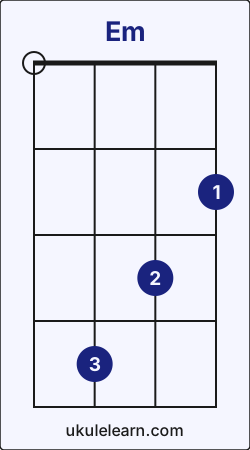 Ukulele Em chord diagram
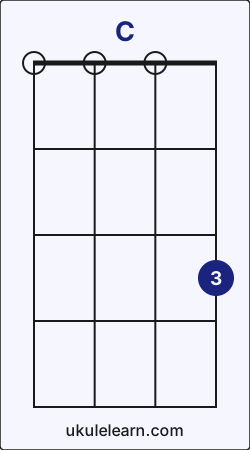 Ukulele C chord diagram
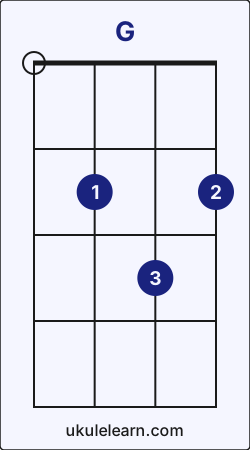 Ukulele G chord diagram
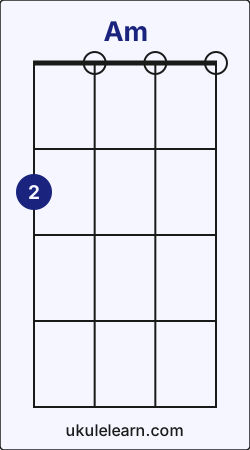 Ukulele Am chord diagram
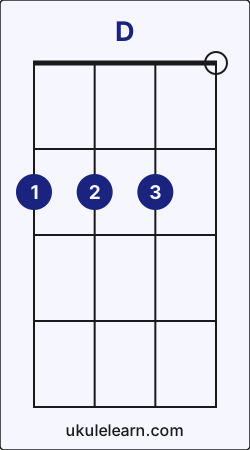 Ukulele D chord diagram
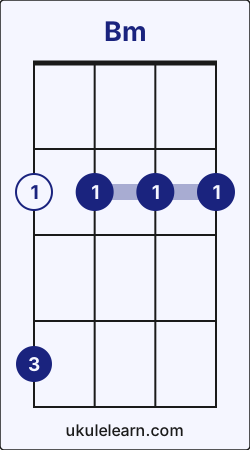 Ukulele Bm chord diagram
[Opening]
[Em] [C] [G]
[Em]When I was a young boy [C]I was scared of growing [G]up
I [Em]did’t understand it but [C]I was terrified of [G]love
Felt [Em]like I had to choose but [C]it was outta my con[G]trol
I [Em]needed to be saved, I was [C]going crazy on my [G]own
It took me [Am]years to tell my [G]mother, I ex[C]pected the worst
I [Am]gathered all the [G]courage in the [D]world
[chorus]
She said, “I love you [Em]no [C]matter [G]what
I just [Em]want you to be [C]happy and always [G]be who you are”
She [Em]wrapped her arms [C]around me, said, “Don’t try to [G]be what you’re [D]not
Cause I [Em]love you no [C]matter [G]what”, she [Em]loves me no [C]matter [G]what
[section 2]
I [Em]got a little older [C]wishing all my time [G]away
[Em]Riding on the pavement, [C]every sunny day was [G]grey
I [Em]trusted in my friends then [C]all my world came crashing [G]down
I wish I [Em]never said a thing cause to [C]them I’m a stranger [G]now
I ran [Am]home I saw my [G]mother, it was [C]written on my face
Felt like I [C]had a heart of [G]glass about to [D]break
[chorus]
She said, “I love you [Em]no [C]matter [G]what
I just [Em]want you to be [C]happy and always [G]be who you are”
She [Em]wrapped her arms [C]around me, said, “Don’t try to [G]be what you’re not
[D]Cause I [Em]love you no [C]matter [G]what, yeah”
[section 3]
[C]Now I’m a man and I’m so much [G]wiser, [C]I walk the earth with my head held [G]higher
[C]I got the love that I [D]need, but I was [Em]still missing [Bm]one special Ampiece
My [G]father looked at [C]me
[Closing]
He said “I love you [Em]no [C]matter [G]what
I just [Em]want you to be [C]happy and always [G]be who you are”
[D]He [Em]wrapped his arms [C]around me, said, “Don’t try to [G]be what you’re not
[D]Cause I [Em]love you no [C]matter [G]what”, [D]he [Em]loves me no [C]matter [G]what
And they [Em]love me no [C]matter [G]what
[D] [Em] [C] [G]
How to play No Matter What on Ukulele (Step-by-step)
Calum Scott - No Matter What on ukulele requires 6 chords and 10 core chord transitions. You can find the full step-by-step guide below. Before you start, tune your instrument. The song uses the ↓-↑-↓-↑ pattern; practice it muted first, or simplify to downstrokes while you learn the changes.
No Matter What uses these transitions most often: C → G (28), Em → C (25), and G → Em (15). These transitions may feel a little challenging at first, but with steady practice you can play this song quickly.When you are ready, begin with Em - C chord transition.
1. Em → C chord transition
To move from Em to C;
- While playing Em, first lift your index finger and middle finger.
- Lift your ring finger from C string fret 4 and place it on A string fret 3.
2. C → G chord transition
To move from C to G;
- Lift your ring finger from A string fret 3 and place it on E string fret 3.
- Place index finger on C string fret 2.
- Place middle finger on A string fret 2.
3. G → Em chord transition
To move from G to Em;
- Lift your index finger from C string fret 2 and place it on A string fret 2.
- Slide your middle finger from A string fret 2 to E string fret 3.
- Lift your ring finger from E string fret 3 and place it on C string fret 4.
4. G → Am chord transition
To move from G to Am;
- While playing G, first lift your index finger and ring finger.
- Lift your middle finger from A string fret 2 and place it on G string fret 2.
5. C → Am chord transition
To move from C to Am;
- While playing C, lift your ring finger from A string fret 3.
- Place middle finger on G string fret 2.
6. G → D chord transition
To move from G to D;
- Lift your index finger from C string fret 2 and place it on G string fret 2.
- Slide your middle finger from A string fret 2 to C string fret 2.
- Slide your ring finger on E string from fret 3 to fret 2.
7. D → Em chord transition
To move from D to Em;
- Lift your index finger from G string fret 2 and place it on A string fret 2.
- Slide your middle finger from C string fret 2 to E string fret 3.
- Lift your ring finger from E string fret 2 and place it on C string fret 4.
8. C → D chord transition
To move from C to D;
- Lift your ring finger from A string fret 3 and place it on E string fret 2.
- Place index finger on G string fret 2.
- Place middle finger on C string fret 2.
9. Em → Bm chord transition
To move from Em to Bm;
- While playing Em, lift your middle finger from E string fret 3.
- Lift your index finger from A string fret 2 and place it on C string fret 2.
- Slide your ring finger from C string fret 4 to G string fret 4.
10. Bm → G chord transition
To move from Bm to G;
- Keep index finger on C string fret 2.
- Lift your ring finger from G string fret 4 and place it on E string fret 3.
- Place middle finger on A string fret 2.
No Matter What chord transition analysis
A short, data-driven summary of the chord flow in No Matter What.
- No Matter What includes 101 chord transitions, 10 of them unique.
- These transitions represent 0.03% of all chord transitions in Ukulelearn.
- No Matter What contains 6 of the top 10 transitions across Ukulelearn.
- These transition patterns show how No Matter What connects to the rest of Ukulelearn. Mastering them helps you move to similar songs faster.After C, the most likely next chords across Ukulelearn are G (35%), F (16%), and D (11%).
- C → G: 35%
- C → D: 11%
After G, the most likely next chords across Ukulelearn are C (25%), D (24%), and Am (13%).- G → C: 25%
- G → D: 24%