
Ariana Grande - Problem Ukulele Chords
Before you play, tune your ukulele and use the tools below to set up your view and flow. Using the Transpose tool, switch to F,A#,C keys to play this song with easier chords.
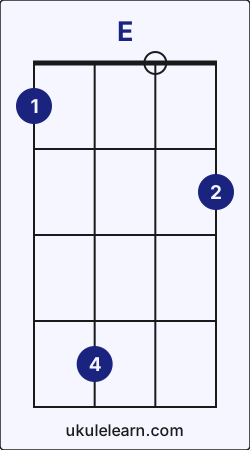 Ukulele E chord diagram
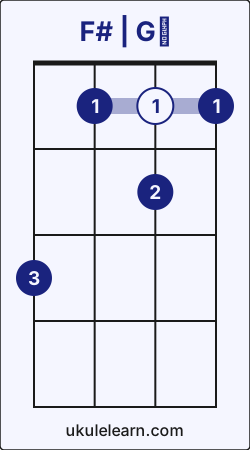 Ukulele F# | G♭ chord diagram
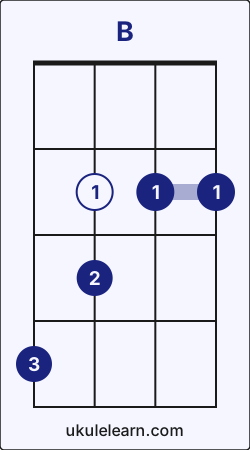 Ukulele B chord diagram
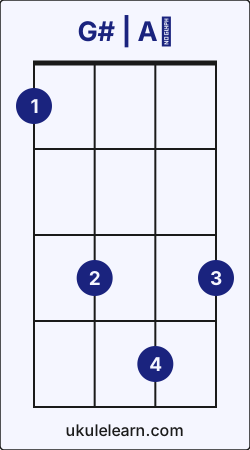 Ukulele G# | A♭ chord diagram
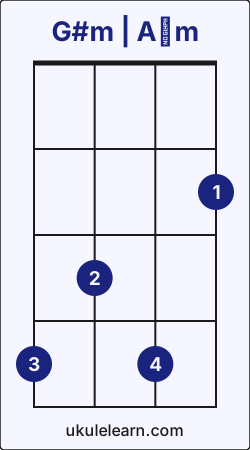 Ukulele G#m | A♭m chord diagram
[Opening]
[E]Baby, even though I hate [F#]ya, I wanna [B]love ya, I want you
[E]And even though I can’t forgive [F#]ya, I really [G#]want to, I want you
[E]Tell me, tell me [F#]baby, [B]why did you leave me
[E]Cause even though I shouldn’t want [F#]it, I gotta [G#m]have it. I want you
[chorus]
[E]Head in the clouds; [F#]got no [B]weight on my shoulders
[E]I should be [F#]wiser; and [G#m]realize that I’ve got
[chorus]
[G#m]One less problem without ya, I got [G#m]one less problem without ya
I got [G#m]one less problem without ya, I got [G#m]one less, one less problem
[G#m]One less problem without ya, I got [G#m]one less problem without ya
I got [G#m]one less problem without ya, I got [G#m]one less, one less problem
[section 2]
[E]I know you’re never gonna wake [F#]up, I gotta [B]give up; but it’s you
[E]Know I shouldn’t never call [F#]back, or let you [G#m]come back
But it’s you, [E]every time you [F#]touch me, [B]and say you love me
[E]I get a little bit [F#]breathless, I shouldn’t [G#m]want it; but it’s you
[chorus]
[E]Head in the clouds; [F#]got no [B]weight on my shoulders
[E]I should be [F#]wiser; and [G#m]realize that I’ve got
[chorus]
[G#m]One less problem without ya, I got [G#m]one less problem without ya
I got [G#m]one less problem without ya, I got [G#m]one less, one less problem
[G#m]One less problem without ya, I got [G#m]one less problem without ya
I got [G#m]one less problem without ya, I got [G#m]one less, one less problem
[section 3]
[G#m]It’s Iggy Iggz; what you got?
[G#m]Smart money betting, I’ll be better off without you
[G#m]In no time I’ll be forgetting all about you, you saying that you know
[G#m]But I really really doubt you, understand my life is easy, when I ain’t around you
[section 4]
[G#m]Iggy Iggy, too biggie to be here stressing, I’m thinking I love the thought of you
[G#m]More than I love your presence, and the best thing now, is probably for you to exit
[G#m]I let you go, let you back, I finally learned my lesson
[G#m]No half-stepping, either you want it or you just playing, I’m listening to you knowing
[G#m]I can’t believe what you’re saying, there’s a million you’s baby boy, so don’t be dumb
[G#m]I got 99 problems, but you won’t be one, like What
[Closing]
[E] [F#] [B]One less, one less problem, [E] [F#] [G#m]One less, one less problem
[chorus]
[E]Head in the clouds; [F#]got no [B]weight on my shoulders
[E]I should be [F#]wiser; and [G#m]realize that I’ve got
[chorus]
[G#m]One less problem without ya, I got [G#m]one less problem without ya
I got [G#m]one less problem without ya, I got [G#m]one less, one less problem
[G#m]One less problem without ya, I got [G#m]one less problem without ya
I got [G#m]one less problem without ya, I got [G#m]one less, one less problem
How to play Problem on Ukulele (Step-by-step)
Ariana Grande - Problem on ukulele requires 5 chords and 7 core chord transitions. You can find the full step-by-step guide below. Before you start, tune your instrument. The song uses the ↓-↓↑-↓↑-↓↑ pattern; practice it muted first, or simplify to downstrokes while you learn the changes.
Problem uses these transitions most often: E → F# (16), B → E (8), and F# → B (8). These transitions may feel a little challenging at first, but with steady practice you can play this song quickly.When you are ready, begin with E - F# chord transition.
1. E → F# chord transition
To move from E to F#;
- Lift your index finger from G string fret 4 and place it on C string fret 1.
- Slide your middle finger from A string fret 2 to E string fret 2.
- Place ring finger on G string fret 3.
2. F# → B chord transition
To move from F# to B;
- Lift your index finger from C string fret 1 and place it on E string fret 2.
- Slide your middle finger from E string fret 2 to C string fret 3.
- Slide your ring finger on G string from fret 3 to fret 4.
3. B → E chord transition
To move from B to E;
- While playing B, lift your ring finger from G string fret 4.
- Lift your index finger from E string fret 2 and place it on G string fret 4.
- Slide your middle finger from C string fret 3 to A string fret 2.
4. F# → G# chord transition
To move from F# to G#;
- Lift your index finger from C string fret 1 and place it on G string fret 1.
- Slide your middle finger from E string fret 2 to C string fret 3.
- Lift your ring finger from G string fret 3 and place it on A string fret 3.
- Place pinky on E string fret 4.
5. G# → E chord transition
To move from G# to E;
- While playing G#, first lift your ring finger and pinky.
- Slide your index finger on G string from fret 1 to fret 4.
- Slide your middle finger from C string fret 3 to A string fret 2.
6. F# → G#m chord transition
To move from F# to G#m;
- Lift your index finger from C string fret 1 and place it on A string fret 2.
- Slide your middle finger from E string fret 2 to C string fret 3.
- Slide your ring finger on G string from fret 3 to fret 4.
- Place pinky on E string fret 4.
7. G#m → E chord transition
To move from G#m to E;
- While playing G#m, first lift your ring finger and pinky.
- Lift your index finger from A string fret 2 and place it on G string fret 4.
- Slide your middle finger from C string fret 3 to A string fret 2.
Problem chord transition analysis
A short, data-driven summary of the chord flow in Problem.
- Problem includes 47 chord transitions, 7 of them unique.
- These transitions represent 0.01% of all chord transitions in Ukulelearn.
- These transition patterns show how Problem connects to the rest of Ukulelearn. Mastering them helps you move to similar songs faster.After G#m, the most likely next chords across Ukulelearn are A (26%), E (23%), and F# (19%).
- G#m → E: 23%
After E, the most likely next chords across Ukulelearn are A (25%), D (14%), and B (11%).- E → F#: 3%