
Vance Joy - Red Eye Ukulele Chords
Before you play, tune your ukulele and use the tools below to set up your view and flow.
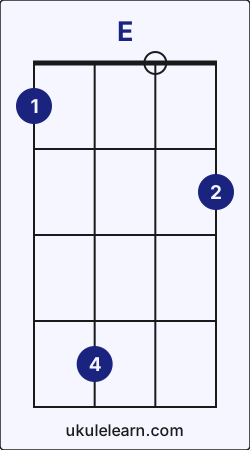 Ukulele E chord diagram
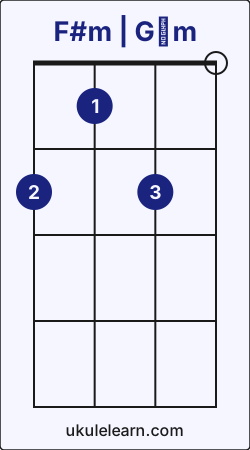 Ukulele F#m | G♭m chord diagram
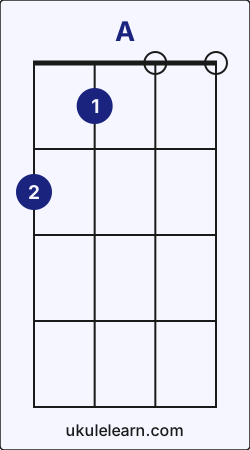 Ukulele A chord diagram
[Opening]
[E] [F#m] [A] [E] [F#m] [A]
[E]She [F#m]don’t like [A]small places
Give her [E]highways and byways and [F#m]don’t get stuck in her [A]head
[section 2]
[E]And [F#m]its been so [A]long
And [E]I will read into [F#m]everything you don’t [A]say Oh, in your silent ways
[chorus]
I’m a [E]dog lying down on a [F#m]warm bit of pavement
[A]Checking this collar you see what the name is
[E]Figured it’s worth it, well I [F#m]hope that you’re right
You’re [A]falling asleep on the red eye tonight
[chorus]
[A]And you know that you’re [E]looking [F#m]well
[A]Won’t you come through my door [E]asking how was your [F#m]day
[A]Well you know that I’m still [E]a Dog[F#m]
[A]And I’m trusting my nose will it [E]show me the way[F#m]
[section 3]
[E]I’m [F#m]glad that you’re [A]still here
Won’t you [E]hold up a candle I’m [F#m]stumbling in the dark [A]
[E]And [F#m]when I [A]needed hope
I [E]remind myself that [F#m]at least I got one thing right
[A]It’ll always be right
[chorus]
I’m a [E]dog lying down on a [F#m]warm bit of pavement
[A]Checking this collar you see what the name is
[E]Figured it’s worth it, well [F#m]I hope that you’re right
You?re [A]falling asleep on the red eye tonight
[chorus]
And you know that you’re [E]looking [F#m]well
[A]Won’t you come through my door asking [E]how was your day [F#m]
[A]And you know that I’m still [E]under [F#m]
[A]And I’m trusting my nose will it [E]show me the way[F#m]
[section 4]
[A]Won’t you get out while you [E]can [F#m]
[A]Won’t you cover your eyes if you’re [E]tired of seeing [F#m]
[A]Won’t you get out while you [E]can [F#m]
[A]And try saving yourself
[section 5]
[E] [F#m] [A] [E] [F#m] [A]
Let’s talk in the [E]morning [F#m]
[A]Oh baby it’s late can we talk in the [E] [F#m]morning
[A]Oh baby it’s late can we talk in the [E] [F#m]morning
[A]Oh baby it’s late can we talk in the [E] [F#m]morning
[A]Oh baby it’s late, Baby it’s late
[Closing]
[E](Tell [F#m]me when, tell me [A]when)
[E](Tell [F#m]me when, tell me [A]when)
[E](Tell [F#m]me when, tell me [A]when)
[E](Tell [F#m]me when, tell me [A]when)
How to play Red Eye on Ukulele (Step-by-step)
Vance Joy - Red Eye on ukulele requires 3 chords and 3 core chord transitions. You can find the full step-by-step guide below. Before you start, tune your instrument. The song uses the ↓-↓↑-↓↑-↓↑ pattern; practice it muted first, or simplify to downstrokes while you learn the changes.
Red Eye uses these transitions most often: E → F#m (35), F#m → A (34), and A → E (33). These transitions may feel a little challenging at first, but with steady practice you can play this song quickly.When you are ready, begin with E - F#m chord transition.
1. E → F#m chord transition
To move from E to F#m;
- Lift your index finger from G string fret 4 and place it on C string fret 1.
- Slide your middle finger from A string fret 2 to G string fret 2.
- Place ring finger on E string fret 2.
2. F#m → A chord transition
To move from F#m to A;
- While playing F#m, lift your ring finger from E string fret 2.
- Keep index finger on C string fret 1.
- Keep middle finger on G string fret 2.
3. A → E chord transition
To move from A to E;
- Lift your index finger from C string fret 1 and place it on G string fret 4.
- Slide your middle finger from G string fret 2 to A string fret 2.
Red Eye chord transition analysis
A short, data-driven summary of the chord flow in Red Eye.
- Red Eye includes 103 chord transitions, 3 of them unique.
- These transitions represent 0.03% of all chord transitions in Ukulelearn.
- Red Eye contains 1 of the top 25 transitions across Ukulelearn.
- These transition patterns show how Red Eye connects to the rest of Ukulelearn. Mastering them helps you move to similar songs faster.After E, the most likely next chords across Ukulelearn are A (25%), D (14%), and B (11%).
- E → F#m: 9%
After F#m, the most likely next chords across Ukulelearn are D (22%), A (19%), and E (14%).- F#m → A: 19%
- F#m → E: 14%