
Carpenters - Solitaire Ukulele Chords
Before you play, tune your ukulele and use the tools below to set up your view and flow. Using the Transpose tool, switch to F,C keys to play this song with easier chords.
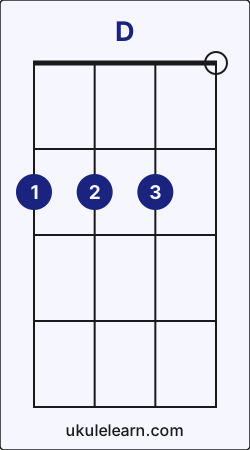 Ukulele D chord diagram
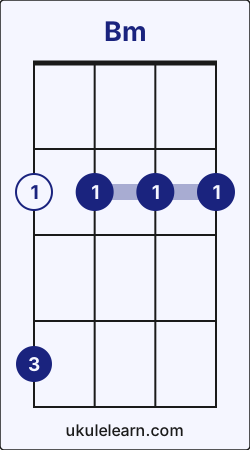 Ukulele Bm chord diagram
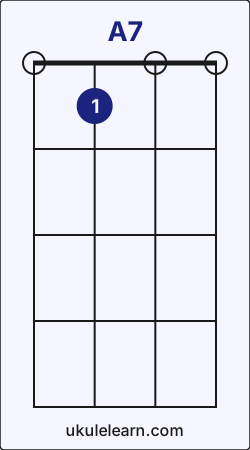 Ukulele A7 chord diagram
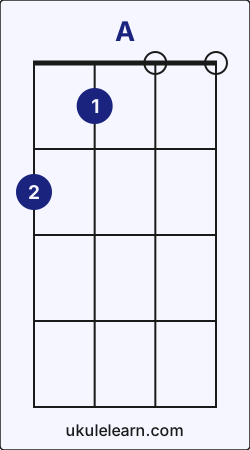 Ukulele A chord diagram
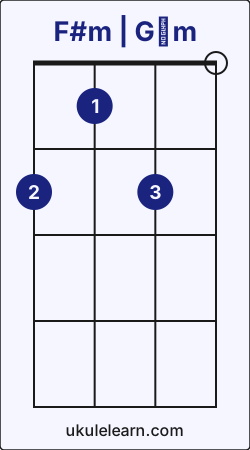 Ukulele F#m | G♭m chord diagram
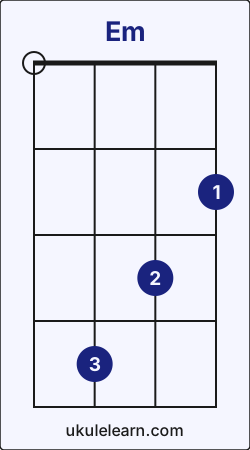 Ukulele Em chord diagram
[Opening]
[D]There was a man [Bm]a lonely man
[A7]Who lost his love through his indiffe[D]rence
A heart that cared [Bm]that went unshared
[A7]Until it died within his [D]silence [A]
[section 2]
And [D]solitaire’s the only game in [F#m]town
And [Bm]every road that takes him takes him down
And [Em]by himself it’s easy to pre[A]tend
He’ll never [D]love again [A]
[section 3]
And [D]keeping to himself he plays the [F#m]game
With[Bm]out her love it always ends the same
While [Em]life goes on around him every[A]where
He’s playing [D]solitaire [A7]
[Closing]
[D]A little hope [Bm]goes up in smoke
[A7]Just how it goes goes without [D]saying
There was a man [Bm]a lonely man
[A7]Who would command the hand [D]he’s playing [A]
How to play Solitaire on Ukulele (Step-by-step)
Carpenters - Solitaire on ukulele requires 6 chords and 8 core chord transitions. You can find the full step-by-step guide below. Before you start, tune your instrument. The song uses the ↓-↓↑-↓↑-↓↑ pattern; practice it muted first, or simplify to downstrokes while you learn the changes.
Solitaire uses these transitions most often: A7 → D (5), A → D (4), and Bm → A7 (4). These transitions may feel a little challenging at first, but with steady practice you can play this song quickly.When you are ready, begin with D - Bm chord transition.
1. D → Bm chord transition
To move from D to Bm;
- While playing D, lift your middle finger from C string fret 2.
- Lift your index finger from G string fret 2 and place it on C string fret 2.
- Slide your ring finger from E string fret 2 to G string fret 4.
2. Bm → A7 chord transition
To move from Bm to A7;
- While playing Bm, lift your ring finger from G string fret 4.
- Slide your index finger on C string from fret 2 to fret 1.
3. A7 → D chord transition
To move from A7 to D;
- Lift your index finger from C string fret 1 and place it on G string fret 2.
- Place middle finger on C string fret 2.
- Place ring finger on E string fret 2.
4. D → A chord transition
To move from D to A;
- While playing D, lift your ring finger from E string fret 2.
- Lift your index finger from G string fret 2 and place it on C string fret 1.
- Slide your middle finger from C string fret 2 to G string fret 2.
5. D → F#m chord transition
To move from D to F#m;
- Lift your index finger from G string fret 2 and place it on C string fret 1.
- Slide your middle finger from C string fret 2 to G string fret 2.
- Keep ring finger on E string fret 2.
6. F#m → Bm chord transition
To move from F#m to Bm;
- While playing F#m, lift your middle finger from G string fret 2.
- Slide your index finger on C string from fret 1 to fret 2.
- Slide your ring finger from E string fret 2 to G string fret 4.
7. Bm → Em chord transition
To move from Bm to Em;
- Lift your index finger from C string fret 2 and place it on A string fret 2.
- Slide your ring finger from G string fret 4 to C string fret 4.
- Place middle finger on E string fret 3.
8. Em → A chord transition
To move from Em to A;
- While playing Em, lift your ring finger from C string fret 4.
- Lift your index finger from A string fret 2 and place it on C string fret 1.
- Slide your middle finger from E string fret 3 to G string fret 2.
Solitaire chord transition analysis
A short, data-driven summary of the chord flow in Solitaire.
- Solitaire includes 29 chord transitions, 8 of them unique.
- These transitions represent 0.01% of all chord transitions in Ukulelearn.
- Solitaire contains 1 of the top 10 transitions across Ukulelearn.
- These transition patterns show how Solitaire connects to the rest of Ukulelearn. Mastering them helps you move to similar songs faster.After D, the most likely next chords across Ukulelearn are G (29%), A (17%), and Em (17%).
- D → A: 17%
- D → Bm: 5%
After Bm, the most likely next chords across Ukulelearn are G (25%), A (19%), and Em (13%).- Bm → Em: 13%
- Bm → A7: 0%