
Sheryl Crow - Tell Me When It’s Over Ukulele Chords
Before you play, tune your ukulele and use the tools below to set up your view and flow.
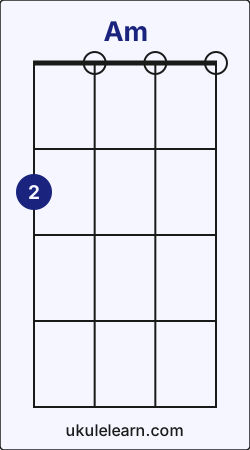 Ukulele Am chord diagram
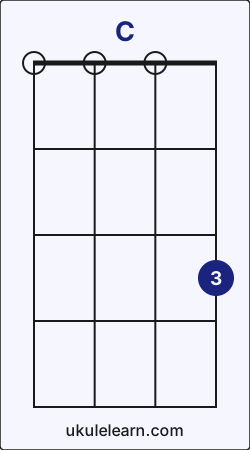 Ukulele C chord diagram
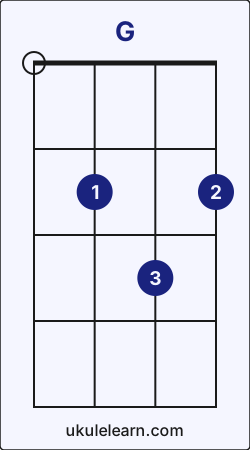 Ukulele G chord diagram
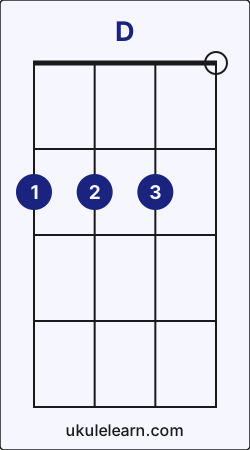 Ukulele D chord diagram
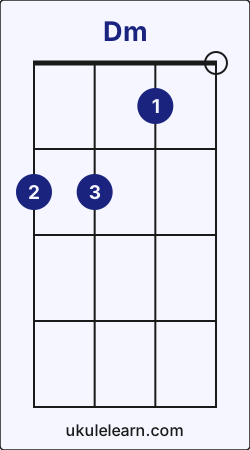 Ukulele Dm chord diagram
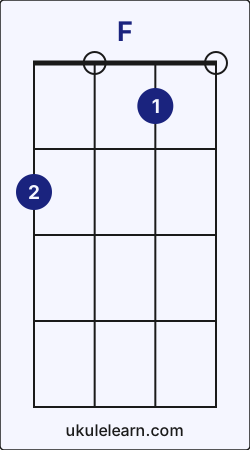 Ukulele F chord diagram
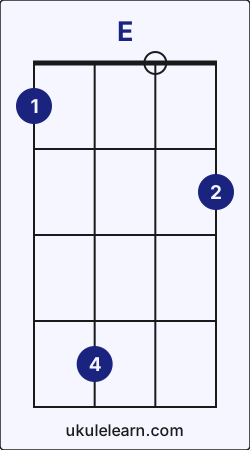 Ukulele E chord diagram
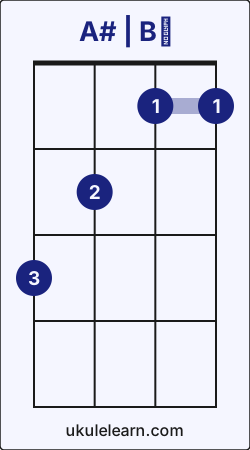 Ukulele A# | B♭ chord diagram
[Opening]
[Am] [C] [G] [D]
You wanna build your [Am]walls, [C] [G]I wanna knock them [D]down
Looking for a [Am]heartbeat, [C] [G]I don’t hear a [D]sound
[section 2]
But [Am]anything’s better than, [C]hanging ’round together
[G]Knowing that the other one’s [D]through, and [Am]honestly, I don’t think
[C]It’s the biggest when we sink, but it’s [G]feeling like
We’re breaking in [D]two
[section 3]
[Dm]Tell me when it’s [Am]over, [G](tell me [Am]when it’s over)
[Dm]Tell me when it’s [Am]over, [G](tell me [Am]when it’s over)
[Dm]Tell me when [Am]it’s [G]over, ’cause [F]I don’t [D]wanna [G]be
The [E]last to [Am]know
[section 4]
[Am] [C] [G] [D]
And I count the [Am]days, [C] [G]but I think our number’s [D]up
Is there [Am]any [C]way, oh, [G]to make you feel [D]enough?
[section 5]
And [Am]I can see something’s changed, [C]everything’s feeling strange
And [G]neither one of us knows [D]why, and [Am]I don’t wanna face it
We’re [C]in a situation where, [G]somebody’s always saying [D]goodbye
[section 6]
[Dm]Tell me when it’s [Am]over, [G](tell me [Am]when it’s over)
[Dm]Tell me when it’s [Am]over, [G](tell me [Am]when it’s over)
[Dm]Tell me when [Am]it’s [G]over, ’cause [F]I don’t [D]wanna [G]be
[section 7]
[Am]Caught up in a dream, (Caught up in a dream)
[C]Riding love supreme, but I know it’s [F]coming
(And I know it’s coming), Yeah, I know it’s [F]coming
[G]Coming, coming, [Am]see it in your face
(See it in your face), You let a [C]good thing go to waste
‘Cause you keep on [F]running, (Keep on running)
You keep on [Bb]running, away from [D]love
[section 8]
[G] [Am] [D] [G] [Am] [D] [G] [F] [F]
[Dm]Tell me when it’s [Am]over, [G](tell me [Am]when it’s over)
[Dm]Tell me when it’s [Am]over, [G](tell me [Am]when it’s over)
[Dm]Tell me when it’s [Am]over, [G](tell me [Am]when it’s over)
[Dm]Tell me when it’s [Am]over, [G](tell me [Am]when it’s over)
[Dm]Tell me when [Am]it’s over, [G](tell me when [Am]it’s over)
[Dm]Tell me when [Am]it’s [G]over oh
[section 9]
[Am]Caught up in a dream, (Caught up in a dream)
[C]Ridin’ love supreme, but I know it’s [F]coming
(And I know it’s coming), Yeah, I know it’s [F]coming
[G]Coming, coming, [Am]see it in your face
[section 10]
(See it in your face) you let a [C]good thing go to waste
‘Cause you keep on [F]running, (Keep on running)
You keep on [Bb]running, away from [Am]love
[Am]Hold me in your arms, (Hold me in your arms)
Come on, [C]let me feel your heart, though I know it’s [F]coming
[Closing]
(And I know it’s coming), and I know it’s [F]coming
[G]Coming, coming, [Am]see it in your face
(See it in your face), you let a [C]good thing go to waste
‘Cause you keep on [F]running, (Keep on running)
You keep on [Bb]running away from [Am]love
[Am] [C] [F] [F] [G] [Am] [C] [F] [Bb]
How to play Tell Me When It's Over on Ukulele (Step-by-step)
Sheryl Crow - Tell Me When It's Over on ukulele requires 8 chords and 16 core chord transitions. You can find the full step-by-step guide below. Before you start, tune your instrument. The song uses the ↓-↓↓↑ pattern; practice it muted first, or simplify to downstrokes while you learn the changes.
Tell Me When It's Over uses these transitions most often: Am → C (18), G → Am (17), and Am → G (12). These transitions may feel a little challenging at first, but with steady practice you can play this song quickly.When you are ready, begin with Am - C chord transition.
1. Am → C chord transition
To move from Am to C;
- While playing Am, lift your middle finger from G string fret 2.
- Place ring finger on A string fret 3.
2. C → G chord transition
To move from C to G;
- Lift your ring finger from A string fret 3 and place it on E string fret 3.
- Place index finger on C string fret 2.
- Place middle finger on A string fret 2.
3. G → D chord transition
To move from G to D;
- Lift your index finger from C string fret 2 and place it on G string fret 2.
- Slide your middle finger from A string fret 2 to C string fret 2.
- Slide your ring finger on E string from fret 3 to fret 2.
4. D → Am chord transition
To move from D to Am;
- While playing D, first lift your index finger and ring finger.
- Lift your middle finger from C string fret 2 and place it on G string fret 2.
5. D → Dm chord transition
To move from D to Dm;
- Lift your index finger from G string fret 2 and place it on E string fret 1.
- Slide your middle finger from C string fret 2 to G string fret 2.
- Lift your ring finger from E string fret 2 and place it on C string fret 2.
6. Dm → Am chord transition
To move from Dm to Am;
- While playing Dm, first lift your index finger and ring finger.
- Keep middle finger on G string fret 2.
7. Am → G chord transition
To move from Am to G;
- Lift your middle finger from G string fret 2 and place it on A string fret 2.
- Place index finger on C string fret 2.
- Place ring finger on E string fret 3.
8. G → F chord transition
To move from G to F;
- While playing G, lift your ring finger from E string fret 3.
- Lift your index finger from C string fret 2 and place it on E string fret 1.
- Slide your middle finger from A string fret 2 to G string fret 2.
9. F → D chord transition
To move from F to D;
- Lift your index finger from E string fret 1 and place it on G string fret 2.
- Slide your middle finger from G string fret 2 to C string fret 2.
- Place ring finger on E string fret 2.
10. G → E chord transition
To move from G to E;
- While playing G, lift your ring finger from E string fret 3.
- Lift your index finger from C string fret 2 and place it on G string fret 4.
- Keep middle finger on A string fret 2.
11. E → Am chord transition
To move from E to Am;
- While playing E, lift your index finger from G string fret 4.
- Lift your middle finger from A string fret 2 and place it on G string fret 2.
12. C → F chord transition
To move from C to F;
- While playing C, lift your ring finger from A string fret 3.
- Place index finger on E string fret 1.
- Place middle finger on G string fret 2.
13. F → Bb chord transition
To move from F to Bb;
- Keep index finger on E string fret 1.
- Lift your middle finger from G string fret 2 and place it on C string fret 2.
- Place ring finger on G string fret 3.
14. Bb → D chord transition
To move from Bb to D;
- Lift your index finger from E string fret 1 and place it on G string fret 2.
- Keep middle finger on C string fret 2.
- Slide your ring finger from G string fret 3 to E string fret 2.
15. F → Dm chord transition
To move from F to Dm;
- Keep index finger on E string fret 1.
- Keep middle finger on G string fret 2.
- Place ring finger on C string fret 2.
16. Bb → Am chord transition
To move from Bb to Am;
- While playing Bb, first lift your index finger and ring finger.
- Lift your middle finger from C string fret 2 and place it on G string fret 2.
Tell Me When It's Over chord transition analysis
A short, data-driven summary of the chord flow in Tell Me When It's Over.
- Tell Me When It's Over includes 132 chord transitions, 16 of them unique.
- These transitions represent 0.04% of all chord transitions in Ukulelearn.
- Tell Me When It's Over contains 5 of the top 10 transitions across Ukulelearn.
- These transition patterns show how Tell Me When It's Over connects to the rest of Ukulelearn. Mastering them helps you move to similar songs faster.After Am, the most likely next chords across Ukulelearn are F (26%), G (21%), and C (16%).
- Am → G: 21%
- Am → C: 16%
After G, the most likely next chords across Ukulelearn are C (25%), D (24%), and Am (13%).- G → D: 24%
- G → Am: 13%