
Taylor Swift - The Last Great American Dynasty Ukulele Chords
Before you play, tune your ukulele and use the tools below to set up your view and flow.
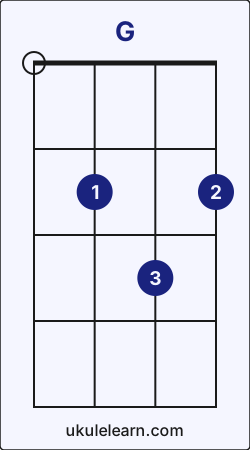 Ukulele G chord diagram
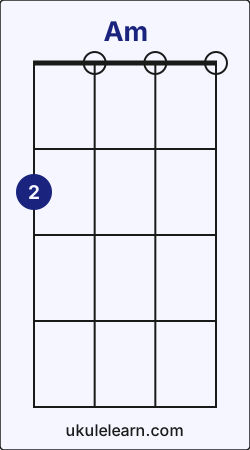 Ukulele Am chord diagram
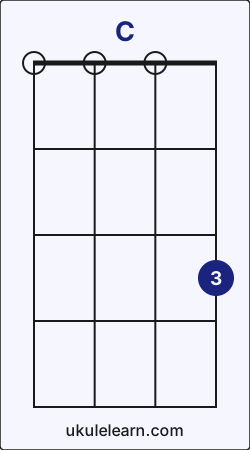 Ukulele C chord diagram
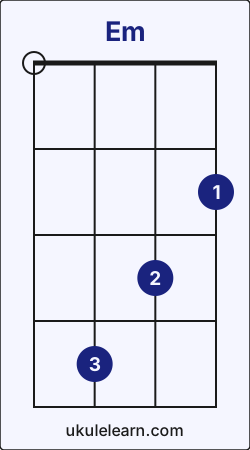 Ukulele Em chord diagram
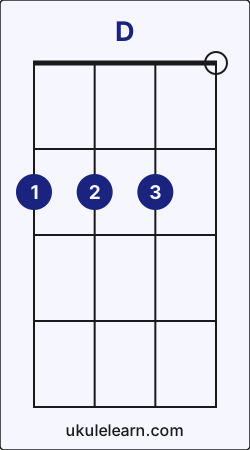 Ukulele D chord diagram
[Opening]
[G]Rebekah rode [Am]up on the afternoon [C]train, it was sunny
[G]Her saltbox house on the [Am]coast took her mind [C]off St. Louis
[G]Bill was the [Am]heir to the Standard [G]Oil name and [C]money
And the [G]town said, [Am]”How did a middle-class [C]divorcée do it?”
[G]The wedding [Am]was charming, if a little [C]gauche
[section 2]
There’s only so far new money [G]goes
They picked out a [Am]home and called it [C]”Holiday House”
[G]Their parties were [Am]tasteful, if a little [Em]loud
The doctor had [C]told him to settle [G]down
It must have been [Am]her fault his heart gave [C]out, and they said…
[chorus]
[D]There goes the [G]last great American [C]dynasty [G]
[D]Who knows, if [G]she never showed up, what could’ve [C] [G]been
[D]There goes the [G]maddest woman this town has [C]ever seen
She had a [G]marvelous time [Am]ruining [C]everything
[section 3]
[G]Rebekah gave [Am]up on the Rhode Island [C]set forever
[G]Flew in all her [Am]Bitch Pack friends from the [C]city
Filled the [G]pool with champagne and [Am]swam with the big names
And [Em]blew through the money on the [C]boys and the ballet
[G]And losing on [Am]card game bets with [C]Dalí, and they said…
[chorus]
[D]There goes the [G]last great [C]American [G]dynasty
[D]Who knows, if [G]she never showed up, what could’ve [C]been [G]
[D]There goes the [G]most shameless woman this [C]town has ever seen
She had a [D]marvelous time [G]ruining [C]everything
[section 4]
[Am]They say she was [Em]seen on occasion
[G]Pacing the rocks, staring [D]out at the midnight sea
[Am]And in a feud with her [Em]neighbor
[G]She stole his dog and [D]dyed it key lime green
[Am]Fifty [Em]years is a long time
[G]Holiday House sat [D]quietly on that beach
[Am]Free of [Em]women with madness, [G]their men and bad habits
[D]And then it was bought by me
[section 5]
[G] [C] [G]
[D]Who knows, if [G]I never showed up, what could’ve been [C] [G]
[D]There goes the [G]loudest woman this town [C]has ever [G]seen
I had a [D]marvelous time [G]ruining everything [C] [G]
[Closing]
I had a [D]marvelous [G]time [C] [G]ruining everything
[D]A marvelous [G] [C]time [G]ruining everything
[D]A marvelous [G]time [C] [G]
I had a [D] [G]marvelous time [C]
How to play The Last Great American Dynasty on Ukulele (Step-by-step)
Taylor Swift - The Last Great American Dynasty on ukulele requires 5 chords and 9 core chord transitions. You can find the full step-by-step guide below. Before you start, tune your instrument. The song uses the ↓-↓↑-↓↑-↓↑ pattern; practice it muted first, or simplify to downstrokes while you learn the changes.
The Last Great American Dynasty uses these transitions most often: C → G (23), G → C (16), and D → G (15). These transitions may feel a little challenging at first, but with steady practice you can play this song quickly.When you are ready, begin with G - Am chord transition.
1. G → Am chord transition
To move from G to Am;
- While playing G, first lift your index finger and ring finger.
- Lift your middle finger from A string fret 2 and place it on G string fret 2.
2. Am → C chord transition
To move from Am to C;
- While playing Am, lift your middle finger from G string fret 2.
- Place ring finger on A string fret 3.
3. C → G chord transition
To move from C to G;
- Lift your ring finger from A string fret 3 and place it on E string fret 3.
- Place index finger on C string fret 2.
- Place middle finger on A string fret 2.
4. Am → Em chord transition
To move from Am to Em;
- Lift your middle finger from G string fret 2 and place it on E string fret 3.
- Place index finger on A string fret 2.
- Place ring finger on C string fret 4.
5. Em → C chord transition
To move from Em to C;
- While playing Em, first lift your index finger and middle finger.
- Lift your ring finger from C string fret 4 and place it on A string fret 3.
6. C → D chord transition
To move from C to D;
- Lift your ring finger from A string fret 3 and place it on E string fret 2.
- Place index finger on G string fret 2.
- Place middle finger on C string fret 2.
7. D → G chord transition
To move from D to G;
- Lift your index finger from G string fret 2 and place it on C string fret 2.
- Slide your middle finger from C string fret 2 to A string fret 2.
- Slide your ring finger on E string from fret 2 to fret 3.
8. Em → G chord transition
To move from Em to G;
- Lift your index finger from A string fret 2 and place it on C string fret 2.
- Slide your middle finger from E string fret 3 to A string fret 2.
- Lift your ring finger from C string fret 4 and place it on E string fret 3.
9. D → Am chord transition
To move from D to Am;
- While playing D, first lift your index finger and ring finger.
- Lift your middle finger from C string fret 2 and place it on G string fret 2.
The Last Great American Dynasty chord transition analysis
A short, data-driven summary of the chord flow in The Last Great American Dynasty.
- The Last Great American Dynasty includes 112 chord transitions, 9 of them unique.
- These transitions represent 0.03% of all chord transitions in Ukulelearn.
- The Last Great American Dynasty contains 5 of the top 10 transitions across Ukulelearn.
- These transition patterns show how The Last Great American Dynasty connects to the rest of Ukulelearn. Mastering them helps you move to similar songs faster.After G, the most likely next chords across Ukulelearn are C (25%), D (24%), and Am (13%).
- G → C: 25%
- G → D: 24%
After C, the most likely next chords across Ukulelearn are G (35%), F (16%), and D (11%).- C → G: 35%
- C → D: 11%