
Ron Hynes - The St. John’s Waltz Ukulele Chords
Before you play, tune your ukulele and use the tools below to set up your view and flow.
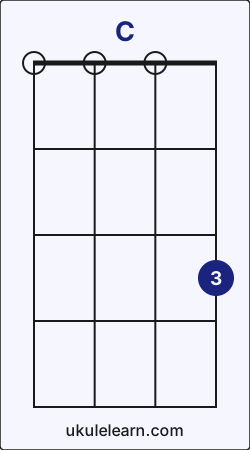 Ukulele C chord diagram
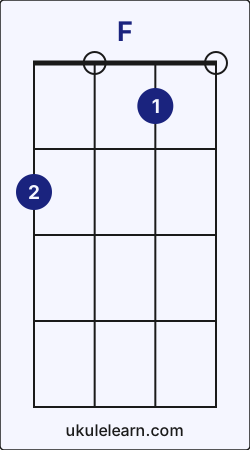 Ukulele F chord diagram
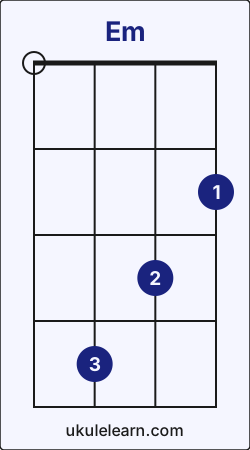 Ukulele Em chord diagram
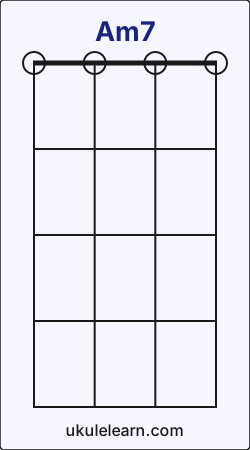 Ukulele Am7 chord diagram
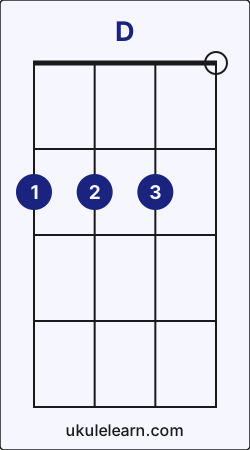 Ukulele D chord diagram
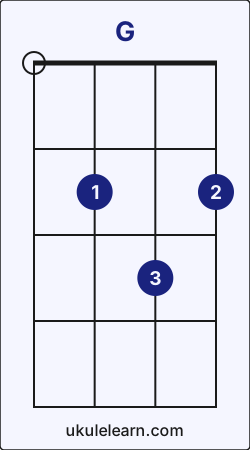 Ukulele G chord diagram
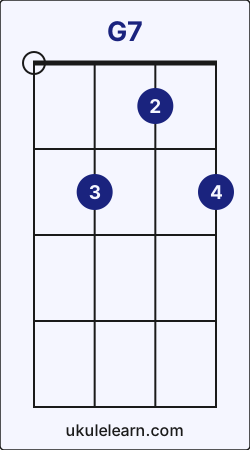 Ukulele G7 chord diagram
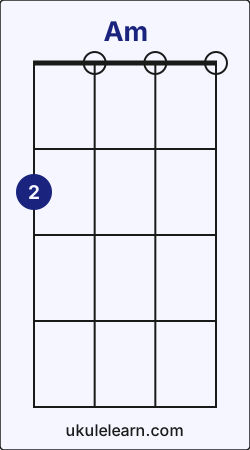 Ukulele Am chord diagram
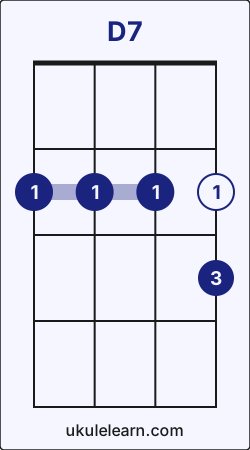 Ukulele D7 chord diagram
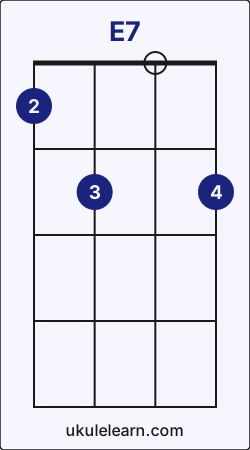 Ukulele E7 chord diagram
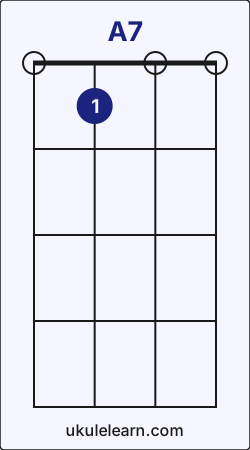 Ukulele A7 chord diagram
[Opening]
Oh the [C]harbour [C]lights are [C]gleaming, and the [F]evening’s still and [C]dark
And the [C]seagulls [Em]are all [Am7]dreaming seagull [D]dreams on Amherst [G]rock
And the [C]mist is [G7]slowly [C]drifting
as the [F]storefront lights go [Am]dim
And the [C]moon is [Em]gently [Am7]lifting
As the [D]last ship’s coming [G]in all the [F]sailors got a [G]story ,
Some are [Am7]true [C]some are [F]false [Am7]
But they’re [D7]always [G]wrecked and they’re [E7]up on the [A7]deck
[D]Dancing the [G]St. John’s [C]Waltz
[section 2]
Oh we’ve [C]had our [C]share of [C]history,
We’ve seen [F]nations come and [C]go
We’ve seen [Em]battles rage over [Am7]land and stage
Two [D]hundred years and [G]more
For [C]glory or [G7]for [C]freedom,
For [F]country or for [Am]king,
Or for [C]money or [Em]fame but there [Am7]are no names
On the [D]graves where men lie [G]sleeping;
All the [F]nine-to-fives survive the [G]day with a [Am7]sigh and a [C]dose of [F]salts
And [Am7]they’re [D7]parking their [G]cars
And [E7]packin’ the [A7]bars, [D]Dancing the [G]St. John’s [C]Waltz
[Closing]
[F] [D7] [G] [E7] [A7] [D] [G] [C]
Oh my [C]heart is [C]on the [C]highway and I’m [F]sold on going to [C]sea
All the [Em]planes fill the [Am7]skyway and the [D]trains run swift and [G]free;
So leave the [C]wayward [G7]free to [C]wander, leave the [F]restless free to [Am]roam
If its [C]rocks in the [Em]bay, it’s an [Am7]old cliché, you’ll [D]find your way back [G]home
So don’t [F]question or [G]inquire, what’s been [Am7]gained, what’s [C]been [F]lost,
In a [Am7]world of [D7]romance, [G]don’t miss [E7]out on the [A7]chance
To be [D]Dancing the [G]St. John’s [C]Waltz
[F] [D7] [G] [E7] [A7] [D] [G] [C]
How to play The St. John's Waltz on Ukulele (Step-by-step)
Ron Hynes - The St. John's Waltz on ukulele requires 11 chords and 19 core chord transitions. You can find the full step-by-step guide below. Before you start, tune your instrument. The song uses the ↓-↓↑-↑↓↑ pattern; practice it muted first, or simplify to downstrokes while you learn the changes.
The St. John's Waltz uses these transitions most often: C → F (11), D → G (11), and G → C (8). These transitions may feel a little challenging at first, but with steady practice you can play this song quickly.When you are ready, begin with C - F chord transition.
1. C → F chord transition
To move from C to F;
- While playing C, lift your ring finger from A string fret 3.
- Place index finger on E string fret 1.
- Place middle finger on G string fret 2.
2. C → Em chord transition
To move from C to Em;
- Lift your ring finger from A string fret 3 and place it on C string fret 4.
- Place index finger on A string fret 2.
- Place middle finger on E string fret 3.
3. Em → Am7 chord transition
To move from Em to Am7;
- While playing Em, first lift your index finger, middle finger, and ring finger.
4. Am7 → D chord transition
To move from Am7 to D;
- Place index finger on G string fret 2.
- Place middle finger on C string fret 2.
- Place ring finger on E string fret 2.
5. D → G chord transition
To move from D to G;
- Lift your index finger from G string fret 2 and place it on C string fret 2.
- Slide your middle finger from C string fret 2 to A string fret 2.
- Slide your ring finger on E string from fret 2 to fret 3.
6. G → C chord transition
To move from G to C;
- While playing G, first lift your index finger and middle finger.
- Lift your ring finger from E string fret 3 and place it on A string fret 3.
7. C → G7 chord transition
To move from C to G7;
- Slide your ring finger on A string from fret 3 to fret 2.
- Place index finger on E string fret 1.
- Place middle finger on C string fret 2.
8. F → Am chord transition
To move from F to Am;
- While playing F, lift your index finger from E string fret 1.
- Keep middle finger on G string fret 2.
9. Am → C chord transition
To move from Am to C;
- While playing Am, lift your middle finger from G string fret 2.
- Place ring finger on A string fret 3.
10. G → F chord transition
To move from G to F;
- While playing G, lift your ring finger from E string fret 3.
- Lift your index finger from C string fret 2 and place it on E string fret 1.
- Slide your middle finger from A string fret 2 to G string fret 2.
11. G → Am7 chord transition
To move from G to Am7;
- While playing G, first lift your index finger, middle finger, and ring finger.
12. Am7 → C chord transition
To move from Am7 to C;
- Place ring finger on A string fret 3.
13. F → Am7 chord transition
To move from F to Am7;
- While playing F, first lift your index finger and middle finger.
14. Am7 → D7 chord transition
To move from Am7 to D7;
- Place index finger on G string fret 2.
- Place ring finger on A string fret 3.
15. D7 → G chord transition
To move from D7 to G;
- Lift your index finger from G string fret 2 and place it on C string fret 2.
- Slide your ring finger from A string fret 3 to E string fret 3.
- Place middle finger on A string fret 2.
16. G → E7 chord transition
To move from G to E7;
- Lift your index finger from C string fret 2 and place it on G string fret 1.
- Slide your middle finger from A string fret 2 to C string fret 2.
- Lift your ring finger from E string fret 3 and place it on A string fret 2.
17. E7 → A7 chord transition
To move from E7 to A7;
- While playing E7, first lift your middle finger and ring finger.
- Lift your index finger from G string fret 1 and place it on C string fret 1.
18. A7 → D chord transition
To move from A7 to D;
- Lift your index finger from C string fret 1 and place it on G string fret 2.
- Place middle finger on C string fret 2.
- Place ring finger on E string fret 2.
19. F → D7 chord transition
To move from F to D7;
- While playing F, lift your middle finger from G string fret 2.
- Lift your index finger from E string fret 1 and place it on G string fret 2.
- Place ring finger on A string fret 3.
The St. John's Waltz chord transition analysis
A short, data-driven summary of the chord flow in The St. John's Waltz.
- The St. John's Waltz includes 103 chord transitions, 19 of them unique.
- These transitions represent 0.03% of all chord transitions in Ukulelearn.
- The St. John's Waltz contains 6 of the top 10 transitions across Ukulelearn.
- These transition patterns show how The St. John's Waltz connects to the rest of Ukulelearn. Mastering them helps you move to similar songs faster.After C, the most likely next chords across Ukulelearn are G (35%), F (16%), and D (11%).
- C → F: 16%
- C → Em: 8%
After G, the most likely next chords across Ukulelearn are C (25%), D (24%), and Am (13%).- G → C: 25%
- G → F: 9%