
Ukulele C#7 | D♭7 chord diagram
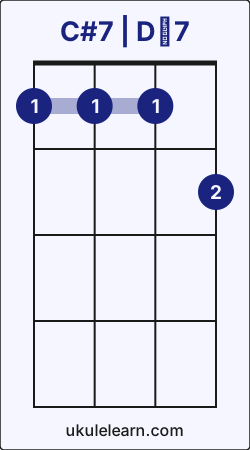
C#7 | D♭7 is one of the essential Ukulele chords. On Ukulelearn, this chord appears in 15 different songs. On this page, you can find how to play C#7 | D♭7, alternative positions, and core chord transitions.
To play C#7 | D♭7, follow these steps: Place index finger on G string, C string, and E string fret 1. Place middle finger on A string fret 2. C#7 can also be written as D♭7; these names are enharmonic equivalents that represent the same pitch class.
Tips
- Place G string with your index finger and C string with your index finger with a vertical finger angle so nearby strings ring clearly without buzz.
- On G string, press fret 1 with your index finger close to the fret wire (not on top) for a cleaner tone.
- Finger choices on C#7 | D♭7 can be optimized for the next chord. For example, when moving from C#7 | D♭7 to F#add9 | G♭add9, using on the A string, use your ring finger, on the G string, use your middle finger, on the C string, use your middle finger, and on the E string, use your middle finger helps preserve hand position with minimal movement.
- Keep the barre firm so every string rings clearly.
Chord Theory
- Notes
- C# - F - G# - B
- Intervals
- 1 - 3 - 5 - b7
- Chord Type
- Dominant 7 — blues and funk tone
- Difficulty
- Intermediate
- Barre chord
- Yes
- Voicings
- 7
Alternative Positions
Different ways to play C#7 | D♭7 on the fretboard, from beginner-friendly to advanced voicings.
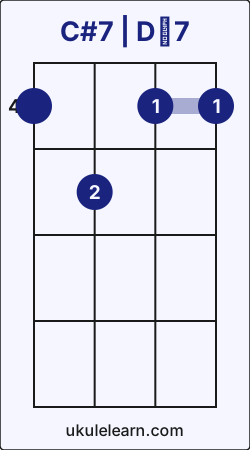 Ukulele C#7 | D♭7 chord diagram4-5-4-4
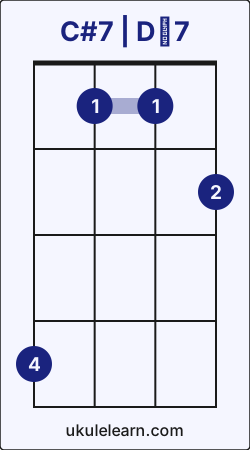 Ukulele C#7 | D♭7 chord diagram4-1-1-2
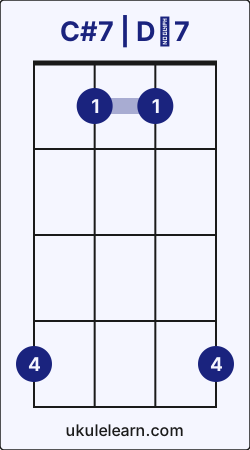 Ukulele C#7 | D♭7 chord diagram4-1-1-4
Easy Transition Chords
These chords have similar finger positions to C#7 | D♭7, making them ideal for practice transitions.
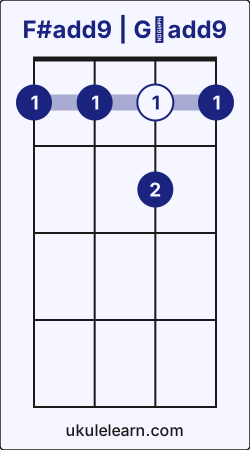
1. C#7 | D♭7 → F#add9 | G♭add9 chord transition
To move from C#7 | D♭7 to F#add9 | G♭add9, follow these steps:
- Keep index finger on G string fret 1.
- Lift your middle finger from A string fret 2 and place it on E string fret 2.
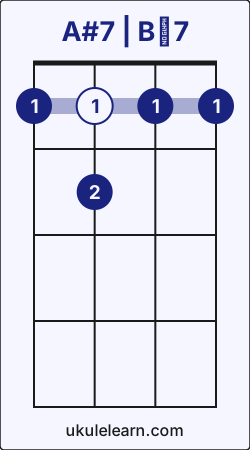
2. C#7 | D♭7 → A#7 | B♭7 chord transition
To move from C#7 | D♭7 to A#7 | B♭7, follow these steps:
- Keep index finger on G string fret 1.
- Lift your middle finger from A string fret 2 and place it on C string fret 2.
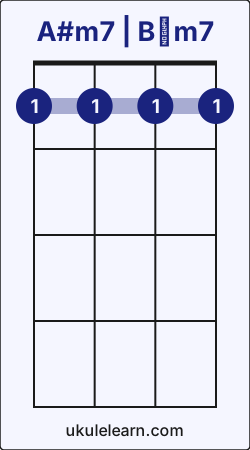
3. C#7 | D♭7 → A#m7 | B♭m7 chord transition
To move from C#7 | D♭7 to A#m7 | B♭m7, follow these steps:
- While playing C#7 | D♭7, lift your middle finger from A string fret 2.
- Keep index finger on G string fret 1.
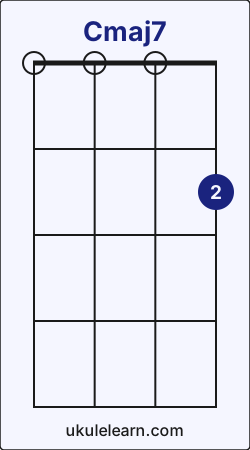
4. C#7 | D♭7 → Cmaj7 chord transition
To move from C#7 | D♭7 to Cmaj7, follow these steps:
- While playing C#7 | D♭7, lift your index finger from G string fret 1.
- Keep middle finger on A string fret 2.
5. C#7 | D♭7 → A7 chord transition
To move from C#7 | D♭7 to A7, follow these steps:
- While playing C#7 | D♭7, lift your middle finger from A string fret 2.
- Lift your index finger from G string fret 1 and place it on C string fret 1.
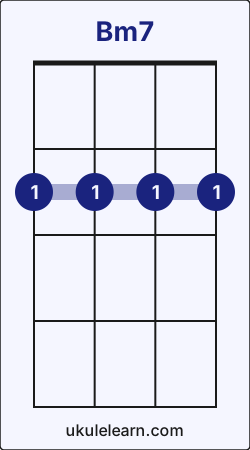
6. C#7 | D♭7 → Bm7 chord transition
To move from C#7 | D♭7 to Bm7, follow these steps:
- While playing C#7 | D♭7, lift your middle finger from A string fret 2.
- Slide your index finger on G string from fret 1 to fret 2.

Most Common Transitions
The most frequent chord transitions from C#7 | D♭7 across songs on this site.
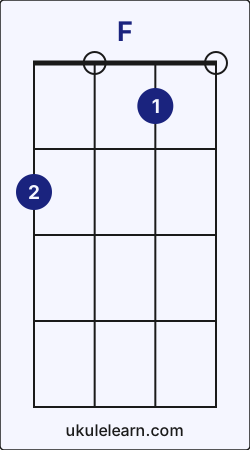
1. C#7 | D♭7 → F chord transition
To move from C#7 | D♭7 to F, follow these steps:
- Lift your index finger from G string fret 1 and place it on E string fret 1.
- Slide your middle finger from A string fret 2 to G string fret 2.
On Ukulelearn, songs containing C#7 | D♭7 use the transition to F at 25.5%. You can practice this transition in 2 different songs.
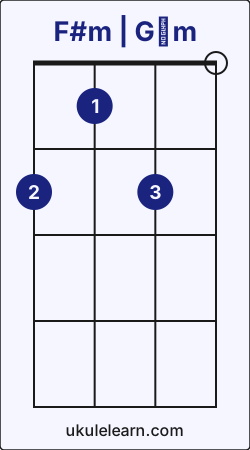
2. C#7 | D♭7 → F#m chord transition
To move from C#7 | D♭7 to F#m, follow these steps:
- Lift your index finger from G string fret 1 and place it on C string fret 1.
- Slide your middle finger from A string fret 2 to G string fret 2.
- Place ring finger on E string fret 2.
On Ukulelearn, songs containing C#7 | D♭7 use the transition to F#m at 23.5%. You can practice this transition in 5 different songs.
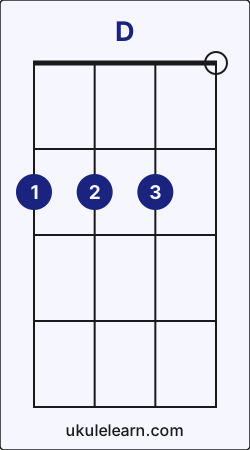
3. C#7 | D♭7 → D chord transition
To move from C#7 | D♭7 to D, follow these steps:
- Slide your index finger on G string from fret 1 to fret 2.
- Slide your middle finger from A string fret 2 to C string fret 2.
- Place ring finger on E string fret 2.
On Ukulelearn, songs containing C#7 | D♭7 use the transition to D at 17.6%. You can practice this transition in 5 different songs.
4. C#7 | D♭7 → A chord transition
To move from C#7 | D♭7 to A, follow these steps:
- Lift your index finger from G string fret 1 and place it on C string fret 1.
- Slide your middle finger from A string fret 2 to G string fret 2.
On Ukulelearn, songs containing C#7 | D♭7 use the transition to A at 17.6%. You can practice this transition in 2 different songs.

Songs Using C#7 | D♭7 Chord
Popular songs that feature the C#7 | D♭7 chord, perfect for practice.
Frequently Asked Questions
Is C#7 | D♭7 suitable for beginners on Ukulele?
C#7 | D♭7 sits in the intermediate range for Ukulele players. It uses a 2-fret span and includes a barre technique. Work on clean tone before pushing tempo.
Any beginner-friendly alternative for C#7 | D♭7?
C#7 | D♭7 has a more accessible version for Ukulele players. The alternative voicing uses fingering 4-1-1-4. It is a practical bridge between beginner and full voicings.
Which chords pair well with C#7 | D♭7 on Ukulele?
C#7 | D♭7 works well with F and F#m on Ukulele. Based on our catalog data, transitions from C#7 | D♭7 to F account for 25.5% (13 total changes in 2 songs), and transitions to F#m account for 23.5% (12 total changes in 5 songs).
Which songs include C#7 | D♭7?
Aerosmith - Dream On Ukulele Chords is one of 8 songs featuring the C#7 | D♭7 chord.