
Simple Plan - When I’m Gone Ukulele Chords
Before you play, tune your ukulele and use the tools below to set up your view and flow.
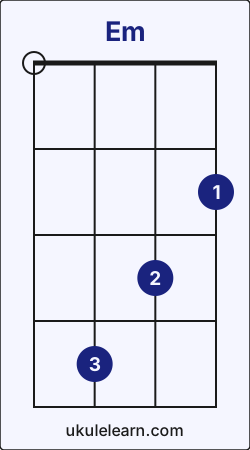 Ukulele Em chord diagram
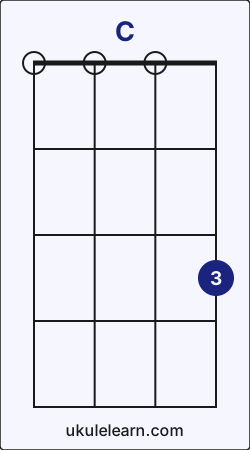 Ukulele C chord diagram
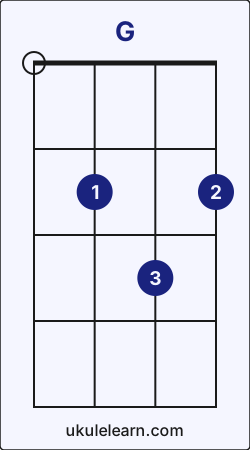 Ukulele G chord diagram
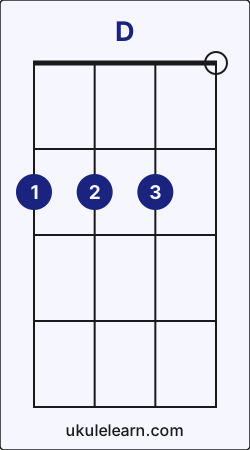 Ukulele D chord diagram
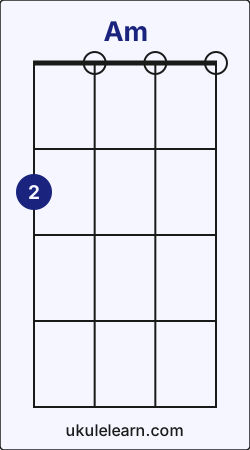 Ukulele Am chord diagram
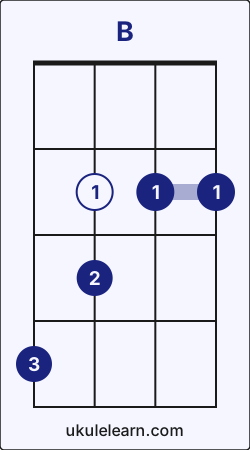 Ukulele B chord diagram
[Opening]
[Em]I look around me and [C]all I seem to see, is [G]people going nowhere [D]expecting sympathy
It’s like we’re [Em]going through the motions, of a [C]scripted destiny
Tell me [G]where’s our inspiration, if [D]life won’t wait I guess it’s up to [C]me
[chorus]
[C]Whoa-[G]oh, no we’re [Em]not gonna waste another [D]moment in this [C]town
[C]Whoa-[G]oh, and [Em]we won’t come back [D]the world is calling [C]out
[C]Whoa-[G]oh, leave the [Em]past in the past gonna [D]find the future
And [C]misery loves [G]company, well [Am]so long you’ll [B]miss me when I’m [Em]gone (gone)
[chorus]
[C](Gone, [Am]gone), you’re gonna [B]miss me when I’m [Em]gone (gone)
[C](Gone, [Am]gone) [B]
[section 2]
[Em]Procrastination, [C]running circles in my head, [G]while you sit there contemplating
[D]You’re wound up left for dead, (you’re left for dead)
[Em]Life is what happens, while you’re [C]busy making your excuses
[G]Another day, another [D]casualty, [D]but that won’t happen to [C]me
[chorus]
[C]Whoa-[G]oh, no we’re [Em]not gonna waste another [D]moment in this [C]town
[C]Whoa-[G]oh, and [Em]we won’t come back [D]the world is calling [C]out
[C]Whoa-[G]oh, leave the [Em]past in the past gonna [D]find the future
And [C]misery loves [G]company, well [Am]so long you’ll [B]miss me when I’m [Em]gone (gone)
[chorus]
[C](Gone, [Am]gone), you’re gonna [B]miss me when I’m [Em]gone (gone)
[C](Gone, [Am]gone), you’re gonna [B]miss me when I’m [Em]gone [C] [Am] [B]
When I’m [Em]gone [C] [Am] [B]
[Closing]
I [Em]won’t look back, when I [C]say goodbye, gonna [G]leave this hole behind me
Gonna [D]take what’s mine tonight, ’cause every [Em]wasted day, becomes a [C]wasted chance
You’re gonna [G]wake up feeling sorry, ’cause [D]life won’t wait, I guess it’s up to [C]you
[chorus]
[C]Whoa-[G]oh, no we’re [Em]not gonna waste another [D]moment in this [C]town
[C]Whoa-[G]oh, and [Em]we won’t come back [D]the world is calling [C]out
[C]Whoa-[G]oh, leave the [Em]past in the past gonna [D]find the future
And [C]misery loves [G]company, well [Am]so long you’ll [B]miss me when I’m [Em]gone (gone)
[chorus]
[C](Gone, [Am]gone), you’re gonna [B]miss me when I’m [Em]gone (gone)
[C](Gone, [Am]gone), you’re gonna [B]miss me when I’m [Em]gone
[C](Gone, [Am]gone), you’re gonna [B]miss me when I’m [Em]gone
[C](Gone, [Am]gone), you’re gonna [B]miss me when I’m [Em]gone
How to play When I'm Gone on Ukulele (Step-by-step)
Simple Plan - When I'm Gone on ukulele requires 6 chords and 10 core chord transitions. You can find the full step-by-step guide below. Before you start, tune your instrument. The song uses the ↓-↓↑-↑↓↑ pattern; practice it muted first, or simplify to downstrokes while you learn the changes.
When I'm Gone uses these transitions most often: C → G (18), Em → C (16), and Am → B (13). These transitions may feel a little challenging at first, but with steady practice you can play this song quickly.When you are ready, begin with Em - C chord transition.
1. Em → C chord transition
To move from Em to C;
- While playing Em, first lift your index finger and middle finger.
- Lift your ring finger from C string fret 4 and place it on A string fret 3.
2. C → G chord transition
To move from C to G;
- Lift your ring finger from A string fret 3 and place it on E string fret 3.
- Place index finger on C string fret 2.
- Place middle finger on A string fret 2.
3. G → D chord transition
To move from G to D;
- Lift your index finger from C string fret 2 and place it on G string fret 2.
- Slide your middle finger from A string fret 2 to C string fret 2.
- Slide your ring finger on E string from fret 3 to fret 2.
4. D → Em chord transition
To move from D to Em;
- Lift your index finger from G string fret 2 and place it on A string fret 2.
- Slide your middle finger from C string fret 2 to E string fret 3.
- Lift your ring finger from E string fret 2 and place it on C string fret 4.
5. D → C chord transition
To move from D to C;
- While playing D, first lift your index finger and middle finger.
- Lift your ring finger from E string fret 2 and place it on A string fret 3.
6. G → Em chord transition
To move from G to Em;
- Lift your index finger from C string fret 2 and place it on A string fret 2.
- Slide your middle finger from A string fret 2 to E string fret 3.
- Lift your ring finger from E string fret 3 and place it on C string fret 4.
7. G → Am chord transition
To move from G to Am;
- While playing G, first lift your index finger and ring finger.
- Lift your middle finger from A string fret 2 and place it on G string fret 2.
8. Am → B chord transition
To move from Am to B;
- Lift your middle finger from G string fret 2 and place it on C string fret 3.
- Place index finger on E string fret 2.
- Place ring finger on G string fret 4.
9. B → Em chord transition
To move from B to Em;
- Lift your index finger from E string fret 2 and place it on A string fret 2.
- Slide your middle finger from C string fret 3 to E string fret 3.
- Lift your ring finger from G string fret 4 and place it on C string fret 4.
10. C → Am chord transition
To move from C to Am;
- While playing C, lift your ring finger from A string fret 3.
- Place middle finger on G string fret 2.
When I'm Gone chord transition analysis
A short, data-driven summary of the chord flow in When I'm Gone.
- When I'm Gone includes 112 chord transitions, 10 of them unique.
- These transitions represent 0.03% of all chord transitions in Ukulelearn.
- When I'm Gone contains 6 of the top 10 transitions across Ukulelearn.
- These transition patterns show how When I'm Gone connects to the rest of Ukulelearn. Mastering them helps you move to similar songs faster.After C, the most likely next chords across Ukulelearn are G (35%), F (16%), and D (11%).
- C → G: 35%
- C → Am: 10%
After Em, the most likely next chords across Ukulelearn are C (27%), G (18%), and D (17%).- Em → C: 27%
- Em → D: 17%