
Westlife - When You’re Looking Like That Ukulele Chords
Before you play, tune your ukulele and use the tools below to set up your view and flow.
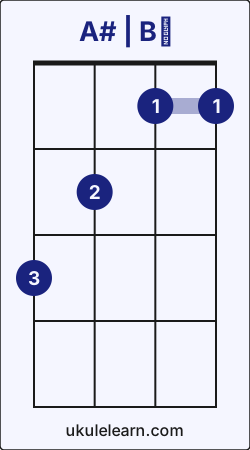 Ukulele A# | B♭ chord diagram
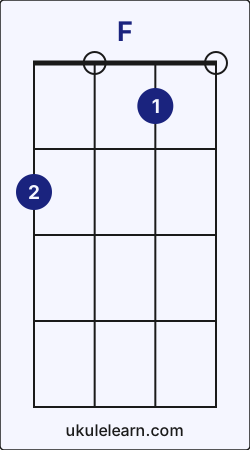 Ukulele F chord diagram
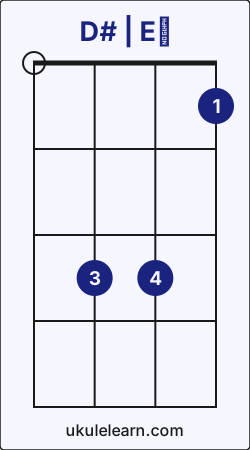 Ukulele D# | E♭ chord diagram
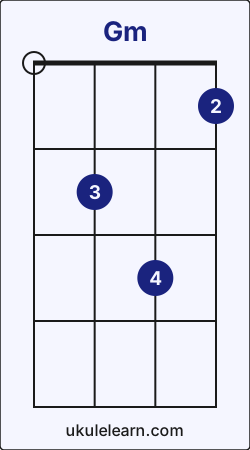 Ukulele Gm chord diagram
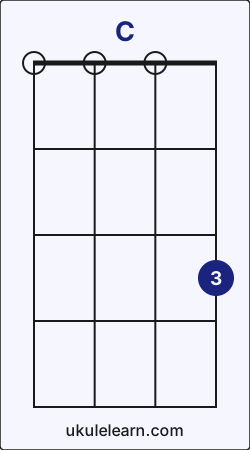 Ukulele C chord diagram
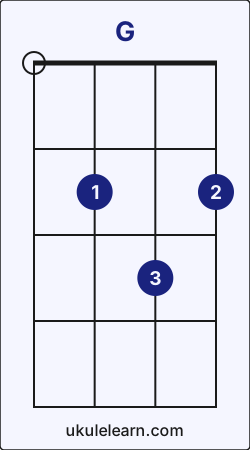 Ukulele G chord diagram
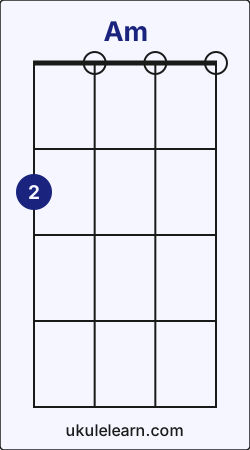 Ukulele Am chord diagram
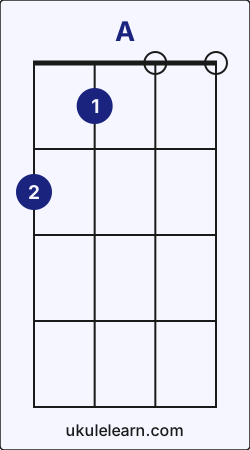 Ukulele A chord diagram
[Opening]
[A#] [F] [D#] [A#] [F] [D#]
She’s a [A#]5 foot 10 in catsuit, and Bambi [D#]eyes [A#]everybody
Who was staring [F]wouldn’t believe, that this [D#]girl was mine
[A#]I should have know I was, [F]wrong [D#]when I left her for a life
In pity but [A#]they say you never, miss the [F]water until [D#]it’s gone
[section 2]
Guess I [Gm]failed to [F]love you, and you’re [D#]taking it out [F]tonight
[chorus]
[C]How am I [G]supposed to leave [Am]you now, [F]when you’re looking like [C]that
I can’t [G]believe what I just [Am]gave away, now [F]I can’t take it [C]back
I don’t wanna get [G]lost, [Am]I don’t wanna live my [F]life without you
[C]How am I [G]supposed to leave [Am]you now, [F]when you’re looking like [C]that
[section 3]
[A#]She’s all dressed up [F]for glamour and rock [D#]n´ roll
[A#]Wanna squeeze her real tight, get [F]out of this place, if only I could [D#]take control
[A#]But she’s out of my [F]reach forever, [D#]and just week ago she lied next to me
[A#]It’s so ironic how I had to [F]lose just to [D#]see
[section 4]
That I had [G]failed to [F]love you, and you’re [D#]taking it out [F]tonight
[chorus]
[C]How am I [G]supposed to leave [Am]you now, [F]when you’re looking like [C]that
I can’t [G]believe what I just [Am]gave away, now [F]I can’t take it [C]back
I don’t wanna get [G]lost, [Am]I don’t wanna live my [F]life without you
[C]How am I [G]supposed to leave [Am]you now, [F]when you’re looking like [C]that
[section 5]
[C]I don’t wanna [G]forget you, [Am]I don’t even [F]wanna try
[C]How am I [G]supposed to walk on [Am]bye, [F]when you’re looking like [C]that
[Closing]
[C]How am I [G]supposed to [Am]leave you (when you’re lookin’ like that)
[C]I can’t [G]believe what I just [A]gave away (Ooh no baby)
[F]’Cause I take it [C]back (I’m [G]lost)
I don’t wanna [Am]live my life without [F]you (live my life without you)
[C]How am I [G]supposed to leave [Am]you now, [F]when you’re looking like [C]that
[chorus]
[C]How am I [G]supposed to leave [Am]you now, [F]when you’re looking like [C]that
I can’t [G]believe what I just [Am]gave away, now [F]I can’t take it [C]back
I don’t wanna get [G]lost, [Am]I don’t wanna live my [F]life without you
[C]How am I [G]supposed to leave [Am]you now, [F]when you’re looking like [C]that
How to play When You're Looking Like That on Ukulele (Step-by-step)
Westlife - When You're Looking Like That on ukulele requires 8 chords and 15 core chord transitions. You can find the full step-by-step guide below. Before you start, tune your instrument. The song uses the ↓-↓↑-↑↓↑ pattern; practice it muted first, or simplify to downstrokes while you learn the changes.
When You're Looking Like That uses these transitions most often: F → C (19), C → G (18), and G → Am (17). These transitions may feel a little challenging at first, but with steady practice you can play this song quickly.When you are ready, begin with A# - F chord transition.
1. A# → F chord transition
To move from A# to F;
- While playing A#, lift your ring finger from G string fret 3.
- Keep index finger on E string fret 1.
- Lift your middle finger from C string fret 2 and place it on G string fret 2.
2. F → D# chord transition
To move from F to D#;
- While playing F, lift your middle finger from G string fret 2.
- Lift your index finger from E string fret 1 and place it on A string fret 1.
- Place ring finger on C string fret 3.
- Place pinky on E string fret 3.
3. D# → A# chord transition
To move from D# to A#;
- While playing D#, lift your pinky from E string fret 3.
- Lift your index finger from A string fret 1 and place it on E string fret 1.
- Slide your ring finger from C string fret 3 to G string fret 3.
- Place middle finger on C string fret 2.
4. D# → Gm chord transition
To move from D# to Gm;
- While playing D#, lift your pinky from E string fret 3.
- Keep index finger on A string fret 1.
- Lift your ring finger from C string fret 3 and place it on E string fret 3.
- Place middle finger on C string fret 2.
5. Gm → F chord transition
To move from Gm to F;
- While playing Gm, lift your ring finger from E string fret 3.
- Lift your index finger from A string fret 1 and place it on E string fret 1.
- Slide your middle finger from C string fret 2 to G string fret 2.
6. F → C chord transition
To move from F to C;
- While playing F, first lift your index finger and middle finger.
- Place ring finger on A string fret 3.
7. C → G chord transition
To move from C to G;
- Lift your ring finger from A string fret 3 and place it on E string fret 3.
- Place index finger on C string fret 2.
- Place middle finger on A string fret 2.
8. G → Am chord transition
To move from G to Am;
- While playing G, first lift your index finger and ring finger.
- Lift your middle finger from A string fret 2 and place it on G string fret 2.
9. Am → F chord transition
To move from Am to F;
- Keep middle finger on G string fret 2.
- Place index finger on E string fret 1.
10. C → A# chord transition
To move from C to A#;
- Lift your ring finger from A string fret 3 and place it on G string fret 3.
- Place index finger on E string fret 1.
- Place middle finger on C string fret 2.
11. D# → G chord transition
To move from D# to G;
- While playing D#, lift your pinky from E string fret 3.
- Lift your index finger from A string fret 1 and place it on C string fret 2.
- Slide your ring finger from C string fret 3 to E string fret 3.
- Place middle finger on A string fret 2.
12. G → F chord transition
To move from G to F;
- While playing G, lift your ring finger from E string fret 3.
- Lift your index finger from C string fret 2 and place it on E string fret 1.
- Slide your middle finger from A string fret 2 to G string fret 2.
13. Am → C chord transition
To move from Am to C;
- While playing Am, lift your middle finger from G string fret 2.
- Place ring finger on A string fret 3.
14. G → A chord transition
To move from G to A;
- While playing G, lift your ring finger from E string fret 3.
- Slide your index finger on C string from fret 2 to fret 1.
- Slide your middle finger from A string fret 2 to G string fret 2.
15. A → F chord transition
To move from A to F;
- Lift your index finger from C string fret 1 and place it on E string fret 1.
- Keep middle finger on G string fret 2.
When You're Looking Like That chord transition analysis
A short, data-driven summary of the chord flow in When You're Looking Like That.
- When You're Looking Like That includes 109 chord transitions, 15 of them unique.
- These transitions represent 0.03% of all chord transitions in Ukulelearn.
- When You're Looking Like That contains 5 of the top 10 transitions across Ukulelearn.
- These transition patterns show how When You're Looking Like That connects to the rest of Ukulelearn. Mastering them helps you move to similar songs faster.After F, the most likely next chords across Ukulelearn are C (40%), G (21%), and Am (11%).
- F → C: 40%
- F → D#: 0%
After C, the most likely next chords across Ukulelearn are G (35%), F (16%), and D (11%).- C → G: 35%
- C → A#: 0%