
Cream - White Room Ukulele Chords
Before you play, tune your ukulele and use the tools below to set up your view and flow.
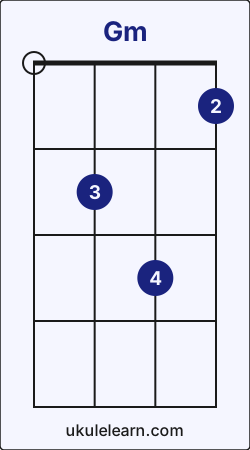 Ukulele Gm chord diagram
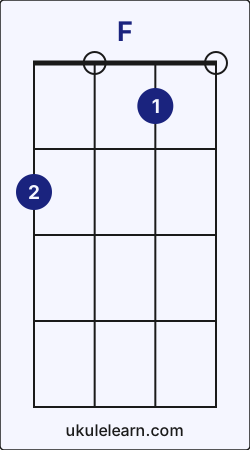 Ukulele F chord diagram
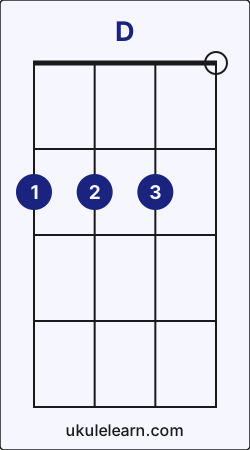 Ukulele D chord diagram
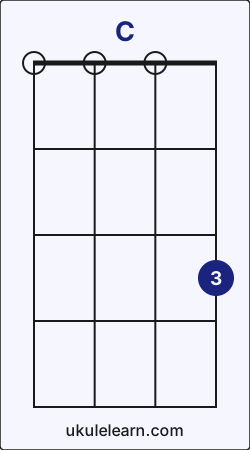 Ukulele C chord diagram
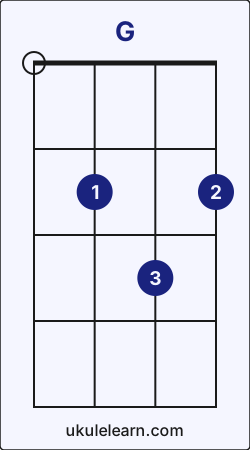 Ukulele G chord diagram
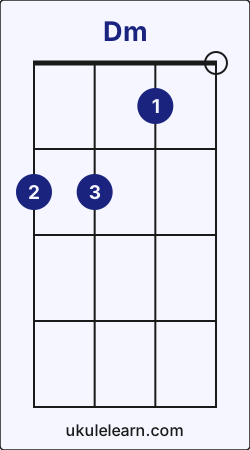 Ukulele Dm chord diagram
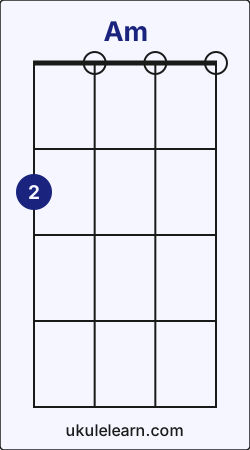 Ukulele Am chord diagram
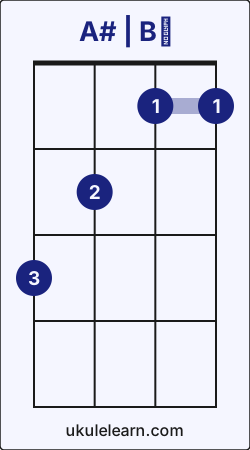 Ukulele A# | B♭ chord diagram
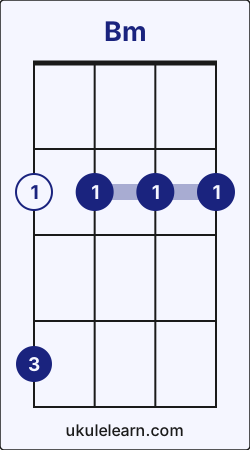 Ukulele Bm chord diagram
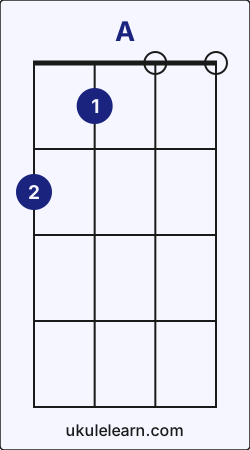 Ukulele A chord diagram
[Opening]
[Gm] [F] [D] [C] [G] [F] [Dm] [C]
[Am]In the [C]white [D]room with [C]black [G]curtains
[Bb]near the [Dm]station [C] [G]
[Bb]Blackroof [Dm]country, [C]no gold [Bm]pavements,
[Bb]tired [Dm]starlings [C] [G]
[Bb]Silver [Dm]horses [C]ran down [G]moonbeams [Bb]in your [Dm]dark eyes [C] [G]
[Bb]Dawnlight [Dm]smiles [C]on you [Bm]leaving, [Bb]my con[D]tentment [C] [G]
[section 2]
I’ll [C]wait in this [G]place where the [Bb]sun never [A]shines
[C]Wait in this [G]place where the [Bb]shadows [C]run from [D]themselves
You said [D]no strings [C]could se[G]cure you [F]at the [Dm]station [C]
[Bb]Platform [Dm]ticket, [C]restless [Bm]diesels, [Bb]goodbye [D]windows
[C]I walked [Dm]into [C]such a [G]sad time [Bb]at the [Dm]station
[Bb]As I [Dm]walked out, [C]felt my [G]own need [Bb]just be[D]ginning
[section 3]
I’ll [C]wait in the [G]queue when the [Bb]trains come [A]back
[C]Lie with [G]you where the [Bb]shadows [C]run from them[D]selves
[interlude]
[Gm] [F] [D] [C] [G] [F] [Dm] [C]
[section 4]
At the [Am]party [C]she was [Bm]kindness [Bb]in the [D]hard crowd [G] [C]
Conso[D]lation [C]for the [G]old wound now for[Dm]gotten [F] [G]
[Bb]Yellow [Dm]tigers [C]crouched in [Bm]jungles [Bb]in her [D]dark eyes [G]
She’s just [C]dressing, [C]goodbye [Bm]windows, [Bb]tired [D]starlings [G]
[Closing]
[Bb]I’ll [C]sleep in this [G]place with the [Bb]lonely [A]crowd;
[C]Lie in the [G]dark where the [Bb]shadows [C]run from them[D]selves
[outro]
[Gm] [F] [D] [C] [G] [F] [Dm] [C] [Am]
[outro]
[F] [G] [C] [G]
How to play White Room on Ukulele (Step-by-step)
Cream - White Room on ukulele requires 10 chords and 20 core chord transitions. You can find the full step-by-step guide below. Before you start, tune your instrument. The song uses the ↓-↓↑-↑↓↑ pattern; practice it muted first, or simplify to downstrokes while you learn the changes.
White Room uses these transitions most often: C → G (20), G → Bb (15), and Dm → C (14). These transitions may feel a little challenging at first, but with steady practice you can play this song quickly.When you are ready, begin with Gm - F chord transition.
1. Gm → F chord transition
To move from Gm to F;
- While playing Gm, lift your ring finger from E string fret 3.
- Lift your index finger from A string fret 1 and place it on E string fret 1.
- Slide your middle finger from C string fret 2 to G string fret 2.
2. F → D chord transition
To move from F to D;
- Lift your index finger from E string fret 1 and place it on G string fret 2.
- Slide your middle finger from G string fret 2 to C string fret 2.
- Place ring finger on E string fret 2.
3. D → C chord transition
To move from D to C;
- While playing D, first lift your index finger and middle finger.
- Lift your ring finger from E string fret 2 and place it on A string fret 3.
4. C → G chord transition
To move from C to G;
- Lift your ring finger from A string fret 3 and place it on E string fret 3.
- Place index finger on C string fret 2.
- Place middle finger on A string fret 2.
5. G → F chord transition
To move from G to F;
- While playing G, lift your ring finger from E string fret 3.
- Lift your index finger from C string fret 2 and place it on E string fret 1.
- Slide your middle finger from A string fret 2 to G string fret 2.
6. F → Dm chord transition
To move from F to Dm;
- Keep index finger on E string fret 1.
- Keep middle finger on G string fret 2.
- Place ring finger on C string fret 2.
7. Dm → C chord transition
To move from Dm to C;
- While playing Dm, first lift your index finger and middle finger.
- Lift your ring finger from C string fret 2 and place it on A string fret 3.
8. C → Am chord transition
To move from C to Am;
- While playing C, lift your ring finger from A string fret 3.
- Place middle finger on G string fret 2.
9. G → Bb chord transition
To move from G to Bb;
- Lift your index finger from C string fret 2 and place it on E string fret 1.
- Slide your middle finger from A string fret 2 to C string fret 2.
- Lift your ring finger from E string fret 3 and place it on G string fret 3.
10. Bb → Dm chord transition
To move from Bb to Dm;
- Keep index finger on E string fret 1.
- Lift your middle finger from C string fret 2 and place it on G string fret 2.
- Slide your ring finger from G string fret 3 to C string fret 2.
11. C → Bm chord transition
To move from C to Bm;
- Lift your ring finger from A string fret 3 and place it on G string fret 4.
- Place index finger on C string fret 2.
12. Bm → Bb chord transition
To move from Bm to Bb;
- Lift your index finger from C string fret 2 and place it on E string fret 1.
- Slide your ring finger on G string from fret 4 to fret 3.
- Place middle finger on C string fret 2.
13. Bb → D chord transition
To move from Bb to D;
- Lift your index finger from E string fret 1 and place it on G string fret 2.
- Keep middle finger on C string fret 2.
- Slide your ring finger from G string fret 3 to E string fret 2.
14. Bb → A chord transition
To move from Bb to A;
- While playing Bb, lift your ring finger from G string fret 3.
- Lift your index finger from E string fret 1 and place it on C string fret 1.
- Slide your middle finger from C string fret 2 to G string fret 2.
15. A → C chord transition
To move from A to C;
- While playing A, first lift your index finger and middle finger.
- Place ring finger on A string fret 3.
16. Bb → C chord transition
To move from Bb to C;
- While playing Bb, first lift your index finger and middle finger.
- Lift your ring finger from G string fret 3 and place it on A string fret 3.
17. D → Gm chord transition
To move from D to Gm;
- Lift your index finger from G string fret 2 and place it on A string fret 1.
- Keep middle finger on C string fret 2.
- Slide your ring finger on E string from fret 2 to fret 3.
18. D → G chord transition
To move from D to G;
- Lift your index finger from G string fret 2 and place it on C string fret 2.
- Slide your middle finger from C string fret 2 to A string fret 2.
- Slide your ring finger on E string from fret 2 to fret 3.
19. G → Dm chord transition
To move from G to Dm;
- Lift your index finger from C string fret 2 and place it on E string fret 1.
- Slide your middle finger from A string fret 2 to G string fret 2.
- Lift your ring finger from E string fret 3 and place it on C string fret 2.
20. Am → F chord transition
To move from Am to F;
- Keep middle finger on G string fret 2.
- Place index finger on E string fret 1.
White Room chord transition analysis
A short, data-driven summary of the chord flow in White Room.
- White Room includes 137 chord transitions, 20 of them unique.
- These transitions represent 0.04% of all chord transitions in Ukulelearn.
- White Room contains 5 of the top 10 transitions across Ukulelearn.
- These transition patterns show how White Room connects to the rest of Ukulelearn. Mastering them helps you move to similar songs faster.After C, the most likely next chords across Ukulelearn are G (35%), F (16%), and D (11%).
- C → G: 35%
- C → D: 11%
After G, the most likely next chords across Ukulelearn are C (25%), D (24%), and Am (13%).- G → C: 25%
- G → F: 9%