
Carpenters - You Ukulele Chords
Before you play, tune your ukulele and use the tools below to set up your view and flow. Using the Transpose tool, switch to F,G,C keys to play this song with easier chords.
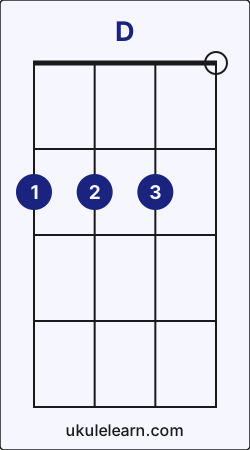 Ukulele D chord diagram
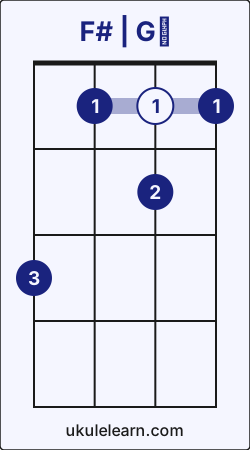 Ukulele F# | G♭ chord diagram
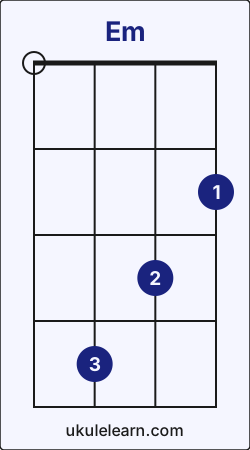 Ukulele Em chord diagram
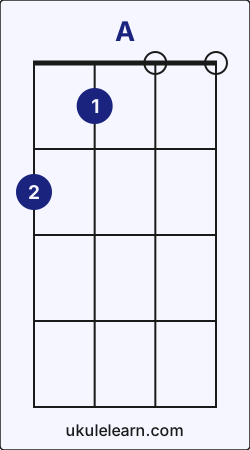 Ukulele A chord diagram
[Opening]
[D] [F#] [Em] [A]
[D]You are the [F#]one who [Em]makes me [A]happy
When [D]everything [F#]else turns to [Em]grey [A]
[D]Yours is the [F#]voice that [Em]wakes me [A]mornings
And [D]sends me [F#]out into the [Em]day [A]
You are the [D]crowd that sits [F#]quiet
[Em]Listening to [A]me
And [D]all the mad [F#]sense that I [Em]make [A]
[chorus]
You are one of the few things worth remembering
And [D]since it’s all [F#]true
How could [Em]anyone mean [A]more to me
Than [D]you [F#] [Em] [A]
[section 2]
[D]Sorry if [F#]sometimes [Em]I look past [A]you
There’s [D]no one [F#]beyond your [Em]eyes [A]
[D]Inside my [F#]head [Em]wheels are [A]turning
Hey, [D]sometimes I’m [F#]not so [Em]wise [A]
You are my [D]heart and my [F#]soul
My [Em]inspiration [A]
Just [D]like the old [F#]love song [Em]goes [A]
[chorus]
You are one of the few things worth remembering
And [D]since it’s all [F#]true
How could [Em]anyone mean [A]more to me
Than [D]you [F#] [Em] [A]
[Closing]
You’re my [D]heart and my [F#]soul
My [Em]inspiration [A]
Just [D]like the old [F#]love song [Em]goes [A]
How to play You on Ukulele (Step-by-step)
Carpenters - You on ukulele requires 4 chords and 4 core chord transitions. You can find the full step-by-step guide below. Before you start, tune your instrument. The song uses the ↓-↓↑-↓↑-↓↑ pattern; practice it muted first, or simplify to downstrokes while you learn the changes.
You uses these transitions most often: D → F# (19), Em → A (19), and F# → Em (19). These transitions may feel a little challenging at first, but with steady practice you can play this song quickly.When you are ready, begin with D - F# chord transition.
1. D → F# chord transition
To move from D to F#;
- Lift your index finger from G string fret 2 and place it on C string fret 1.
- Slide your middle finger from C string fret 2 to E string fret 2.
- Lift your ring finger from E string fret 2 and place it on G string fret 3.
2. F# → Em chord transition
To move from F# to Em;
- Lift your index finger from C string fret 1 and place it on A string fret 2.
- Slide your middle finger on E string from fret 2 to fret 3.
- Lift your ring finger from G string fret 3 and place it on C string fret 4.
3. Em → A chord transition
To move from Em to A;
- While playing Em, lift your ring finger from C string fret 4.
- Lift your index finger from A string fret 2 and place it on C string fret 1.
- Slide your middle finger from E string fret 3 to G string fret 2.
4. A → D chord transition
To move from A to D;
- Lift your index finger from C string fret 1 and place it on G string fret 2.
- Slide your middle finger from G string fret 2 to C string fret 2.
- Place ring finger on E string fret 2.
You chord transition analysis
A short, data-driven summary of the chord flow in You.
- You includes 75 chord transitions, 4 of them unique.
- These transitions represent 0.02% of all chord transitions in Ukulelearn.
- You contains 1 of the top 10 transitions across Ukulelearn.
- These transition patterns show how You connects to the rest of Ukulelearn. Mastering them helps you move to similar songs faster.After D, the most likely next chords across Ukulelearn are G (29%), A (17%), and Em (17%).
- D → F#: 0%
After F#, the most likely next chords across Ukulelearn are B (19%), Bm (15%), and E (13%).- F# → Em: 4%